
The Amazon Horned Frog—also known as the Amazonian Horned Frog or Ceratophrys cornuta—is one of the most visually striking and behaviorally unique amphibians of the Amazon Rainforest. With its wide mouth, horn-like projections, and aggressive hunting style, it’s earned nicknames like the “Pac-Man frog” due to its voracious appetite and circular shape.
This article explores everything you need to know about the Amazon Horned Frog, from its physical and behavioral adaptations to its diet, habitat, predators, and the unusual features that make it a true marvel of evolution.
What Is the Amazon Horned Frog?
The Amazon Horned Frog is a ground-dwelling amphibian known for its camouflaged appearance and massive head, which can make up nearly half its body length. This ambush predator is found in South America’s tropical lowland forests, especially in Brazil, Colombia, Ecuador, and Peru. Its horn-like eyelid flaps give it its name and help it blend into leaf litter on the forest floor.
Also called the Amazonian Horned Frog, it belongs to the Ceratophryidae family, a group known for their defensive posturing and powerful bite force relative to body size.
Table of Contents
Amazon Horned Frog Habitat
Where Does the Amazon Horned Frog Live?
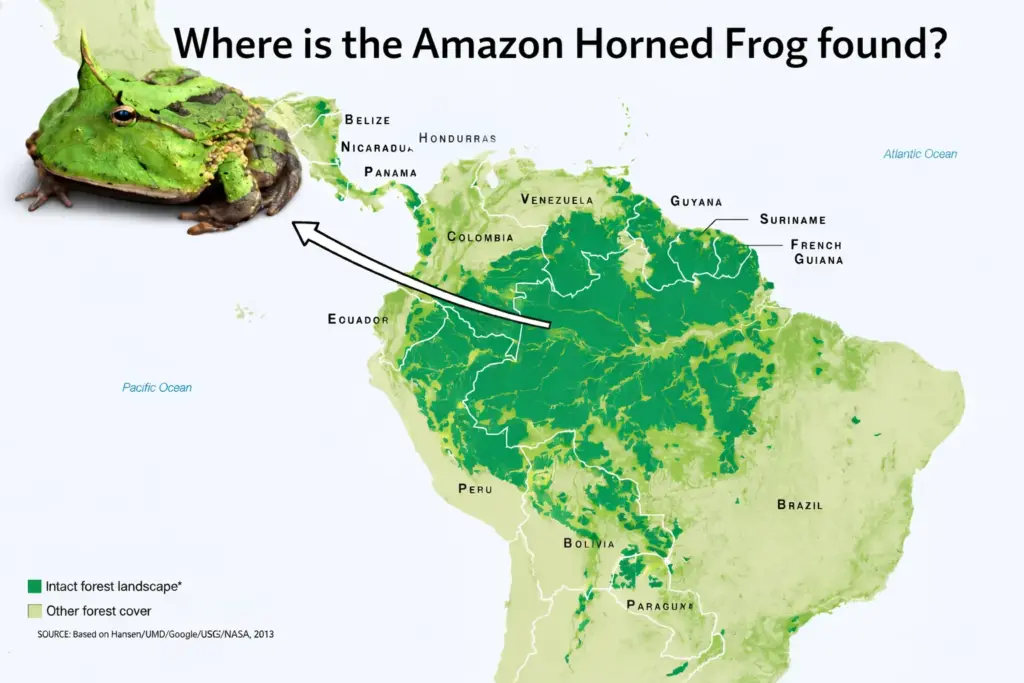
The Amazon Horned Frog inhabits the tropical rainforests of the Amazon Basin, thriving in moist environments with thick vegetation and soft, wet soil. It prefers the forest floor, where its coloration blends in perfectly with decaying leaves and underbrush.
- Countries: Brazil, Peru, Colombia, Ecuador, and surrounding regions
- Microhabitat: Lowland rainforest floor near slow-moving water
- Conditions: High humidity, shaded areas, dense vegetation
These frogs are typically sedentary and stay in the same small territory for extended periods, relying on camouflage to stay hidden from both prey and predators.
Amazon Horned Frog Appearance
What Does the Amazon Horned Frog Look Like?
The Amazon Horned Frog has an unusually large head and body with a flattened, circular shape. Its most distinctive feature is the pair of horn-like extensions above the eyes, which are actually elongated upper eyelids.
Key characteristics:
- Bright patterns in green, yellow, or brown to match leaf litter
- Stocky body with short limbs
- Large, wide mouth capable of consuming prey almost its own size
- Dark markings along the sides to break up its outline
Horned frog species
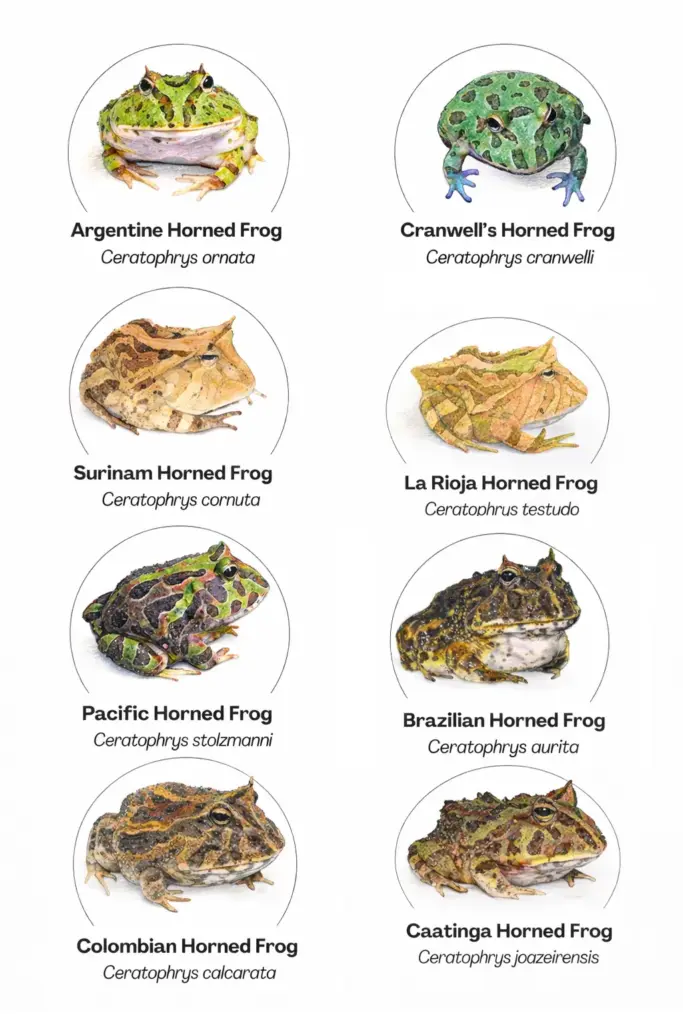
Argentine Horned Frog
Cerotophrys ornata
The Argentine Horned Frog is one of the largest and most striking members of the genus, known for its broad head, powerful jaws, and vivid green, yellow, and brown coloration that provides excellent camouflage among leaf litter. Native to grasslands and subtropical forests of Argentina, Uruguay, and parts of Brazil, this ambush predator spends most of its time buried in soil, waiting for prey such as insects, small mammals, reptiles, and even other frogs. Its aggressive feeding behavior and bold markings have made it one of the most recognizable horned frogs.
Brazilian Horned Frog
Ceratophrys aurita
Endemic to the Atlantic Forest of eastern Brazil, the Brazilian Horned Frog is a robust species adapted to humid forest floors and seasonal wetlands. It typically displays earthy green, brown, and yellow tones with irregular spotting that blends seamlessly into its surroundings. This species is a sit-and-wait predator, relying on stealth rather than speed. Habitat loss has impacted its populations, making it an important species for conservation awareness within Brazil’s threatened forest ecosystems.
Caatinga Horned Frog
Ceratophrys joazeirensis
The Caatinga Horned Frog is specially adapted to the dry, semi-arid Caatinga biome of northeastern Brazil. Its coloration often reflects sandy and olive hues, helping it remain concealed in dry soils and sparse vegetation. During dry seasons, it can remain dormant underground, emerging rapidly after heavy rains to feed and breed. This species demonstrates the remarkable adaptability of horned frogs to harsh and fluctuating environments.
Colombian Horned Frog
Ceratophrys calcarata
Found primarily in Colombia and parts of neighboring regions, the Colombian Horned Frog inhabits tropical lowland forests and floodplains. It is recognized by its stout body, prominent eye ridges, and mottled brown and yellow patterns that mimic forest debris. Like other horned frogs, it is an opportunistic ambush predator with a surprisingly powerful bite. Its secretive nature makes it less frequently observed than some of its relatives.
Cranwell’s Horned Frog
Ceratophrys cranwelli
Often referred to as the “Chaco Horned Frog,” Cranwell’s Horned Frog is native to the dry Chaco regions of Paraguay, Bolivia, and Argentina. It is highly variable in color, ranging from bright green to brown or reddish tones, often with bold blotches. This species is well known for its tolerance of dry conditions and its explosive feeding response. It is one of the most commonly kept horned frogs due to its adaptability and striking appearance.
La Rioja Horned Frog
Ceratophrys testudo
The La Rioja Horned Frog is a lesser-known species native to arid and semi-arid regions of northwestern Argentina. Its flattened body shape and muted earth-tone coloration help it blend into rocky and sandy environments. This frog spends much of its life hidden beneath the surface, emerging mainly during the rainy season. Its limited range makes it particularly sensitive to environmental changes.
Pacific Horned Frog
Ceratophrys stolzmanni
Native to the Pacific lowlands of Ecuador and northern Peru, the Pacific Horned Frog inhabits tropical dry forests and seasonal wetlands. It is distinguished by complex patterns of greens, browns, and purples that provide excellent camouflage. This species is adapted to environments with strong seasonal changes, remaining inactive during dry periods and becoming highly active during rains. It plays an important role as a predator within its ecosystem.
Surinam Horned Frog
Ceratophrys cornuta
The Surinam Horned Frog is one of the most iconic species in the genus, instantly recognizable by its long, horn-like extensions above the eyes. Found throughout the Amazon Basin and surrounding regions, it thrives in humid rainforests and swampy areas. Its dramatic appearance, combined with its aggressive feeding behavior, has earned it the nickname “Amazon Horned Frog.” Perfectly camouflaged among fallen leaves, it is a master ambush predator of the rainforest floor
Amazon Horned Frog Size
How Big Is the Amazon Horned Frog?
The Amazon Horned Frog is among the largest of its kind.
- Males: 10–13 cm (4–5 inches)
- Females: 13–15 cm (5–6 inches), generally larger than males
- Weight: Up to 0.5 kg (1.1 lbs)
Their size, combined with their aggression and strong bite, makes them fearsome predators in their ecosystem.
Amazon Horned Frog Behavior and Survival
How Does the Amazon Horned Frog Survive?
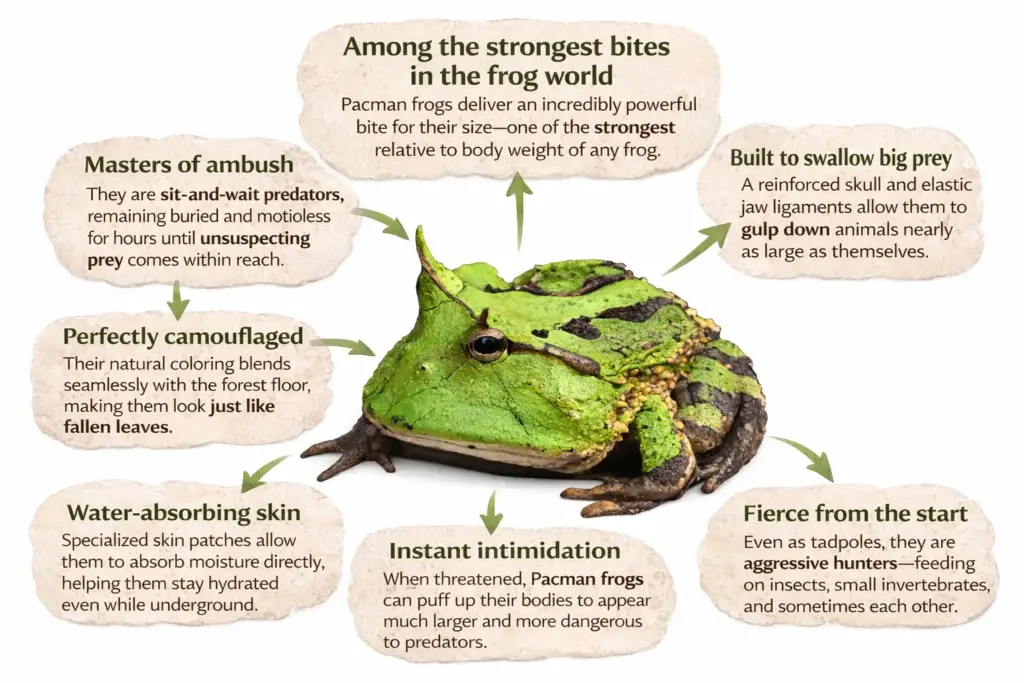
These frogs are ambush predators, meaning they wait patiently for unsuspecting prey to come within striking distance. When they attack, they open their mouths suddenly and lunge forward, swallowing prey whole.
Survival strategies include:
- Camouflage and stillness to avoid detection
- Lightning-fast ambush strikes
- Burrowing into soil to avoid dehydration or heat
Their sedentary lifestyle conserves energy, while their opportunistic diet allows them to feed on a wide range of animals.
Amazon Horned Frog Adaptations
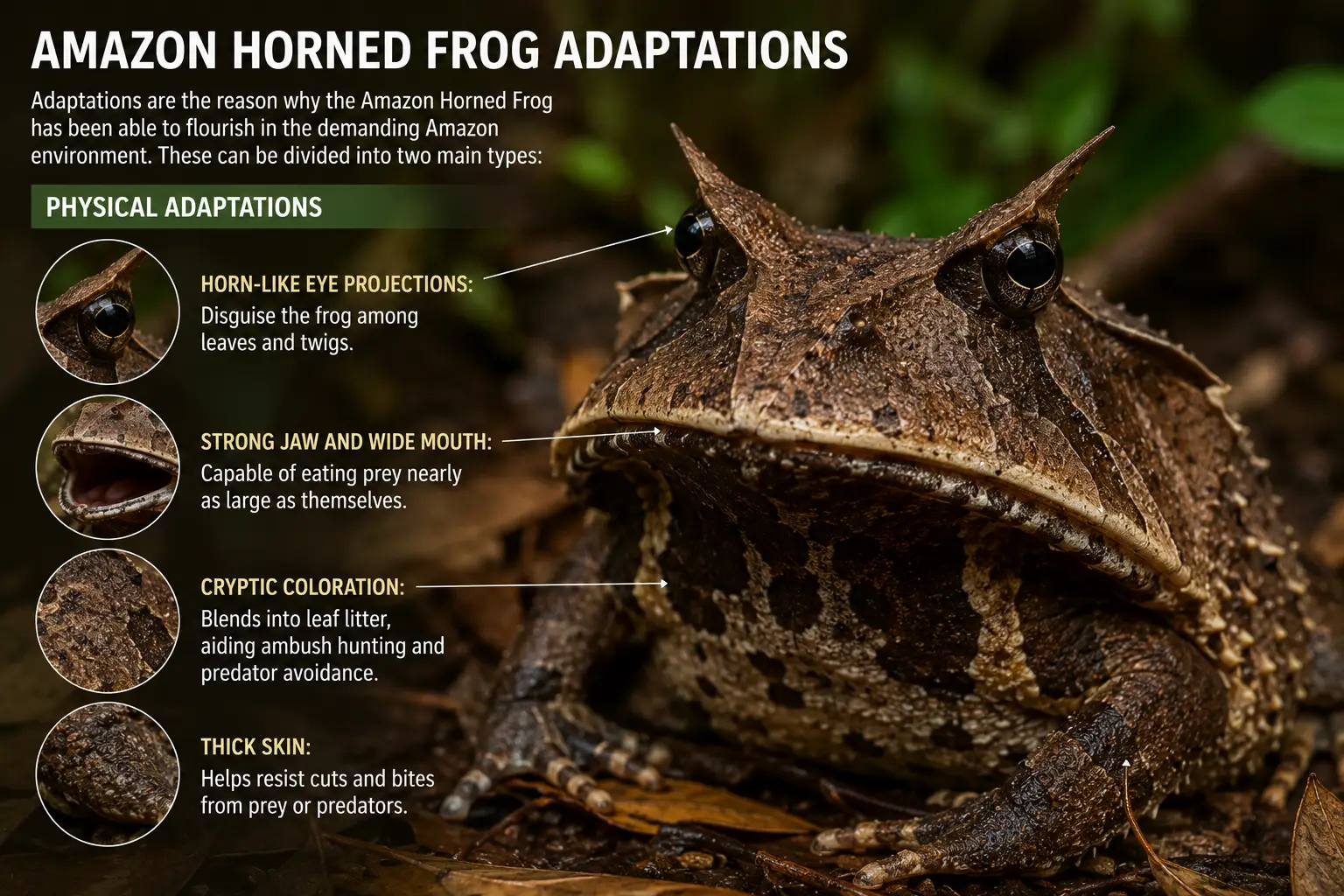
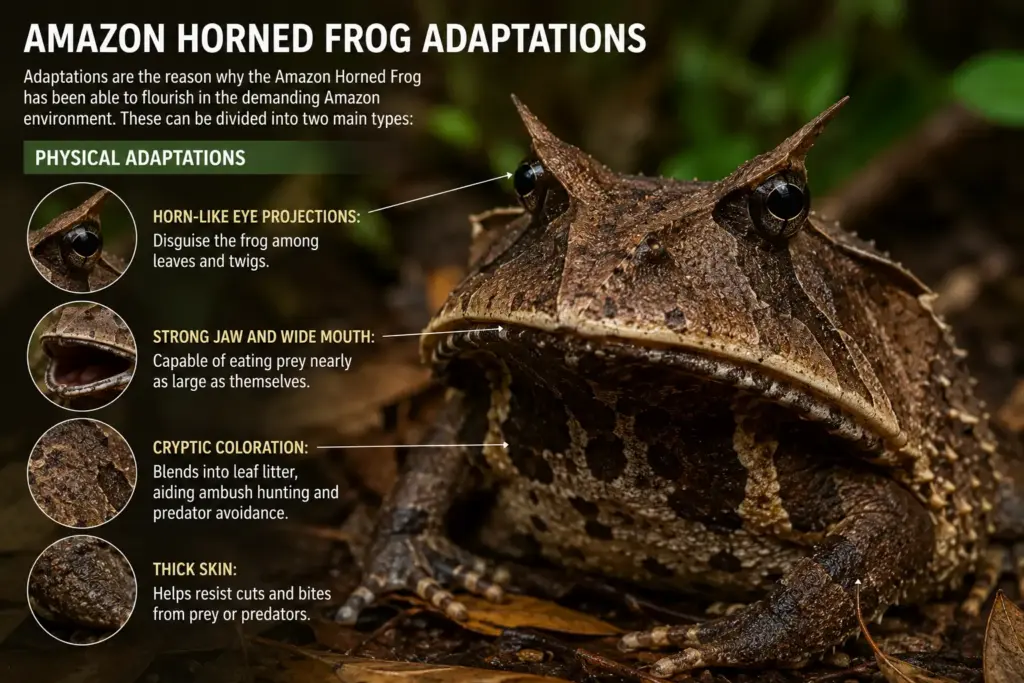
Adaptations are the reason why the Amazon Horned Frog has been able to flourish in the demanding Amazon environment. These can be divided into two main types:
Physical Adaptations
- Horn-like eye projections: Disguise the frog among leaves and twigs
- Strong jaw and wide mouth: Capable of eating prey nearly as large as themselves
- Cryptic coloration: Blends into leaf litter, aiding ambush hunting and predator avoidance
- Thick skin: Helps resist cuts and bites from prey or predators
Behavioral Adaptations
- Sit-and-wait predation: They rely on stealth rather than energy-intensive chasing
- Aggressive feeding: Known to attempt eating animals too large to swallow
- Burrowing behavior: Helps them regulate temperature and avoid desiccation
- Inflation and hissing: When threatened, they puff up their bodies and hiss loudly to intimidate predators
These adaptations not only aid in hunting but also in defending against predators and surviving seasonal changes in rainfall and humidity.
Amazon Horned Frog Teeth and Bite
Do Amazon Horned Frogs Have Teeth?
Yes—amazingly, these frogs do have teeth, but not in the way mammals do. They possess vomerine teeth on the roof of their mouth and bony projections in their lower jaw. These help them grip and subdue prey.
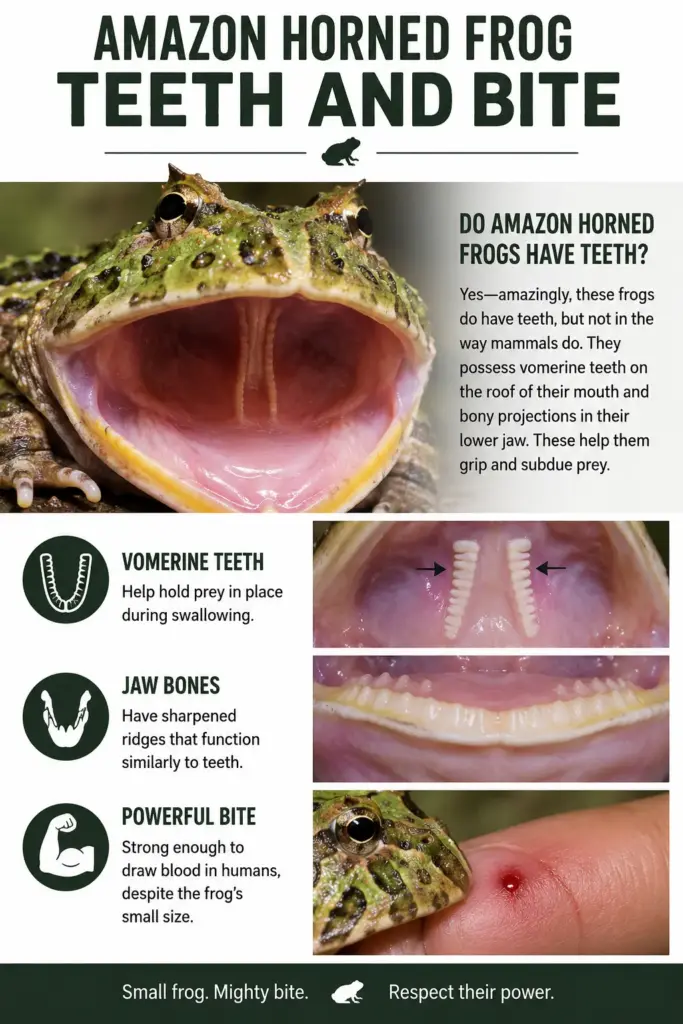
- Vomerine teeth: Help hold prey in place during swallowing
- Jaw bones: Have sharpened ridges that function similarly to teeth
- Powerful bite: Strong enough to draw blood in humans, despite the frog’s small size
While not venomous, their bite can be surprisingly painful, especially when they clamp down and refuse to let go.
What Does the Amazon Horned Frog Eat?
The Amazon Horned Frog has a voracious appetite. It eats almost anything that fits in its mouth, including:
- Insects
- Small birds
- Lizards
- Frogs (including other horned frogs)
- Small mammals like mice
It’s not uncommon for them to overestimate their capabilities, occasionally choking on prey that is too large. This “bite-first, evaluate-later” approach is part of their aggressive predatory nature.
Amazon Horned Frog Predators
Despite its formidable appearance, the Amazon Horned Frog has natural enemies.
Common predators include:
- Snakes
- Large birds (especially herons and hawks)
- Mammals like raccoons and opossums
- Humans (due to habitat destruction and the pet trade)
To counter this, horned frogs employ:
- Camouflage
- Burrowing to hide
- Puffing up and hissing to appear larger and more threatening
Their effectiveness at hiding means many predators pass them by entirely.
Facts About Amazon Horned Frogs
Here are some lesser-known but fascinating tidbits:
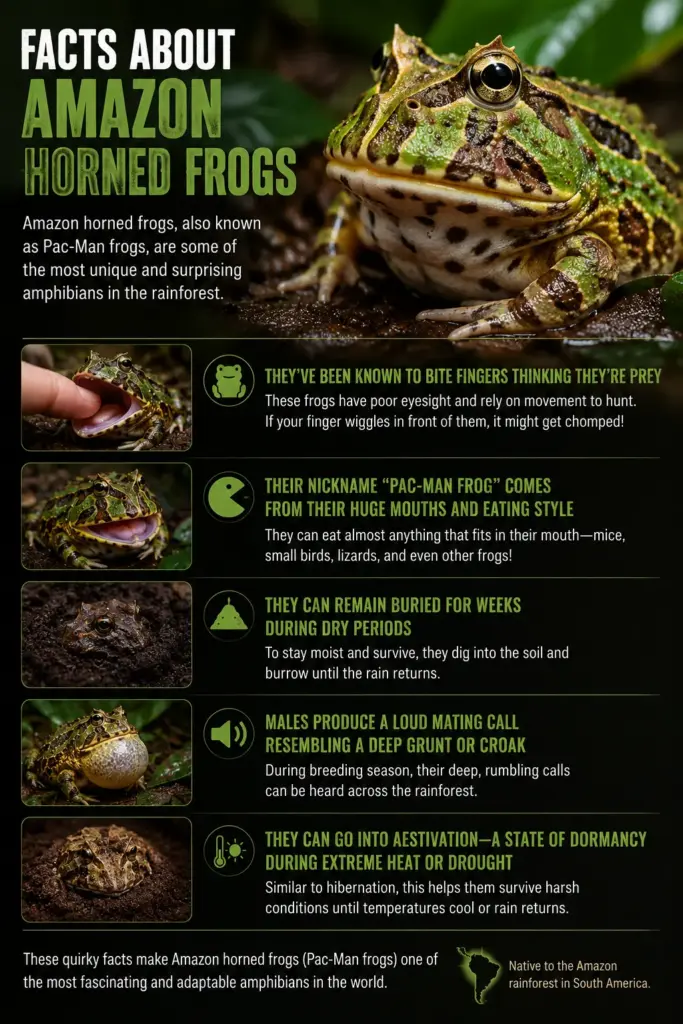
- 🐸 They’ve been known to bite fingers thinking they’re prey
- 🐸 Their nickname “Pac-Man frog” comes from their huge mouths and eating style
- 🐸 They can remain buried for weeks during dry periods
- 🐸 Males produce a loud mating call resembling a deep grunt or croak
- 🐸 They can go into aestivation—a state of dormancy during extreme heat or drought
These quirky facts make them one of the most interesting amphibians in the world.
What Is Unusual About the Amazon Horned Frog?
Several unusual traits set the Amazon Horned Frog apart:
- Its aggression—rare among amphibians—is comparable to predatory reptiles
- It eats prey close to its own size, including vertebrates
- It has horn-like projections, a rarity among frogs
- It can survive weeks without food, thanks to a slow metabolism and fat storage
Perhaps most unusual of all is that this frog is both predator and prey—and has evolved to be masterful in both roles.
Amazonian Horned Frog vs Other Horned Frogs
There are several species of horned frogs, but the Amazonian Horned Frog (Ceratophrys cornuta) is distinct due to:
- Its impressive size (among the largest frog species in the world)
- Longer, sharper horn-like projections above the eyes
- A true Amazon Rainforest habitat, unlike other horned frogs that prefer drier or seasonal environments
- More vibrant and complex coloration patterns that provide camouflage among leaf litter
It is often confused with:
- Argentine Horned Frog (Ceratophrys ornata)
- Chaco Horned Frog (Ceratophrys cranwelli)
However, only the Amazonian Horned Frog is native to the dense, humid Amazon Rainforest ecosystem. In this environment, it shares its habitat with a wide variety of amphibians, including poison dart frogs, known for their bright warning colors and toxic skin secretions, and glass frogs, which are famous for their translucent bodies that reveal internal organs.
Unlike poison dart frogs, which rely on toxicity for defense, the Amazonian Horned Frog depends on ambush predation and camouflage. Glass frogs, on the other hand, are arboreal and nocturnal, highlighting the ecological diversity of the Amazon’s frog species. Together, these amphibians demonstrate how different survival strategies have evolved within the same rainforest ecosystem.
How Do Amazon Horned Frogs Survive in Harsh Conditions?
During dry seasons or extreme temperatures, the Amazon Horned Frog buries itself underground, forming a protective cocoon made of dead skin. This helps retain moisture and allows the frog to wait out tough times.
- Aestivation phase: Can last several weeks
- Emergence: Triggered by rain and humidity
- Feeding frenzy: After emerging, they eat voraciously to rebuild energy stores
This behavior ensures their survival in an environment where food and water availability fluctuate seasonally.
Conservation and Ecological Importance
Though not currently endangered, Amazon Horned Frogs are affected by:
- Deforestation
- Pet trade collection
- Climate change affecting rainfall patterns
They serve as both predator and prey and play a vital role in controlling insect populations and serving as food for higher-level predators.
Protecting their habitat supports a wide range of species, making them a valuable indicator of rainforest health.
The Strange and Stunning Amazon Horned Frog
From its horn-like brows to its massive appetite and powerful bite, the Amazon Horned Frog is one of the most fascinating and misunderstood animals of the rainforest floor. Its many adaptations and unusual behaviors make it a star subject for biology, conservation, and even art.
Whether you’re a student, wildlife enthusiast, or conservationist, learning about this frog sheds light on just how strange, specialized, and astonishing nature can be.