
The Amazon horned frog is one of the most unusual amphibians found in the tropical rainforests of South America. Recognized by its large head, wide mouth, colorful body, and distinctive pointed projections above its eyes, this remarkable frog has developed specialized adaptations that help it survive on the forest floor. Scientifically known as Ceratophrys cornuta, it is also called the Amazonian horned frog or Surinam horned frog.
Unlike many frogs that actively search for insects and other small animals, the Amazon horned frog is an ambush predator. It hides among fallen leaves, soil, and forest vegetation, waiting for unsuspecting prey to approach. Its powerful jaws and enormous mouth allow it to capture surprisingly large animals, including other frogs and small vertebrates.
Table of Contents
This fascinating amphibian is distributed across several countries in the Amazon Basin, including Peru, Brazil, Colombia, Ecuador, Bolivia, and the Guianas. Its ability to blend into the rainforest environment makes it difficult to spot, even for people exploring areas with extraordinary amphibian biodiversity.
From its unusual physical characteristics and feeding habits to its reproduction and ecological role, the Amazon horned frog offers a fascinating example of how wildlife adapts to life in one of the world’s richest tropical ecosystems.
What Is an Amazon Horned Frog?
The Amazon horned frog is a terrestrial amphibian belonging to the family Ceratophryidae and the genus Ceratophrys. Its scientific name, Ceratophrys cornuta, identifies a species particularly well adapted to life among the leaves and vegetation of tropical South American forests.
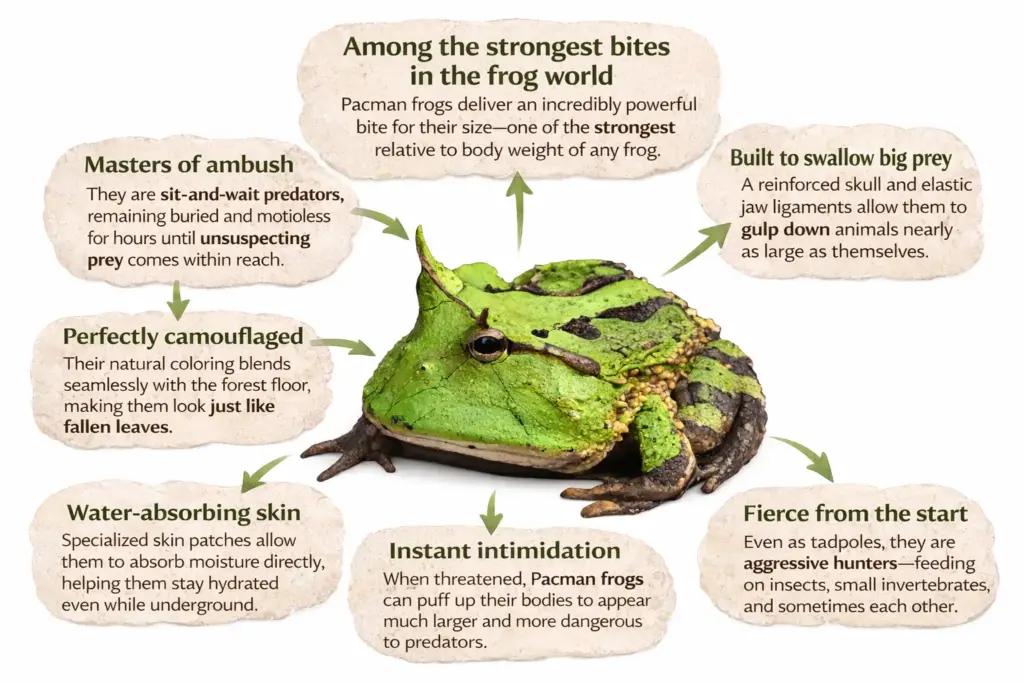
It is best known for its large, rounded body, broad head, powerful mouth, and horn-like projections above its eyes. These characteristics give it an unusual appearance compared with many other rainforest frogs.
Although it spends much of its time on the ground, the Amazon horned frog depends on freshwater environments during reproduction. Temporary pools, shallow wetlands, and other seasonal water bodies provide important places for its eggs and developing tadpoles.
Scientific Classification of the Amazon Horned Frog
Understanding the scientific classification of this species helps distinguish it from other horned frogs and amphibians found in South America.
- Common name: Amazon horned frog
- Alternative common names: Amazonian horned frog, Surinam horned frog
- Scientific name: Ceratophrys cornuta
- Kingdom: Animalia
- Phylum: Chordata
- Class: Amphibia
- Order: Anura
- Family: Ceratophryidae
- Genus: Ceratophrys
- Species: Ceratophrys cornuta
The genus Ceratophrys includes several species commonly known as horned frogs or Pac-Man frogs. They are recognized for their unusually large mouths and rounded bodies.
The Amazon horned frog should not be confused with every other Pac-Man frog species. Although related species share similar physical characteristics, Ceratophrys cornuta has its own geographic distribution, appearance, and biological characteristics.
Why Is It Called the Amazon Horned Frog?
The name comes from its distribution in the Amazon region and the small pointed projections above its eyes. These structures resemble miniature horns and contribute to its distinctive appearance.
Its alternative name, Surinam horned frog, reflects an older common name associated with its distribution in the Guianas. However, its range extends far beyond Suriname and includes extensive areas of the Amazon Basin.
Another popular name is the horned Pac-Man frog. This name refers to its enormous mouth and rounded shape, which resemble the familiar video game character.
What Does an Amazon Horned Frog Look Like?
The Amazon horned frog has one of the most recognizable appearances among tropical rainforest amphibians. Its body is broad and rounded, its head is disproportionately large, and its mouth occupies a significant portion of its face.
Its physical appearance is not simply unusual. The frog’s coloration, body shape, and specialized facial structures are closely connected to its survival strategy.
Size and Body Shape
The Amazon horned frog is a relatively large terrestrial frog. Adults can measure approximately 7–15 centimeters in body length, although measurements vary between individuals and populations.
Females are generally larger than males, an example of sexual size dimorphism commonly observed in amphibians.
Its compact body and short limbs give it a heavy appearance. Unlike frogs that depend on long legs for jumping over considerable distances, the Amazon horned frog spends much of its time remaining motionless on the ground.
Its broad head and large mouth are especially important when capturing prey. Rather than chasing animals over long distances, it relies on a sudden forward movement to catch anything suitable that comes within striking range.
The Horns Above Its Eyes
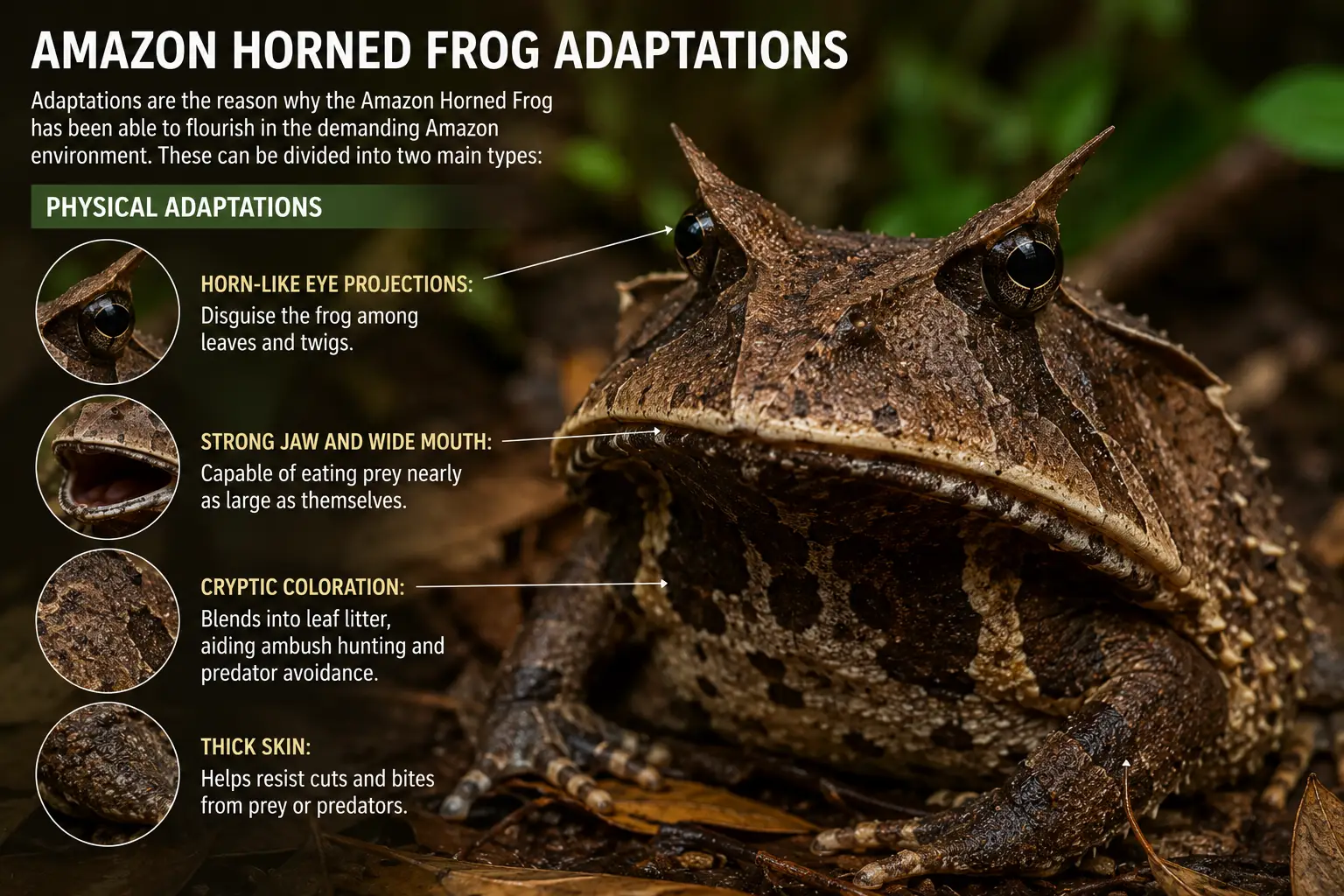
One of the most distinctive features of the Amazon horned frog is the pair of pointed projections above its eyes.
These structures give the species its common name and help create an unusual outline that resembles pieces of vegetation or dead leaves.
The projections contribute to the frog’s overall camouflage, breaking up the shape of its head when it sits among fallen leaves and other forest debris.
Although they look like horns, they are not weapons used for attacking prey. The frog primarily captures food with its mouth and powerful jaws.
Color and Camouflage Patterns
The skin of the Amazon horned frog can display a combination of green, brown, tan, and other earthy colors.
Some individuals have darker markings, irregular patches, or contrasting patterns across their backs. These colors help them blend into the natural surroundings of the rainforest floor.
Its appearance may resemble a mixture of damp leaves, soil, moss, and decomposing vegetation.
This camouflage is especially effective when the frog remains still. A motionless individual can be difficult to distinguish from the surrounding leaf litter, even when someone is standing relatively close.
Eyes and Mouth
The eyes of the Amazon horned frog are positioned toward the upper portion of its large head. This arrangement allows the animal to remain partially buried while keeping its surroundings under observation.
Its enormous mouth is another remarkable adaptation.
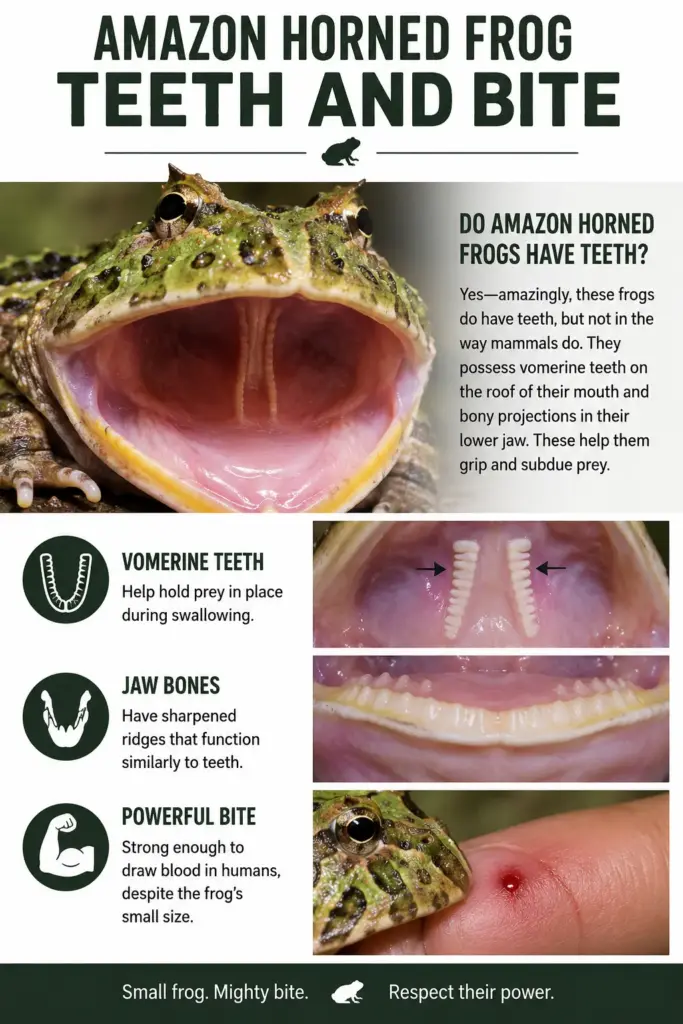
The mouth can open widely, allowing the frog to capture prey that appears surprisingly large relative to its body. Its jaws and teeth help secure animals before they are swallowed.
Together, the eyes, mouth, and horn-like projections make the Amazon horned frog an exceptionally specialized ambush predator.
Where Does the Amazon Horned Frog Live?
The Amazon horned frog inhabits tropical regions of South America, particularly areas associated with the Amazon Basin.
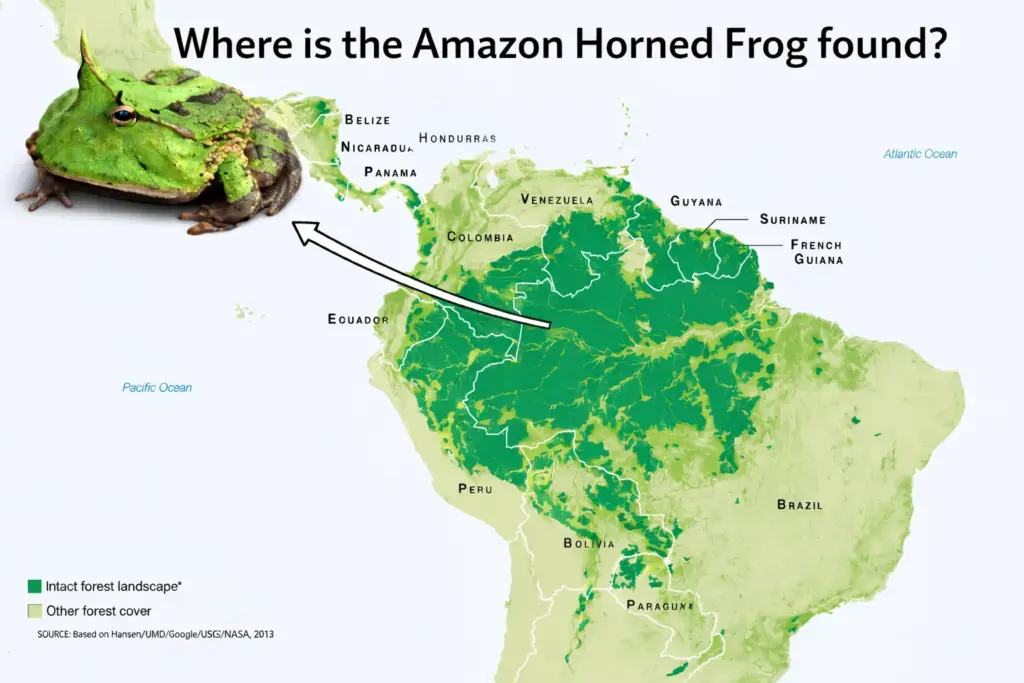
It is a rainforest amphibian adapted to living among fallen leaves, moist soil, and vegetation close to freshwater environments.
Unlike tree frogs that spend much of their lives in branches and vegetation, this species is primarily terrestrial. It is generally associated with the forest floor, where its camouflage and hunting behavior provide important survival advantages.
Geographic Distribution in South America
The documented distribution of Ceratophrys cornuta includes several countries in northern and western South America.
These include:
- Peru
- Brazil
- Colombia
- Ecuador
- Bolivia
- Guyana
- Suriname
- French Guiana
- Northeastern Venezuela
Its distribution includes different environments within the Amazonian region, rather than being restricted to a single rainforest location.
In Peru, records from northeastern and southeastern Amazonian areas demonstrate the presence of this species in the country’s tropical forest ecosystems.
Amazon Horned Frog Habitat
The preferred habitat of the Amazon horned frog includes moist tropical forests, particularly areas where fallen leaves and natural ground cover provide suitable hiding places.
It can be associated with terra firme forest, which refers to rainforest that generally remains above the regular flooding of major rivers.
The forest floor offers several important resources:
- Fallen leaves that provide camouflage.
- Moist soil that helps maintain suitable environmental conditions.
- Insects and other invertebrates for food.
- Other small amphibians and vertebrates that can become prey.
- Seasonal pools and freshwater areas for reproduction.
Although the species is terrestrial as an adult, its life cycle is closely connected to freshwater habitats.
Why Does It Live on the Rainforest Floor?
The forest floor provides an excellent environment for an animal that depends on camouflage and ambush hunting.
Thousands of leaves, roots, branches, and pieces of decomposing vegetation create a complex surface where the frog can remain hidden.
Instead of spending energy searching continuously for food, it can occupy a suitable position and wait for prey to approach.
This strategy is particularly useful in tropical ecosystems, where small animals frequently move through the leaf litter.
Can You Find the Amazon Horned Frog in Peru?
Yes. The Amazon horned frog occurs in Peru, where it forms part of the country’s extraordinary amphibian diversity.
The Peruvian Amazon contains extensive tropical forests with a wide variety of frogs, reptiles, birds, and mammals.
Scientific records from the Loreto region, southeastern Peru, and the Manu area document the species in different parts of the country.
Its presence is particularly interesting for people studying Amazon rainforest wildlife because it is a relatively specialized ground-dwelling predator.
However, finding one in the wild can be difficult. Its camouflage allows it to remain almost invisible among fallen leaves, and its behavior makes it less noticeable than many active frogs.
What Does the Amazon Horned Frog Eat?
The Amazon horned frog is a carnivorous amphibian with a broad diet. It feeds on different animals that live close to the forest floor, including insects, other amphibians, and small vertebrates.
Its large mouth allows it to capture prey that many other frogs of similar size would be unable to swallow.
Rather than depending on a single food source, it takes advantage of available animals within its habitat.
Insects and Other Invertebrates
Insects are an important component of the Amazon horned frog’s diet.
Depending on local availability, potential prey includes:
- Beetles
- Ants
- Other small insects
- Various terrestrial invertebrates
These animals are commonly found among leaves, soil, and decomposing vegetation.
The frog does not necessarily need to search actively for every meal. It can remain hidden until an insect passes close enough to be captured.
Other Frogs and Amphibians
One of the most interesting characteristics of the Amazon horned frog is its ability to eat other frogs.
Smaller amphibians that move through the leaf litter can become prey if they approach too closely.
Scientific observations from southeastern Peru have documented a diverse range of prey animals, including several frog species.
This behavior demonstrates that the Amazon horned frog is not simply an insect-eating amphibian. It is a predator capable of consuming other vertebrates.
Fish and Small Vertebrates
The species has also been documented consuming fish, small reptiles, and other vertebrates.
Its feeding behavior depends on the size of the available prey and the frog’s ability to capture and swallow it.
Although popular descriptions sometimes emphasize its ability to eat mice, frogs, and other surprisingly large animals, its diet in the wild should be understood in the context of its natural habitat and available prey.
The important characteristic is its opportunistic carnivorous feeding strategy.
Do Amazon Horned Frogs Eat Other Tadpoles?
Yes. Cannibalism and predation between tadpoles are among the remarkable feeding behaviors associated with horned frogs.
Amazonian horned frog tadpoles are unusual because they can be carnivorous rather than relying exclusively on plant material or suspended organic matter.
They may consume other tadpoles, including individuals from their own species.
This behavior provides an example of how predatory feeding can occur during different stages of an amphibian’s life cycle.
How Does the Amazon Horned Frog Hunt?
The Amazon horned frog uses a hunting method known as ambush predation or sit-and-wait hunting.
Rather than pursuing its prey over long distances, it selects a suitable position, hides its body, and waits until a potential meal comes within striking distance.
This technique allows the frog to conserve energy while taking advantage of animals moving through the rainforest floor.
The Sit-and-Wait Hunting Strategy
The frog partially buries itself in soil or settles among fallen leaves, leaving its eyes and part of its head visible.
Its body coloration helps it blend into the surrounding environment.
When an insect, frog, or another small animal approaches, the Amazon horned frog reacts quickly.
It opens its mouth and lunges forward, attempting to capture the animal before it can escape.
The attack can happen very quickly, making the frog an effective predator despite its relatively sedentary lifestyle.
How Does Camouflage Help It Catch Prey?
Camouflage is essential to its hunting strategy.
The green and brown markings on its body resemble the colors commonly found on the rainforest floor.
The horn-like projections above its eyes also contribute to its unusual outline, potentially helping it resemble pieces of leaves or vegetation.
Remaining motionless is just as important as having the correct coloration.
If the frog moves unnecessarily, it may attract the attention of potential prey or predators.
By staying hidden, it can wait for an opportunity without revealing its location.
How Does It Swallow Large Prey?
The Amazon horned frog has a disproportionately large mouth compared with its body.
This physical characteristic allows it to capture animals that may appear surprisingly large.
After catching prey, the frog uses its jaws and teeth to hold the animal while swallowing it.
Its feeding strategy is based on capturing suitable prey in a single attack rather than tearing food into smaller pieces.
This behavior has contributed to the species’ reputation as one of the most impressive ambush-hunting frogs of the Amazon rainforest.
Amazon Horned Frog Behavior and Adaptations
The Amazon horned frog has several behavioral and physical adaptations that help it survive in tropical rainforest environments.
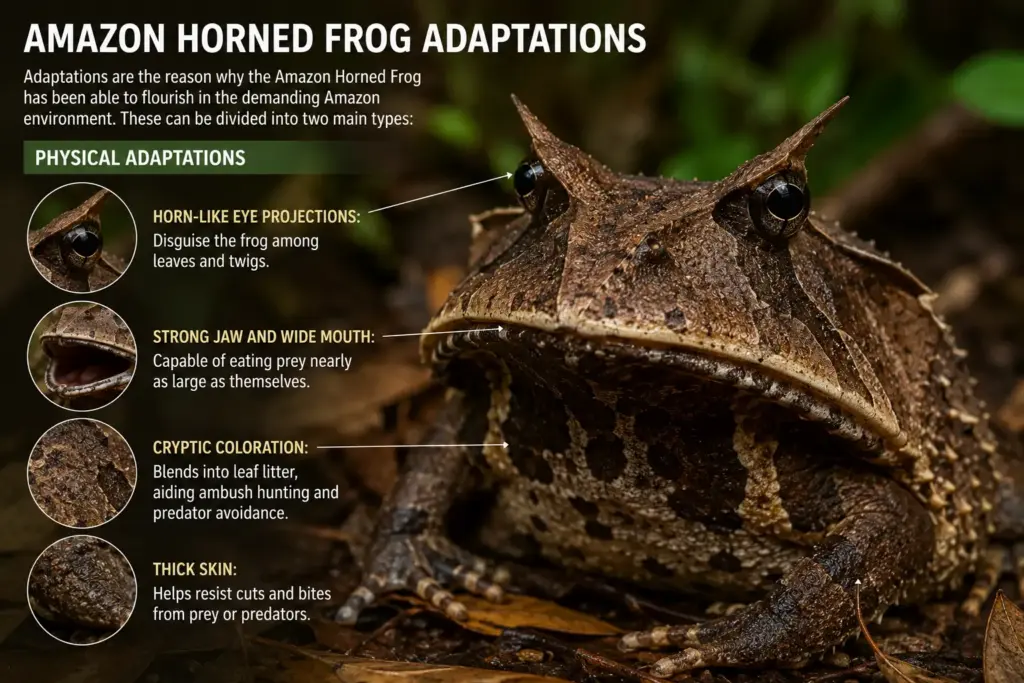
Its camouflage, hunting technique, body shape, and activity patterns are closely related to its terrestrial lifestyle.
Is the Amazon Horned Frog Nocturnal?
The Amazon horned frog is generally described as nocturnal, meaning it is more active during nighttime hours.
Nighttime activity can help amphibians avoid some of the heat and moisture loss associated with daytime conditions.
During the day, the frog may remain hidden among leaves or partially buried in suitable ground cover.
At night, it can become more active and take advantage of animals moving through its habitat.
However, activity patterns can vary according to environmental conditions, seasonal changes, and local habitat characteristics.
How Does It Protect Itself From Predators?
The main defensive advantage of the Amazon horned frog is its camouflage.
Its coloration allows it to blend into the forest floor, reducing the likelihood of being detected by animals searching for prey.
Remaining motionless also helps it avoid attracting attention.
The frog’s large mouth and powerful jaws may provide a defensive advantage if it is disturbed or threatened, although its primary use is capturing food.
Its survival depends on remaining difficult to detect and occupying suitable habitat.
Adaptations for Life in the Amazon Rainforest
Several characteristics make this amphibian particularly well adapted to the rainforest environment:
1. Camouflage coloration: Green, brown, and earthy markings help it blend into fallen leaves and soil.
2. Large mouth: Its enormous mouth allows it to capture a wide variety of prey.
3. Horn-like projections: The structures above its eyes contribute to its distinctive outline and camouflage.
4. Ambush hunting: Waiting for prey reduces the need for constant movement and energy expenditure.
5. Terrestrial lifestyle: Its body and behavior are adapted to hunting among ground vegetation and leaf litter.
These adaptations demonstrate how specialized amphibians can occupy ecological niches within tropical forests.
Amazon Horned Frog Reproduction and Life Cycle
The reproduction of the Amazon horned frog depends on suitable environmental conditions and access to freshwater habitats.
Like other amphibians, it has a life cycle that includes eggs, aquatic tadpoles, and terrestrial adults.
Seasonal rainfall can create temporary pools and other freshwater environments that provide important breeding opportunities.
Mating Behavior
During the breeding season, male Amazon horned frogs produce calls that help attract females.
Acoustic communication is particularly important for frogs because their calls can travel through vegetation and reach potential mates.
Once a male and female come together, mating takes place in or near suitable freshwater environments.
Fertilization is external, meaning the eggs are fertilized outside the female’s body.
The timing of reproduction is influenced by seasonal environmental conditions, especially the availability of water.
Amazon Horned Frog Eggs
After fertilization, the eggs develop in freshwater environments.
The number of eggs and the time required for development can vary with environmental conditions.
Historical species accounts report clutches in the hundreds, with estimates of approximately 300–600 eggs.
The eggs eventually hatch into aquatic tadpoles.
Water availability is particularly important because the early developmental stages cannot survive independently of a suitable aquatic environment.
Tadpole Development
The tadpole stage is one of the most interesting parts of the Amazon horned frog’s life cycle.
Unlike many frog tadpoles that feed mainly on algae, plant material, or organic particles, horned frog tadpoles can be carnivorous.
They may feed on smaller tadpoles and other available aquatic prey.
This predatory behavior is an unusual adaptation among amphibians and helps explain why the species is considered an especially interesting subject for biological research.
As the tadpoles grow, they gradually develop the body structures associated with adult frogs.
Metamorphosis Into Adult Frogs
Metamorphosis is the biological process through which an aquatic tadpole transforms into a frog.
During this stage, the animal develops limbs, changes its body proportions, and gradually loses its tadpole characteristics.
Its body becomes more suitable for life on land.
Once metamorphosis is complete, the young frog can begin exploring the surrounding terrestrial habitat and eventually develop the feeding and hunting behavior of adult individuals.
The transition from aquatic tadpole to terrestrial frog demonstrates the remarkable flexibility of amphibian life cycles.
How Long Does an Amazon Horned Frog Live?
The exact lifespan of the Amazon horned frog in the wild is not well established.
Its longevity depends on several factors, including environmental conditions, access to food, predation, disease, and habitat quality.
Individuals maintained in captivity have been reported to live for approximately ten years on average, with some records reaching around fifteen years.
However, captive lifespan estimates should not automatically be treated as representative of wild populations.
In natural rainforest ecosystems, many young amphibians do not survive to adulthood because they face predation, competition, and environmental changes.
Amazon Horned Frog Predators and Natural Threats
Although the Amazon horned frog is an effective predator, it is also part of the rainforest food web and can be vulnerable to larger animals.
Its camouflage helps reduce the risk of being detected, but it does not make the species immune to predation.
Potential natural predators include larger snakes, birds, and other animals capable of capturing amphibians.
Eggs and tadpoles are particularly vulnerable because they develop in freshwater environments where aquatic predators may be present.
Threats to Its Habitat
The quality of rainforest habitat is important for the long-term survival of the species.
Changes to tropical forest environments can affect the availability of suitable hiding places, prey, and breeding areas.
Potential pressures include:
- Deforestation and forest fragmentation.
- Agricultural expansion.
- Habitat degradation.
- Pollution of freshwater environments.
- Changes in local water availability.
- Collection of wild amphibians for the animal trade.
Because amphibians depend on environmental conditions that can be easily altered, maintaining healthy rainforest ecosystems is important for their conservation.
Is the Amazon Horned Frog Endangered?
The conservation status of the Amazon horned frog should be checked against the latest species assessment rather than assumed from its unusual appearance or geographic distribution.
The species has a broad distribution across parts of South America, but this does not mean that every local population is equally secure.
Some populations may experience pressures from habitat loss, environmental degradation, and collection.
The IUCN Red List is an important resource for checking the most recent global conservation assessment of Ceratophrys cornuta.
It is also important to distinguish global conservation status from local conservation concerns. A species may occur across a large geographic area while particular populations face significant threats.
Why Is Rainforest Conservation Important?
The Amazon rainforest supports an extraordinary diversity of amphibians, reptiles, birds, mammals, insects, and plants.
Protecting forest ecosystems helps maintain the environmental conditions required by these animals.
For the Amazon horned frog, healthy forest floors provide camouflage, shelter, feeding opportunities, and access to appropriate breeding environments.
Conserving freshwater habitats is equally important because amphibians depend on water during their early developmental stages.
Protecting tropical forests therefore helps preserve not only individual species but also the ecological relationships that maintain Amazonian biodiversity.
Interesting Facts About the Amazon Horned Frog
The Amazon horned frog has several fascinating characteristics that make it one of the most unusual amphibians in South America.
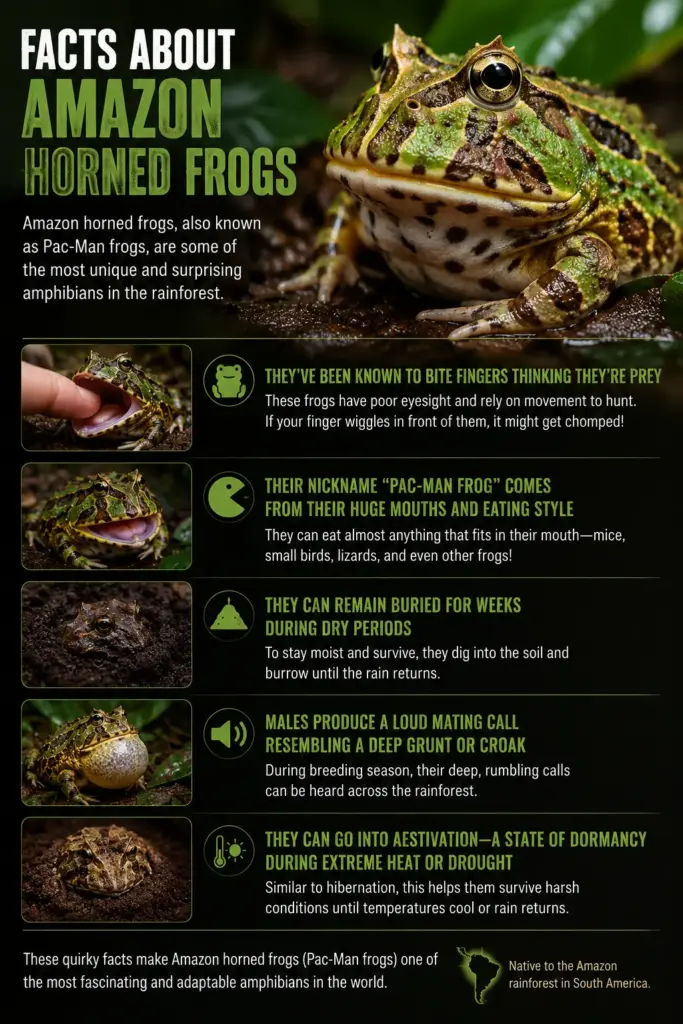
Here are some interesting facts about this remarkable rainforest species.
1. It has horn-like projections above its eyes. These pointed structures give the species its distinctive name and unusual appearance.
2. It is an ambush predator. Instead of chasing prey, it hides among leaves and waits for animals to approach.
3. It has an enormous mouth. Its large mouth allows it to capture prey that can be surprisingly large compared with its body.
4. It eats other frogs. Its carnivorous diet includes smaller amphibians and other vertebrates.
5. Its tadpoles can be carnivorous. Unlike many frog larvae, they may consume other tadpoles.
6. Females are generally larger than males. This difference in body size is an example of sexual dimorphism.
7. It lives across several South American countries. Its distribution includes Peru, Brazil, Colombia, Ecuador, Bolivia, and the Guianas.
8. Its camouflage is extremely effective. Its green and brown coloration helps it disappear among rainforest leaves and soil.
9. It is primarily terrestrial as an adult. It spends much of its time on the rainforest floor rather than in trees.
10. It is a member of the Pac-Man frog group. Its large mouth and rounded body explain this popular group name.
The Amazon Horned Frog and the Biodiversity of the Peruvian Amazon
Peru is home to an extraordinary variety of tropical wildlife, and amphibians are an important part of this biodiversity.
The Amazon rainforest contains countless microhabitats, from flooded forests and riverbanks to terra firme forest and temporary freshwater pools.
These environments support different frog species with specialized behaviors and adaptations.
The Amazon horned frog is particularly interesting because it occupies a terrestrial hunting niche. While many rainforest frogs are associated with branches, vegetation, or water, this species is closely connected to the leaf litter and soil of the forest floor.
Regions such as Loreto, Madre de Dios, and other Amazonian areas provide important opportunities for studying amphibian diversity.
In the southeastern Peruvian Amazon, scientific research has documented the species’ presence and feeding behavior, demonstrating how much can be learned by studying the relationships between rainforest predators and their prey.
For wildlife enthusiasts, discovering a ground-dwelling frog like Ceratophrys cornuta can be a reminder that Amazon biodiversity is not limited to colorful birds, monkeys, and large mammals.
Some of the rainforest’s most fascinating animals are small, secretive, and extremely difficult to see.
What Is the Scientific Name of the Amazon Horned Frog?
The scientific name of the Amazon horned frog is Ceratophrys cornuta. It belongs to the family Ceratophryidae and the genus Ceratophrys.
Where Does the Amazon Horned Frog Live?
The Amazon horned frog lives in tropical regions of South America, particularly within the Amazon Basin. Its distribution includes Peru, Brazil, Colombia, Ecuador, Bolivia, and the Guianas, as well as northeastern Venezuela.
How Big Does an Amazon Horned Frog Get?
Adult Amazon horned frogs can measure approximately 7–15 centimeters in body length. Females are generally larger than males.
What Does the Amazon Horned Frog Eat?
It is a carnivorous amphibian that feeds on insects, other frogs, and various small vertebrates. Its diet can include beetles, fish, lizards, and other available prey.
Why Does the Amazon Horned Frog Have Horns?
The pointed projections above its eyes are responsible for its common name. They contribute to its distinctive appearance and may help break up its outline when it hides among leaves and vegetation.
Is the Amazon Horned Frog Poisonous?
The Amazon horned frog is not generally known as a poisonous or venomous frog. It does not use venom to capture prey. Its main hunting adaptations are camouflage, a large mouth, and ambush behavior.
Is the Amazon Horned Frog Dangerous to Humans?
The Amazon horned frog is not considered a dangerous animal to humans. However, its large mouth and powerful jaws mean it can bite if threatened or handled. It is best observed in its natural habitat without disturbing it.
Is the Amazon Horned Frog Nocturnal?
Yes. It is generally described as nocturnal, meaning it is more active during nighttime hours. During the day, it can remain hidden among fallen leaves and other forest-floor vegetation.
Can Amazon Horned Frogs Eat Other Frogs?
Yes. Other frogs are part of their natural diet. Their large mouths allow them to capture and swallow smaller amphibians.
How Do Amazon Horned Frogs Reproduce?
They reproduce through external fertilization. Males attract females using calls, and eggs are fertilized in freshwater environments. The eggs hatch into tadpoles that eventually undergo metamorphosis and become terrestrial frogs.
Are Amazon Horned Frogs Found in Peru?
Yes. The species has been documented in several Peruvian Amazon regions, including Loreto and southeastern parts of the country. Scientific records also include observations from the Manu region and Madre de Dios.
How Long Does an Amazon Horned Frog Live?
Its exact lifespan in the wild is uncertain. Captive individuals have been reported to live around ten years on average, with some reaching approximately fifteen years.
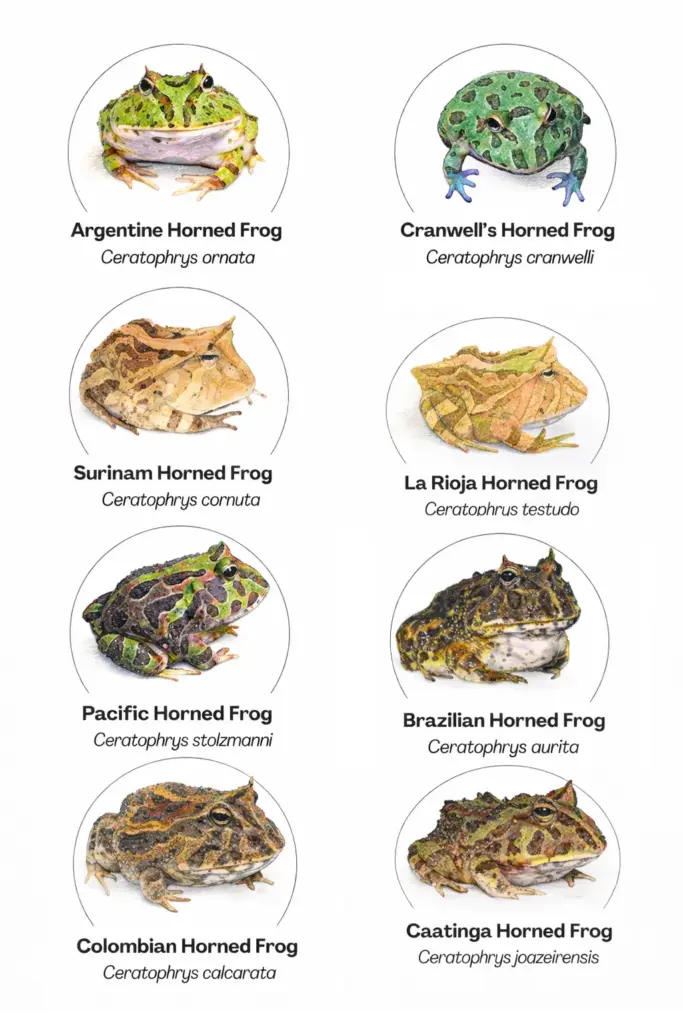
What Is the Difference Between an Amazon Horned Frog and a Pac-Man Frog?
The name Pac-Man frog commonly refers to frogs belonging to the genus Ceratophrys. The Amazon horned frog is one particular species within this group, scientifically identified as Ceratophrys cornuta. Other Pac-Man frogs belong to different species and may have different distributions and physical characteristics.
The Amazon horned frog is a remarkable example of the specialized wildlife found in South America’s tropical rainforests. Its rounded body, horn-like projections, powerful mouth, and extraordinary camouflage make it one of the most recognizable ground-dwelling amphibians of the Amazon Basin.
As an ambush predator, it plays a role in the rainforest food web by feeding on insects, other amphibians, and small vertebrates. Its unusual carnivorous tadpoles also demonstrate how different stages of an amphibian’s life cycle can have highly specialized feeding behaviors.
From the forests of Peru and Brazil to other parts of the Amazon region, Ceratophrys cornuta represents the extraordinary diversity of life found beneath the rainforest canopy.
Learning about this species helps us appreciate that the Amazon rainforest is home not only to iconic wildlife such as jaguars, macaws, and monkeys, but also to fascinating amphibians that contribute to the complexity and balance of tropical ecosystems.