
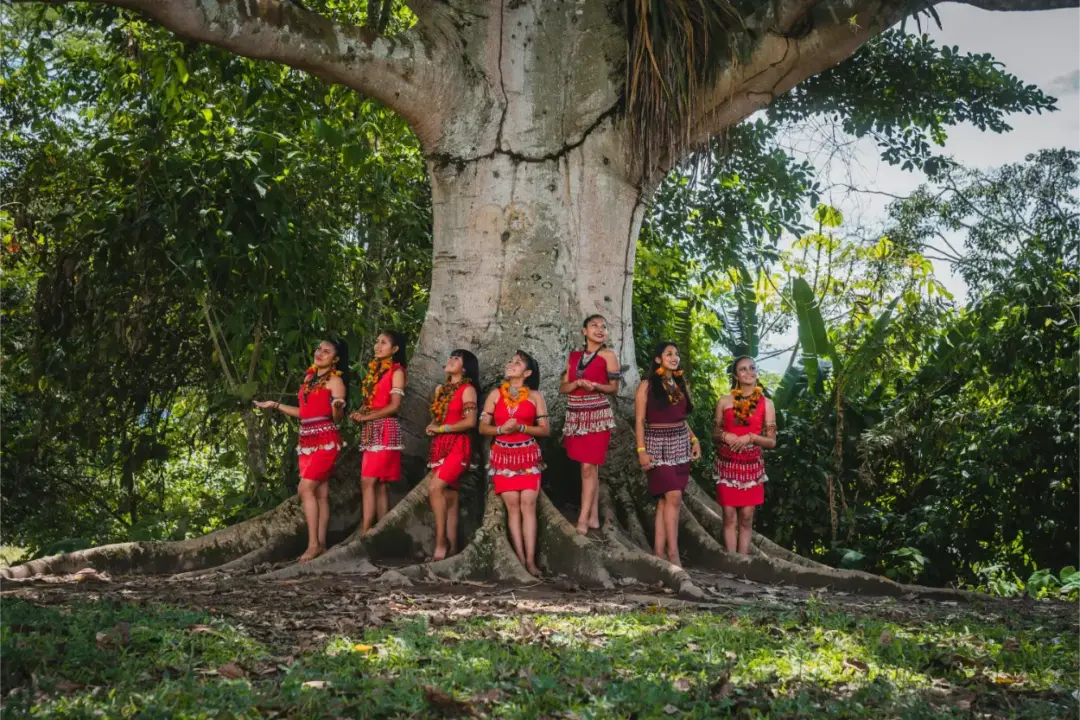
The Peruvian Amazon is one of the most culturally and linguistically diverse regions in South America. Beyond its extraordinary rainforests, rivers, wildlife and traditional communities, this vast territory preserves an impressive variety of Indigenous languages that represent thousands of years of history, knowledge and cultural identity. These languages are an essential part of understanding how Amazonian peoples communicate, organize their communities and maintain their ancestral traditions.
The languages of the Peruvian Amazon include Asháninka, Shipibo-Konibo, Awajún, Wampis, Kukama-Kukamiria, Matsigenka, Yine, Bora, Yagua, Tikuna and many others. Each language reflects a particular cultural heritage and provides unique ways of describing the natural environment, traditional medicine, wildlife and relationships between people and their surroundings.
Peru officially recognizes 48 Indigenous or original languages, of which 44 belong to the Amazonian region and four are spoken in the Andes. This remarkable diversity makes Amazonian Peru an important region for understanding Indigenous linguistic heritage and the preservation of traditional cultures.
How Many Languages Are Spoken in the Peruvian Amazon?
Peru is home to 48 officially recognized Indigenous or original languages, and 44 of them are spoken in the Amazonian region. These languages belong to different linguistic families and are distributed among Indigenous communities across several departments, including Loreto, Ucayali, Amazonas, Madre de Dios, San Martín and Junín.
This linguistic diversity reflects the long history of Indigenous populations throughout the rainforest. Many communities have maintained their languages despite geographical isolation, migration, social changes and the growing influence of Spanish.
Peru’s 48 Indigenous and Original Languages
The country’s Indigenous languages represent different linguistic traditions, with some spoken by large communities and others maintained by relatively small populations. Asháninka is among the most widely spoken Amazonian Indigenous languages.
Other important languages include Awajún, Shipibo-Konibo, Matsigenka, Kukama-Kukamiria, Bora, Yagua, Ese Eja, Harakbut, Wampis, Shawi and Urarina.
It is important to distinguish between Indigenous languages and Indigenous language families. A language family groups languages that share a historical linguistic origin, while individual languages have their own vocabulary, grammar and pronunciation.
Why the Amazon Has Such Remarkable Linguistic Diversity
The Amazon rainforest contains extensive river systems, dense vegetation and geographically separated settlements. These environmental characteristics have contributed to the development and maintenance of different cultural and linguistic traditions.
Over generations, Indigenous communities developed distinct ways of communicating and transmitting knowledge. Rivers served as transportation routes and connections between settlements, while geographical distances also allowed languages and cultural practices to evolve independently.
Spanish and Indigenous Languages in Amazonian Communities
Spanish is widely used in Peru, including throughout Amazonian cities and towns. However, many Indigenous communities continue to use their ancestral languages in everyday communication, family relationships, cultural activities and traditional ceremonies.
Some individuals are bilingual or multilingual, speaking an Indigenous language alongside Spanish or another local language. The degree of language use varies according to age, community, location and educational opportunities.
The Main Indigenous Languages of the Peruvian Amazon
The Amazonian region contains dozens of Indigenous languages, each associated with particular communities and territories. Some have extensive speaker populations, while others face serious challenges related to language transmission.
Asháninka and Ashéninka
Asháninka is one of the most widely spoken Indigenous languages in the Peruvian Amazon. It belongs to the Arawak linguistic family and is traditionally used by Asháninka communities in areas of central and eastern Peru.
Ashéninka is closely associated with the same broader linguistic family, although it is recognized as a distinct language. Both languages are important expressions of Indigenous identity, traditional knowledge and community history.
Where the Asháninka Language Is Spoken
Asháninka-speaking communities are found primarily in the departments of Junín, Ucayali, Pasco, Cusco, Huánuco and other areas of central Peru.
Cultural Importance of the Asháninka Language
The language is used to transmit traditional stories, family knowledge, environmental observations and cultural practices. It also plays an important role in maintaining relationships between generations.
Shipibo-Konibo
Shipibo-Konibo is an important Indigenous language spoken mainly in the Ucayali region. It belongs to the Panoan language family and is closely connected to the cultural identity of Shipibo-Konibo communities.
The language is particularly important for traditional storytelling, community communication, artistic knowledge and descriptions of the natural environment.
Shipibo-Konibo cultural traditions include distinctive visual designs, crafts, music and oral knowledge that are transmitted through generations.
Shipibo-Konibo Language and Traditional Knowledge
Traditional vocabulary reflects relationships with rivers, forests, medicinal plants, animals and everyday activities. Language helps preserve cultural interpretations of the surrounding environment and the knowledge developed through generations of experience.
Awajún and Wampis
Awajún and Wampis are Indigenous languages belonging to the Jivaroan linguistic family. They are primarily associated with northern Amazonian Peru, particularly the departments of Amazonas and Loreto.
These languages are important components of the cultural identity of their respective communities.
Languages of Northern Amazonian Peru
Awajún and Wampis are used in family life, community organization, oral traditions and cultural education. Their continued transmission is important for maintaining traditional knowledge and strengthening Indigenous identity.
Kukama-Kukamiria
Kukama-Kukamiria is an Indigenous language associated with river communities in the department of Loreto. Its history is closely connected to the Amazon River and the surrounding waterways.
The language reflects the importance of fishing, transportation, river environments and community relationships.
Language, River Communities and Oral Traditions
Kukama-Kukamiria contains traditional expressions and vocabulary associated with aquatic environments, fishing practices, plants, animals and everyday life.
Although the language has experienced a decline in intergenerational transmission in some communities, revitalization initiatives are helping strengthen its cultural presence.
Matsigenka and Yine
Matsigenka and Yine are important Indigenous languages of the southern and southeastern Peruvian Amazon.
Matsigenka belongs to the Arawak language family and is spoken in areas of Cusco, Madre de Dios and neighboring regions. Yine is also part of the Arawak family and has a long history in Amazonian communities.
These languages preserve knowledge about forest ecosystems, traditional food, agriculture, medicinal plants and relationships between communities and their territories.
Languages of the Southern Peruvian Amazon
In southern Peru, Indigenous languages are particularly important for understanding the cultural diversity of Madre de Dios and surrounding rainforest territories.
Matsigenka, Yine, Ese Eja and Harakbut are among the languages associated with this broader geographical area.
Other Indigenous Languages of the Peruvian Amazon
The region contains many additional languages that represent distinct cultural and linguistic traditions.
Bora, Yagua, Tikuna and Murui-Muinani
Bora, Yagua, Tikuna and Murui-Muinani are important languages associated with communities in northern Amazonian Peru, especially Loreto.
They preserve different systems of vocabulary, oral communication and cultural knowledge.
Ese Eja, Harakbut, Matsés and Amahuaca
These languages contribute to the remarkable diversity of southern and central Amazonian Peru.
Ese Eja is particularly associated with Madre de Dios and the southeastern rainforest. Harakbut communities also maintain important linguistic and cultural traditions in this region.
Matsés and Amahuaca are associated with Panoan linguistic traditions, while Harakbut represents a distinct linguistic classification.
Indigenous Language Families in the Peruvian Amazon
Language families help explain the historical relationships between different Indigenous languages. Although communities may live relatively close to one another, their languages can belong to completely different families.
Understanding these relationships provides valuable information about the linguistic history of the Amazon rainforest.
Arawak Language Family
The Arawak family is one of the major Indigenous linguistic groups in South America. In Peru, it includes languages such as Asháninka, Ashéninka, Matsigenka, Yine and Yanesha.
These languages are associated with communities distributed across different Amazonian territories.
Panoan Language Family
The Panoan family includes several Indigenous languages of the Peruvian Amazon, particularly in Ucayali and neighboring regions.
Shipibo-Konibo, Cashinahua, Amahuaca, Matsés and Sharanahua are examples of languages belonging to this linguistic tradition.
Jivaroan Language Family
The Jivaroan family is associated with northern Amazonian Peru. Awajún, Wampis and Achuar are important languages in this group.
They represent long-standing cultural traditions and connections between Indigenous communities in northern rainforest territories.
Other Amazonian Linguistic Families
The Amazon also contains several other language families and languages whose historical classification is distinct.
Tucanoan, Záparoan and Other Language Groups
Peruvian Amazonian linguistic diversity includes languages such as Arabela, associated with the Záparoan family, and Bora, which has its own distinct linguistic classification.
Other languages belong to smaller or less widely represented linguistic groups. Their study helps researchers understand the complexity of Amazonian language history.
Where Are Indigenous Languages Spoken in the Peruvian Amazon?
Indigenous languages are distributed across several departments, with different communities maintaining particular linguistic traditions.
Languages of Loreto
Loreto is one of Peru’s most linguistically diverse Amazonian departments. Its communities include speakers of Kukama-Kukamiria, Bora, Yagua, Tikuna, Murui-Muinani, Achuar, Urarina, Shawi and other languages.
The Amazon, Marañón, Napo and Ucayali river systems have historically connected many of these communities.
Languages of Ucayali
Ucayali is particularly associated with Shipibo-Konibo and several other Indigenous languages, including Cashinahua, Amahuaca, Yaminahua and Asháninka.
The region has an important cultural and linguistic relationship with the Ucayali River and its surrounding communities.
Languages of Madre de Dios
Madre de Dios is home to several Indigenous linguistic traditions, including Ese Eja, Harakbut, Matsigenka, Yine and Amahuaca.
These languages are closely connected to the region’s rivers, forests and traditional territories.
Languages of Amazonas, San Martín and Junín
Northern and central Amazonian departments contain additional linguistic communities.
Awajún is important in Amazonas and neighboring regions, while Wampis is associated with northern rainforest territories. Shawi and other Indigenous languages are also represented in this broader geographical area.
Junín is particularly important for Asháninka-speaking communities.
The Cultural Importance of Amazonian Indigenous Languages
Indigenous languages are more than communication systems. They preserve cultural memory, traditional knowledge and the relationships between communities and their natural surroundings.
Traditional Knowledge of Medicinal Plants and Wildlife
Many Indigenous languages contain detailed vocabulary related to medicinal plants, edible fruits, trees, insects, fish, birds and mammals.
This knowledge reflects generations of experience living in the rainforest. Different plants may have specific traditional names based on their appearance, habitat, use or cultural significance.
Language therefore plays an important role in transmitting knowledge about traditional medicine and biodiversity.
Oral Traditions, Legends and Ancestral Stories
Stories, legends, songs and oral histories are important parts of Amazonian cultural heritage.
Through storytelling, older generations transmit information about community origins, historical experiences, traditional values and relationships with the natural world.
These traditions also help younger generations understand their cultural identity.
Language as an Expression of Indigenous Identity
Speaking an ancestral language can strengthen relationships between family members and communities.
It also maintains cultural continuity by preserving expressions, traditional names, knowledge systems and ways of describing the surrounding environment.
Endangered Languages of the Peruvian Amazon
Despite their cultural importance, some Indigenous languages face serious threats. Changes in education, migration, urbanization and the growing dominance of Spanish have affected the number of people who use certain ancestral languages.
Why Some Indigenous Languages Are Disappearing
One of the main challenges is the interruption of language transmission between generations.
When children grow up using Spanish instead of their community’s ancestral language, the number of fluent speakers may gradually decrease.
Other factors include limited educational resources, social discrimination, geographical displacement and reduced opportunities to use Indigenous languages in public services.
Taushiro, Ikitu and Kukama-Kukamiria
Some Amazonian languages are particularly vulnerable.
Taushiro is critically endangered and has been documented with extremely few remaining speakers. Ikitu and Kukama-Kukamiria have also faced serious challenges associated with declining language transmission.
Their preservation requires community participation, educational support and documentation of vocabulary, grammar and oral traditions.
The Importance of Intergenerational Language Transmission
A language has a stronger chance of surviving when children learn it naturally at home and use it in everyday situations.
Families, elders and community leaders play essential roles in transmitting traditional expressions, stories and knowledge.
How Indigenous Languages Are Being Preserved
Preserving Indigenous languages requires cooperation between communities, educators and institutions. The objective is not simply to document words but to maintain languages as living forms of communication.
Bilingual Intercultural Education
Bilingual intercultural education helps children learn through their ancestral language while also developing skills in Spanish.
This approach recognizes the importance of Indigenous identity and creates educational opportunities that respect local cultural traditions.
Community Language Revitalization
Community initiatives may include language workshops, storytelling sessions, traditional songs, educational materials and activities involving older speakers.
These initiatives encourage younger generations to use their ancestral languages in everyday life.
Documenting Vocabulary, Stories and Traditional Knowledge
Recording traditional vocabulary, oral histories and cultural expressions helps preserve linguistic information for future generations.
Documentation is particularly important for languages with very few remaining fluent speakers.
However, preservation also depends on ensuring that communities retain control over their knowledge and decide how it should be shared.
Frequently Asked Questions About the Languages of the Peruvian Amazon
What languages are spoken in the Peruvian Amazon?
The Peruvian Amazon is home to numerous Indigenous languages, including Asháninka, Ashéninka, Shipibo-Konibo, Awajún, Wampis, Matsigenka, Yine, Kukama-Kukamiria, Bora, Yagua, Tikuna, Ese Eja and Harakbut. Spanish is also widely spoken throughout the region.
How many Indigenous languages exist in the Peruvian Amazon?
Peru recognizes 48 Indigenous or original languages, of which 44 are spoken in the Amazonian region and four in the Andes. These languages represent an important part of the country’s cultural and linguistic diversity.
What is the most widely spoken Indigenous language in the Peruvian Amazon?
Asháninka is among the most widely spoken Indigenous languages of the Peruvian Amazon. It is associated with communities in central and eastern Peru and belongs to the Arawak linguistic family.
Are Amazonian Indigenous languages related to each other?
Some Amazonian languages share historical linguistic origins and belong to the same language families. However, others belong to completely different families. For example, Asháninka belongs to the Arawak family, while Shipibo-Konibo belongs to the Panoan family.
Is Spanish spoken throughout the Peruvian Amazon?
Spanish is widely used in Amazonian cities, towns and many communities. However, numerous Indigenous populations continue to speak their ancestral languages in family settings, community activities and traditional cultural practices.
Which Indigenous languages are endangered in Peru?
Several Indigenous languages face different levels of vulnerability. Taushiro is critically endangered, while Ikitu and Kukama-Kukamiria have also experienced significant challenges related to the number of speakers and intergenerational transmission.
What languages are spoken in Madre de Dios?
Indigenous languages associated with Madre de Dios include Ese Eja, Harakbut, Matsigenka, Yine and Amahuaca. These languages represent important cultural traditions of southeastern Amazonian Peru.
Can visitors learn Indigenous languages in the Peruvian Amazon?
Visitors can learn basic expressions and cultural vocabulary through appropriate community-based educational experiences when these are available. Learning greetings, respecting local pronunciation and understanding the cultural context of words can help visitors communicate more respectfully with Indigenous communities.
Conclusion
The languages of the Peruvian Amazon represent an extraordinary cultural heritage that extends far beyond everyday communication. From Asháninka and Shipibo-Konibo to Awajún, Matsigenka, Ese Eja and Kukama-Kukamiria, each language preserves unique traditions, knowledge and relationships with the rainforest.
With 44 Indigenous languages spoken in the Amazonian region, Peru possesses one of the most remarkable examples of linguistic diversity in South America. Protecting this heritage requires supporting Indigenous communities, encouraging language transmission between generations and recognizing the importance of ancestral knowledge.
Preserving these languages means preserving the stories, identities and cultural traditions that have shaped the Peruvian Amazon for generations.