
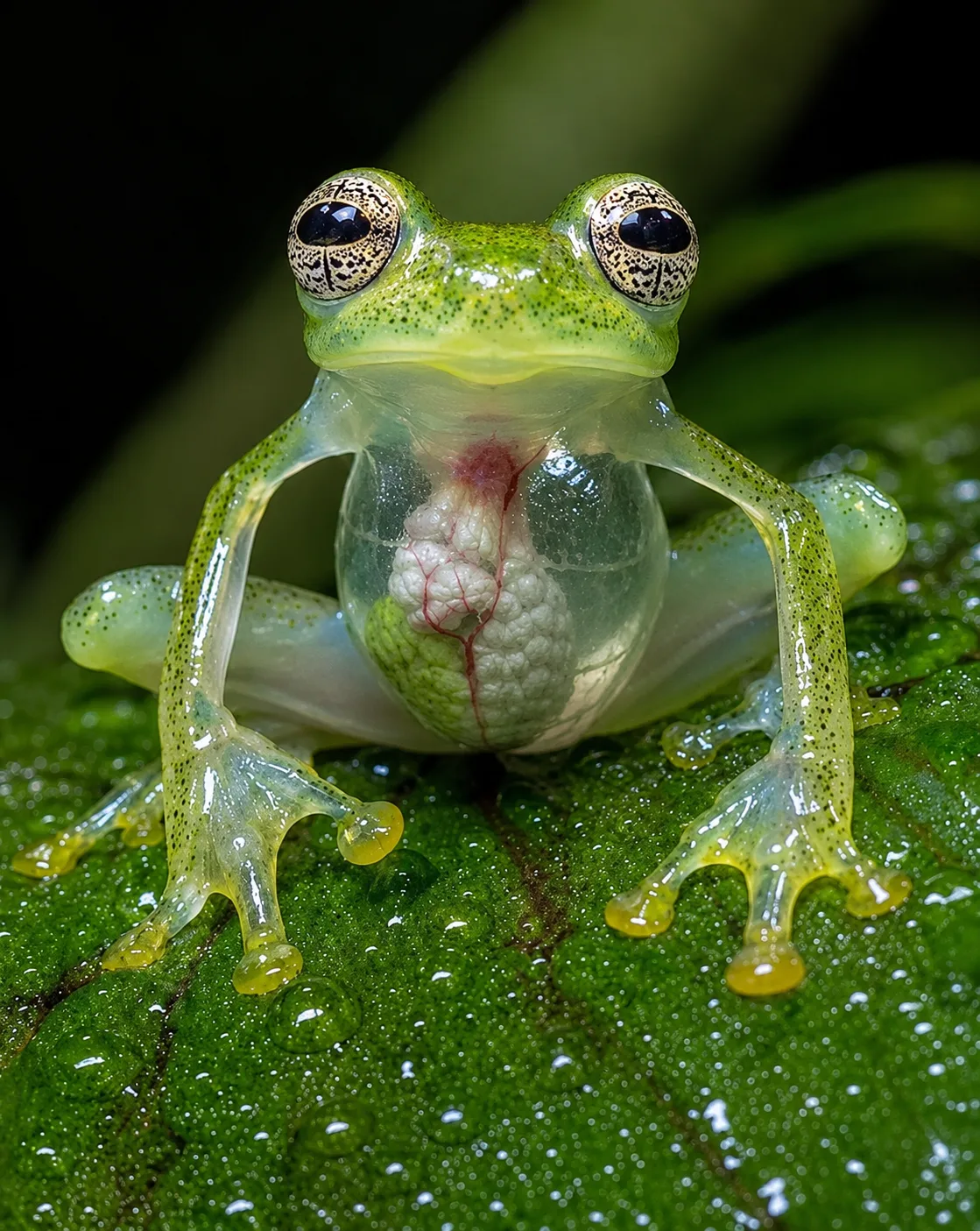
The glass frog is one of the most fascinating amphibians in the tropical rainforests of Central and South America. Famous for its translucent skin and extraordinary camouflage, this small rainforest animal has a remarkable feature that allows people to see some of its internal organs through its abdomen. Its heart, digestive system, liver, and other structures can sometimes be observed without cutting or damaging the animal.
Belonging to the family Centrolenidae, glass frogs are tree-dwelling amphibians that inhabit humid tropical forests, particularly areas near freshwater streams and rivers. Their green bodies help them blend into leaves and vegetation, while their partially transparent undersides make them difficult for predators to detect. These adaptations are especially useful because glass frogs spend much of the day resting on foliage and become more active at night.

Although their delicate appearance makes them look unusual, glass frogs are highly specialized rainforest animals. They have adapted to life among tropical vegetation, where they hunt small insects, reproduce on leaves above streams, and depend on healthy freshwater ecosystems to complete their life cycles.
In this guide, discover everything about glass frogs, including their scientific classification, transparent skin, physical characteristics, habitat, diet, reproduction, behavior, predators, conservation status, and interesting facts.
What Is a Glass Frog?
A glass frog is a small arboreal amphibian belonging to the family Centrolenidae. It gets its common name from the translucent skin covering parts of its body, especially its belly. Unlike most frogs, whose skin completely hides their internal organs, glass frogs have an abdomen that allows some internal structures to be seen from the outside.
Glass frogs are native to the Neotropical region, which includes tropical areas of Central America and South America. They inhabit humid forests, cloud forests, and tropical rainforest ecosystems, where they generally remain close to streams and other freshwater environments.
Table of Contents
These amphibians are particularly adapted to life in trees and shrubs. Their long legs, specialized toe pads, and small bodies help them climb leaves and branches. Many species spend the daytime resting underneath or on top of broad green leaves, where their coloration provides excellent camouflage.
Glass frogs are generally nocturnal, meaning they become active after sunset. During the night, males may call to attract females, adults search for food, and breeding activities take place along forest streams.
Glass Frog Scientific Name and Classification
The scientific family name of glass frogs is Centrolenidae. These amphibians belong to the order Anura, the same order that includes all frogs and toads.
Although the common name suggests that glass frogs are a single species, they actually represent a diverse family containing many different species. They vary in body size, coloration, distribution, and the degree of transparency in their skin.
Their scientific classification is:
- Kingdom: Animalia
- Phylum: Chordata
- Class: Amphibia
- Order: Anura
- Family: Centrolenidae
Several genera are included within the glass frog family, such as Hyalinobatrachium, Centrolene, Nymphargus, Cochranella, and Espadarana.
Each genus contains different species with distinctive physical characteristics and ecological adaptations. Some have highly transparent bellies, while others have partially translucent skin with visible pigmentation.
Why Is It Called a Glass Frog?
The name glass frog comes from the animal’s transparent or translucent abdominal skin. When viewed from underneath, its internal organs can be visible through the belly, creating the appearance of a tiny glass-like animal.
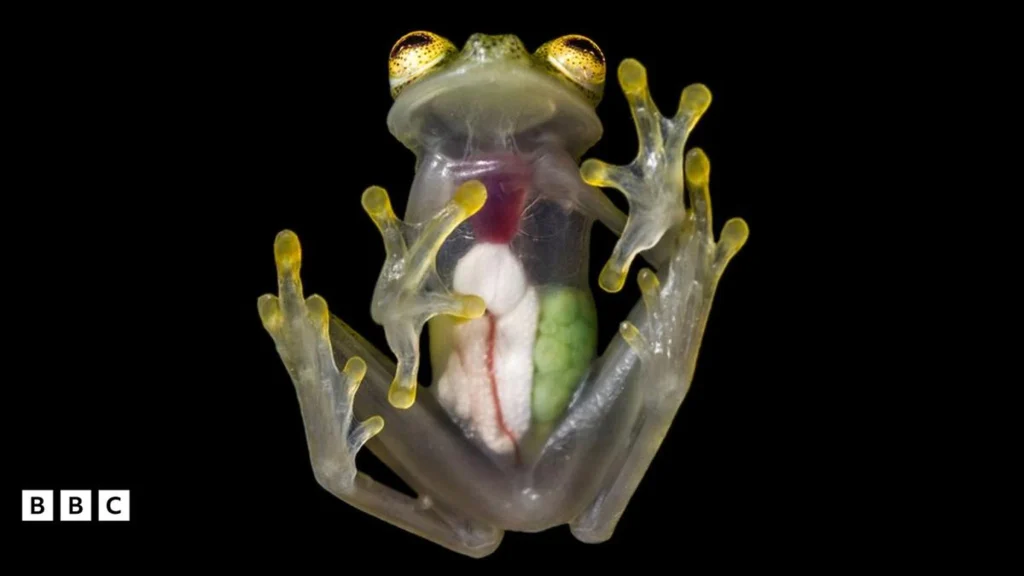
This characteristic is unusual among terrestrial vertebrates. While transparency is relatively common in certain aquatic organisms, it is much rarer among animals living on land.
The glass frog’s translucent appearance is not simply an unusual physical feature. It is also associated with camouflage, helping the animal blend into the leaves where it rests during the day.
Glass Frog Characteristics
Glass frogs have several distinctive characteristics that separate them from other tropical frogs.
Their most recognizable features include:
- Translucent abdominal skin that reveals some internal organs.
- Green dorsal coloration that resembles rainforest foliage.
- Small bodies, usually measuring only a few centimeters.
- Large eyes adapted to low-light conditions.
- Long, slender legs for climbing vegetation.
- Expanded toe pads that help them grip leaves and branches.
- Nocturnal behavior, with most feeding and breeding activities occurring at night.
- Arboreal lifestyles, meaning they spend much of their lives in vegetation.
These characteristics allow glass frogs to survive in humid tropical forests, where camouflage, climbing ability, and access to freshwater breeding sites are important.
What Does a Glass Frog Look Like?
The glass frog is generally a small, delicate-looking amphibian with a green back, slender limbs, and a translucent underside. Its appearance varies considerably depending on the species.
Some glass frogs have bright emerald-green bodies, while others display yellowish-green coloration, small white spots, or darker markings. Their bellies may be partially or almost completely transparent, depending on their anatomy.
When resting on a leaf, their green upper bodies blend into the surrounding vegetation. When viewed from underneath, however, their translucent abdominal skin reveals an entirely different appearance.
Glass Frog Size and Weight
Glass frogs are generally small amphibians. Most species measure approximately 2–7 centimeters in body length, although sizes vary among species.
Their lightweight bodies make climbing and moving through delicate vegetation easier. This is particularly important because many species spend much of their lives on leaves and thin branches above streams.
The exact size and weight of a glass frog depend on its species, age, and sex. Females may be larger than males in some species, especially those that produce relatively large egg clutches.
Despite their small dimensions, glass frogs are highly specialized predators that play an important role in controlling populations of small insects and other invertebrates.
Transparent Skin and Visible Internal Organs
The most remarkable feature of glass frogs is their translucent belly.
Unlike the opaque skin of most amphibians, the ventral skin of glass frogs allows light to pass through, making certain internal structures visible.
Depending on the species and viewing angle, observers may see:
- The heart.
- The liver.
- The digestive tract.
- The stomach and intestines.
- Blood vessels.
- Other internal tissues and organs.
The visibility of these structures makes glass frogs particularly interesting to biologists and wildlife photographers.
However, not every glass frog has completely transparent skin. Some species have a partially translucent abdomen, while others display greater transparency.
Their transparency is especially noticeable when the animal is resting on a leaf and viewed from underneath.
Glass Frog Eyes, Legs, and Body Structure
Glass frogs have large, prominent eyes that help them detect movement and locate prey in low-light environments.
Their eyes are generally positioned toward the sides and front of the head, providing a useful field of vision when moving through vegetation.
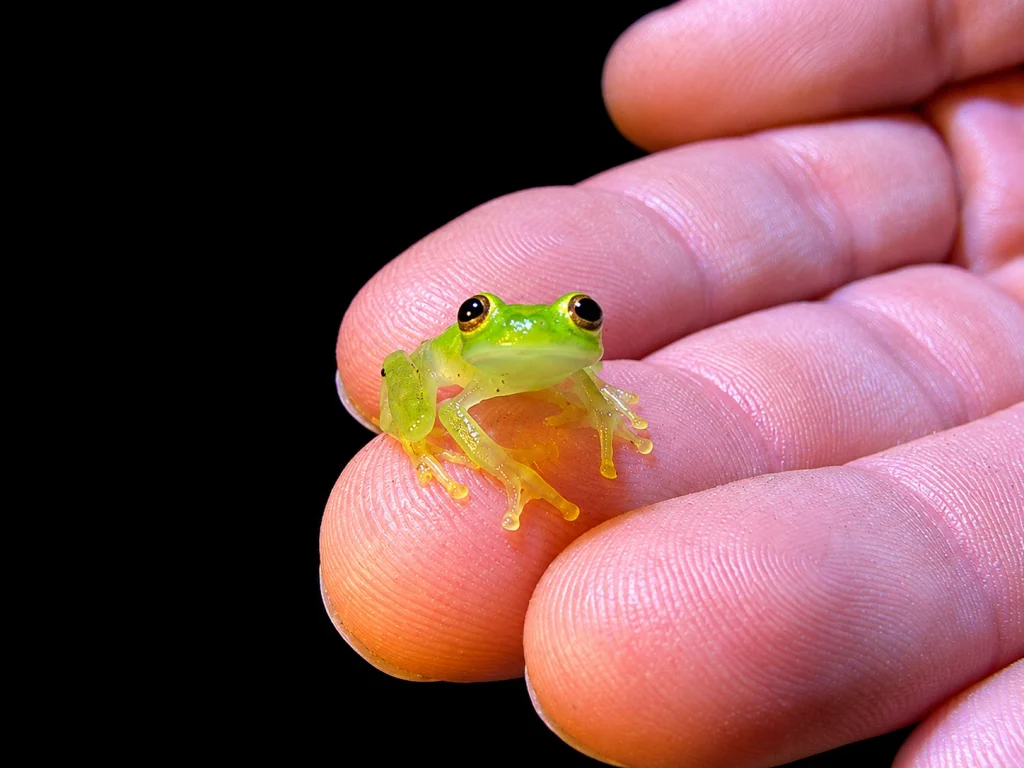
Their legs are relatively long compared with their small bodies. This helps them jump between leaves and branches, while expanded toe pads provide additional grip on wet surfaces.
Their fingers and toes are adapted for climbing. These structures allow them to hold onto vegetation even when leaves become slippery from rain or humidity.
Glass frogs also have delicate bodies that help them move through dense rainforest foliage without requiring large amounts of energy.
Why Are Glass Frogs Transparent?
Glass frogs are transparent because their tissues have specialized characteristics that allow light to pass through them. Their abdominal skin and muscles contain relatively little pigmentation, making the structures beneath them visible.
However, scientists have discovered that glass frog transparency involves more than simply having thin or clear skin.
A 2022 study published in the journal Science revealed an extraordinary mechanism in the northern glass frog, Hyalinobatrachium fleischmanni.
Researchers discovered that resting individuals can remove approximately 89% of their circulating red blood cells from circulation and concentrate them inside the liver. This increases the transparency of their bodies by reducing the amount of red blood circulating through visible tissues.
The research showed that glass frogs can become approximately two to three times more transparent while resting compared with other activity states.
This discovery helps explain how these amphibians maintain their camouflage while sleeping on leaves during the day.
How Glass Frog Transparency Works
Transparency in glass frogs depends on several biological characteristics.
First, their abdominal tissues allow a considerable amount of visible light to pass through. Second, their green dorsal coloration resembles the appearance of leaves. Finally, the ability to temporarily concentrate red blood cells in the liver reduces the visibility of blood in surrounding tissues.
Together, these characteristics help the frog become less noticeable against its natural background.
This adaptation is particularly important because red blood cells contain hemoglobin, a pigment that absorbs light and can make otherwise transparent tissues more visible.
By temporarily changing the distribution of these cells, certain glass frogs can improve their camouflage while resting.
How Transparency Helps with Camouflage
Camouflage is essential for small rainforest animals that are vulnerable to predators.
When a glass frog rests on a leaf, its green back blends with the surrounding vegetation. Its translucent underside also reduces the appearance of a clearly defined body shape.
This makes it harder for predators to recognize the animal as a potential food source.
Rather than relying entirely on traditional camouflage patterns, glass frogs use a combination of green coloration, translucent tissues, and behavioral adaptations.
Their ability to remain still during the day further improves their chances of avoiding detection.
Where Do Glass Frogs Live?
Glass frogs live in tropical environments throughout Central America and South America. They are especially associated with humid forests, where freshwater streams, dense vegetation, and suitable breeding locations are available.
Their geographical distribution includes countries such as Costa Rica, Panama, Colombia, Ecuador, Peru, Venezuela, and several other countries in the Neotropical region.
Different species occupy different elevations and ecosystems. Some inhabit lowland tropical rainforests, while others are found in humid mountain forests and tropical cloud forests.
Glass Frog Habitat
The typical glass frog habitat consists of humid tropical vegetation near clean freshwater streams.
These environments provide the conditions necessary for feeding, climbing, shelter, and reproduction.
Glass frogs frequently occupy:
- Tropical rainforest vegetation.
- Cloud forests.
- Mountain forests.
- Riverbanks and stream edges.
- Shrubs and trees overhanging freshwater.
- Broad leaves and branches.
- Dense vegetation near waterfalls and small forest streams.
Their dependence on humid environments is closely connected to their amphibian biology. Like other frogs, they require suitable moisture conditions to protect their skin and support their life cycle.
Freshwater streams are particularly important because many glass frogs lay their eggs on leaves above flowing water. Once the tadpoles hatch, they can fall into the stream below.
Glass Frogs in the Amazon Rainforest
The Amazon rainforest is one of the major ecosystems associated with glass frog diversity.
Its warm temperatures, high humidity, dense vegetation, and extensive network of rivers and streams provide suitable conditions for numerous amphibian species.
Glass frogs are found in parts of the Amazon Basin, including tropical forests in Peru, Ecuador, Colombia, Brazil, and neighboring countries.
In Peru, glass frogs inhabit humid forest environments, including areas of the Amazon lowlands and other tropical forest regions. Their distribution depends on the species and the particular ecological conditions of each location.
The Amazon rainforest provides an abundance of small insects and other invertebrates, which form an important part of their diet.
Forest streams also create suitable breeding habitats, allowing adults to reproduce on vegetation above the water.
Although glass frogs are not always easy to observe, their distinctive calls may reveal their presence during nighttime walks near streams.
Glass Frogs in Central and South America
Glass frogs are distributed across a wide range of Neotropical environments.
Central America contains numerous species inhabiting humid forests in countries such as Costa Rica and Panama.
Further south, Colombia and Ecuador are particularly important regions for glass frog diversity. Their tropical Andes contain numerous habitats with high levels of amphibian endemism.
Peru also supports glass frog diversity, particularly within humid tropical forest ecosystems.
The distribution of individual species is often relatively restricted. Some are found only in particular mountain valleys, forest reserves, or river systems.
This makes habitat conservation especially important because the destruction of a small geographical area can threaten species with limited distributions.
Why Do Glass Frogs Live Near Streams?
Freshwater streams are essential to the reproductive cycle of many glass frog species.
Females commonly deposit their eggs on the underside of leaves hanging above running water. When the embryos develop and hatch, the tadpoles fall into the stream.
The water provides an environment where the young frogs can continue developing.
Streams also create humid microhabitats that help maintain the moisture required by amphibians.
The vegetation growing along streambanks provides shelter, hunting grounds, calling locations, and suitable egg-laying sites.
For these reasons, glass frogs are strongly associated with healthy forest streams and the surrounding vegetation.
What Do Glass Frogs Eat?
Glass frogs are carnivorous amphibians that primarily feed on small insects and other invertebrates.
Their diet includes tiny animals that live among leaves, branches, and rainforest vegetation.
Because they are relatively small, glass frogs generally hunt prey that they can capture and swallow easily.
Glass Frog Diet
The glass frog diet mainly consists of:
- Small flies.
- Mosquitoes.
- Moths.
- Ants.
- Small beetles.
- Spiders.
- Other tiny invertebrates.
The exact diet varies according to species, body size, habitat, and the availability of prey.
These frogs are important predators within tropical forest ecosystems because they help regulate populations of small insects.
Although glass frogs are not large predators, their feeding behavior contributes to the ecological balance of rainforest communities.
How Glass Frogs Catch Their Food
Glass frogs generally hunt at night, when many small insects become active.
They move through leaves and branches, searching for suitable prey. Like other frogs, they use their vision and rapid movements to capture small animals.
When an insect comes within reach, the frog can use its sticky tongue to catch it.
Their climbing abilities help them search different levels of vegetation, allowing them to find prey on leaves, stems, and branches.
Their small size and camouflage also make it easier to approach prey without attracting unwanted attention.
Glass Frog Predators
Despite their effective camouflage, glass frogs are vulnerable to several rainforest predators.
Potential predators include:
- Snakes.
- Birds.
- Larger frogs.
- Spiders and other predatory invertebrates, particularly against eggs and young stages.
- Other animals that feed on small amphibians.
Glass frog eggs are especially vulnerable because they are deposited on exposed leaves above streams.
Predators may consume the eggs before the embryos develop, while tadpoles face additional threats after entering the water.
Camouflage, nocturnal activity, and parental egg protection in certain species help reduce these risks.
Glass Frog Reproduction and Life Cycle
Glass frog reproduction is closely connected to freshwater streams and surrounding vegetation.
Unlike many frogs that deposit their eggs directly in water, numerous glass frog species lay their eggs on leaves above flowing streams.
This unusual reproductive strategy helps protect developing embryos from some aquatic predators while keeping them close to the water required by the tadpoles.
Glass Frog Mating Behavior
Glass frogs generally reproduce during suitable seasonal conditions when humidity and rainfall provide favorable breeding environments.
Male glass frogs often establish calling locations on leaves and vegetation near streams.
Their calls attract females, which approach males and select suitable partners and egg-laying locations.
After mating, the female deposits a cluster of eggs on the underside of a leaf or another suitable surface above the water.
The number of eggs varies depending on the species.
The male may remain near the eggs and provide parental care, although reproductive behavior differs considerably throughout the family.
Where Do Glass Frogs Lay Their Eggs?
Many glass frogs lay their eggs on the undersides of leaves hanging over streams.
This location provides several advantages.
The leaves keep the eggs above the water, reducing exposure to certain aquatic predators. At the same time, their position above flowing water allows newly hatched tadpoles to fall directly into the stream.
The surrounding vegetation also provides a humid environment that helps prevent the eggs from drying out.
Choosing the right leaf is important because the survival of the developing embryos depends on suitable moisture, temperature, and protection.
Glass Frog Eggs and Tadpoles
Glass frog eggs are usually deposited in clusters attached to vegetation.
Inside each egg, an embryo develops until it reaches the tadpole stage.
Once the eggs hatch, the tadpoles generally drop into the stream below.
Glass frog tadpoles are adapted to aquatic environments, where they continue developing before transforming into young frogs.
During this stage, they gradually develop limbs, change their body structure, and eventually lose their tails through metamorphosis.
The length of the developmental process varies depending on species and environmental conditions.
Parental Care in Glass Frogs
Parental care is one of the most interesting aspects of glass frog reproduction.
In several species, adult frogs protect their eggs after they have been deposited on leaves.
Some males remain near egg clutches, using their bodies to cover and protect the developing embryos. They may also help maintain moisture and remove harmful material from the eggs.
Research has shown that parental care is more widespread among glass frogs than scientists once believed.
Although male egg attendance is documented in several genera, females also provide parental care in some species.
For example, research has documented maternal egg-brooding behavior in Ikakogi tayrona.
These behaviors demonstrate that glass frog reproductive strategies are more diverse and complex than their small size might suggest.
Glass Frog Behavior and Adaptations
Glass frogs have developed several adaptations that allow them to survive in humid tropical forests.
Their behavior is closely connected to the availability of vegetation, insects, and freshwater streams.
Most species are nocturnal and arboreal, meaning they spend much of their lives climbing and resting among trees and shrubs.
Are Glass Frogs Nocturnal?
Yes, most glass frogs are primarily nocturnal.
They become more active after sunset, when they search for food, communicate, and reproduce.
During the night, males often produce calls to attract females. Adults also move through vegetation in search of small insects.
During the day, glass frogs usually rest on leaves and remain relatively inactive.
Their green coloration and translucent undersides help them blend into their surroundings while avoiding predators.
This combination of daytime camouflage and nighttime activity is an important survival strategy.
Glass Frog Camouflage and Defense
Camouflage is one of the most important adaptations of glass frogs.
Their green backs resemble the color of tropical leaves, while their transparent bellies reduce the visibility of their bodies from certain viewing angles.
Their small size also makes them difficult to detect among dense rainforest vegetation.
When threatened, glass frogs may remain motionless or move away through nearby leaves and branches.
Their ability to climb and jump provides additional opportunities to escape predators.
Rather than relying on poison or aggressive defensive behavior, glass frogs primarily depend on avoiding detection.
How Glass Frogs Communicate
Glass frogs communicate mainly through vocalizations.
Males produce calls that help attract females and communicate with other individuals.
These sounds are particularly important during the breeding season, when several frogs may occupy the same streamside habitat.
Each species can have distinctive acoustic characteristics, including differences in call frequency, duration, and rhythm.
Researchers use these calls to identify species and study their behavior in dense rainforest environments.
Because many glass frogs are small and well camouflaged, listening for their calls can sometimes be easier than finding them visually.
Adaptations for Living in the Rainforest
Glass frogs have several adaptations that make them successful rainforest inhabitants.
Their most important adaptations include:
- Transparent abdominal skin for camouflage.
- Green dorsal coloration that resembles foliage.
- Specialized toe pads for climbing.
- Long legs for jumping between vegetation.
- Nocturnal activity that reduces exposure to some daytime predators.
- Reproductive strategies linked to forest streams.
- Parental care in certain species.
- Physiological mechanisms that increase transparency during rest in some species.
Together, these characteristics allow glass frogs to occupy a specialized ecological niche within tropical forest ecosystems.
Are Glass Frogs Poisonous or Dangerous?
Glass frogs are not generally considered poisonous or dangerous to humans.
They should not be confused with poison dart frogs, which include species known for producing potent defensive toxins.
The transparent appearance of a glass frog does not indicate that it is venomous or poisonous.
Glass frogs are small, non-aggressive amphibians that primarily feed on insects and other tiny invertebrates.
However, this does not mean they should be handled unnecessarily.
Are Glass Frogs Toxic to Humans?
Glass frogs are not known for the potent skin toxins associated with certain poison dart frogs.
They do not hunt humans, attack people, or use venom to capture prey.
Like other amphibians, however, their skin is delicate and highly permeable. Oils, chemicals, soaps, and substances on human hands can potentially harm them.
For this reason, observing glass frogs without touching them is the best approach.
Can You Touch a Glass Frog?
It is better not to touch a glass frog in the wild.
Their skin is extremely sensitive to environmental conditions, and direct contact can expose them to harmful substances.
Handling can also cause stress and interfere with their natural behavior.
Wildlife researchers use appropriate handling procedures when examination is necessary. Visitors and wildlife photographers should observe these animals from a respectful distance.
Types of Glass Frogs and Different Species
Glass frogs are not a single species but a diverse family of amphibians.
Different glass frog species can be distinguished by their body coloration, skin transparency, size, markings, geographical distribution, and reproductive behavior.
Some are found in lowland rainforests, while others inhabit tropical mountain forests.
Hyalinobatrachium Glass Frogs
The genus Hyalinobatrachium includes some of the most recognizable glass frogs.
Many species have highly translucent abdominal skin, making their internal organs particularly visible.
One well-known species is the northern glass frog, Hyalinobatrachium fleischmanni.
This species has been especially important in scientific research because of discoveries concerning how glass frogs regulate the distribution of red blood cells to increase transparency while resting.
Centrolene Glass Frogs
The genus Centrolene includes several species distributed across tropical regions of South America.
These frogs are generally associated with humid mountain forests and streamside vegetation.
Some species possess distinctive physical structures and reproductive behaviors.
Certain Centrolene species also exhibit parental care, with males remaining near egg clutches to protect developing embryos.
Nymphargus Glass Frogs
Nymphargus is another important genus within the glass frog family.
Many species are associated with tropical Andean forests, where humid conditions and freshwater streams provide suitable habitats.
Their distribution and physical appearance vary between species.
Some are found in relatively restricted geographical areas, making the conservation of their natural habitats particularly important.
Other Glass Frog Species
Additional genera within Centrolenidae include Cochranella, Espadarana, Vitreorana, and Teratohyla.
Each group contains frogs with distinctive characteristics.
Scientists continue studying glass frog diversity, behavior, classification, and geographical distribution. New species have also been described in recent years, particularly in tropical mountain regions where many habitats remain insufficiently explored.
Are Glass Frogs Endangered?
The conservation status of glass frogs varies significantly between species.
Some have relatively broad geographical distributions, while others occupy restricted habitats and may be particularly vulnerable to environmental changes.
Because many glass frogs depend on healthy forests and freshwater streams, habitat destruction represents an important conservation concern.
Deforestation, agricultural expansion, mining, water pollution, and climate change can affect the environments they require for survival.
Threats to Glass Frog Populations
Glass frogs face several threats throughout their natural distribution.
The most significant include:
- Deforestation and destruction of tropical forests.
- Agricultural expansion and vegetation removal.
- Mining activities and water contamination.
- Pollution of freshwater streams.
- Climate change and changing rainfall patterns.
- Habitat fragmentation.
- Diseases affecting amphibian populations.
These pressures can reduce the availability of suitable breeding sites and affect the survival of eggs and tadpoles.
Deforestation and Habitat Loss
Deforestation is one of the major threats to tropical rainforest biodiversity.
When trees and vegetation are removed, glass frogs lose their shelter, feeding areas, and reproductive habitats.
The destruction of streamside vegetation is particularly damaging because many species depend on leaves hanging above freshwater for egg deposition.
Without suitable vegetation, females may have fewer places to lay eggs, and embryos may become more exposed to predators and environmental stress.
Forest fragmentation can also isolate populations, making it more difficult for individuals to move between suitable habitats.
Glass Frog Conservation Efforts
Protecting glass frogs requires conserving the tropical forests and freshwater ecosystems where they live.
Important conservation measures include:
- Protecting tropical rainforest habitats.
- Preserving vegetation along rivers and streams.
- Reducing water pollution.
- Supporting biological research and species monitoring.
- Preventing illegal deforestation.
- Protecting important amphibian breeding areas.
- Promoting responsible ecotourism and environmental education.
National parks, protected reserves, and other conservation areas can provide important habitats for glass frogs and thousands of other rainforest species.
Because the conservation status differs between species, each population must be evaluated individually.
Protecting glass frogs also helps preserve the wider biodiversity of tropical rainforests.
Interesting Glass Frog Facts
Glass frogs are among the most extraordinary amphibians in the world. Their transparent skin, unusual reproductive behavior, and specialized camouflage make them particularly interesting animals to study.
Here are some fascinating glass frog facts:
- Glass frogs have transparent bellies: Their translucent abdominal skin allows people to see some of their internal organs.
- They belong to the family Centrolenidae: This family includes numerous species of small tropical amphibians.
- They live in Central and South America: Glass frogs inhabit humid tropical forests, including Amazonian and Andean ecosystems.
- Their backs are usually green: This coloration helps them blend into leaves and vegetation.
- Some can hide most of their circulating red blood cells: Certain glass frogs concentrate approximately 89% of their red blood cells in the liver while resting.
- They are mostly nocturnal: Many glass frogs become active after sunset to feed and reproduce.
- They are excellent climbers: Their specialized toe pads help them grip leaves and branches.
- They eat small insects: Their diet includes flies, mosquitoes, ants, and other tiny invertebrates.
- Many lay eggs above streams: Females deposit egg clusters on leaves hanging over freshwater.
- Their tadpoles fall into the water: After hatching, the young enter streams where they continue developing.
- Some males protect their eggs: Certain species exhibit paternal care, guarding and maintaining egg clutches.
- Females also provide parental care in some species: Research has documented maternal egg-brooding behavior.
- Their transparency is a form of camouflage: It helps reduce their visibility while resting on foliage.
- Not every species is completely transparent: The degree of translucency varies across the family.
- They are not the same as poison dart frogs: Glass frogs are not famous for producing the powerful skin toxins associated with certain poison frogs.
These facts show why glass frogs are among the most remarkable examples of adaptation in tropical rainforest ecosystems.
Why Can You See Through a Glass Frog?
You can see through a glass frog because its abdominal skin and underlying tissues are translucent. This allows light to pass through the belly, revealing some internal organs. In certain species, the frog also concentrates most of its circulating red blood cells in its liver while resting, increasing its transparency and helping it camouflage itself.
Can You See a Glass Frog’s Heart?
Yes. In many glass frog species, the heart can be seen through the translucent skin when viewed from underneath. Depending on the species and viewing conditions, other organs, including the liver and digestive tract, may also be visible.
How Big Is a Glass Frog?
Most glass frogs are small amphibians, generally measuring around 2–7 centimeters in body length. Their exact size depends on the species, with some being considerably smaller than others.
How Long Does a Glass Frog Live?
The lifespan of glass frogs varies between species, and reliable information is not available for every member of the family. Their survival depends on factors such as habitat quality, predation, disease, and environmental conditions. A single lifespan estimate should therefore not be applied to all glass frogs.
Are Glass Frogs Poisonous?
Glass frogs are not generally considered poisonous or dangerous to humans. They do not possess the well-known defensive toxins associated with certain poison dart frogs. Nevertheless, they should not be handled unnecessarily because their sensitive skin can be damaged by chemicals and substances on human hands.
Do Glass Frogs Live in the Amazon Rainforest?
Yes. Several glass frog species inhabit tropical forest ecosystems within the Amazon Basin and surrounding regions. They can be found in suitable humid habitats with vegetation and freshwater streams.
What Do Glass Frogs Eat?
Glass frogs are carnivorous and primarily eat small insects and other invertebrates. Their diet can include flies, mosquitoes, ants, moths, small beetles, and spiders.
Where Do Glass Frogs Lay Their Eggs?
Many glass frogs lay their eggs on the underside of leaves hanging above streams. Once the eggs hatch, the tadpoles fall into the water, where they continue their aquatic development.
Are Glass Frogs Endangered?
The conservation status varies between species. Some glass frogs have relatively extensive distributions, while others are threatened by deforestation, habitat fragmentation, pollution, and climate change. Protecting tropical forests and freshwater streams is essential for their long-term survival.
Why Do Glass Frogs Have Green Skin?
Their green dorsal coloration helps them blend into rainforest foliage. When they rest on leaves during the day, this coloration makes them difficult for predators to distinguish from the surrounding vegetation.
Are Glass Frogs Rare?
Glass frogs are not equally rare throughout their geographical range. Some species are relatively widespread, while others have restricted distributions and are difficult to observe. Their small size, nocturnal behavior, and excellent camouflage also make them challenging to find in the wild.
Can Glass Frogs Change Color?
Glass frogs are not known for dramatic color changes like certain other amphibians. However, their appearance and measured transparency can vary with physiological state and lighting conditions. Research has demonstrated that some species become more transparent while resting.
Why Is the Glass Frog So Special?
The glass frog is one of the most extraordinary amphibians living in the tropical rainforests of Central and South America. Its translucent belly, visible internal organs, green coloration, and specialized camouflage make it unlike most other frogs.
Beyond its unusual appearance, the glass frog has a fascinating lifestyle. It spends much of its time climbing vegetation, hunting small insects, and resting on leaves. Its reproduction is equally remarkable, with many species laying eggs above freshwater streams and certain adults providing parental care to developing embryos.
Scientific discoveries about glass frog transparency have also revealed remarkable biological mechanisms, including the ability of some species to temporarily concentrate red blood cells in the liver to become more transparent while resting.
However, these small amphibians depend on healthy tropical forests and freshwater ecosystems. Protecting their natural habitats is essential for preserving their populations and the extraordinary biodiversity of the Amazon rainforest, the tropical Andes, and other Neotropical environments.
The glass frog is a powerful example of how evolution produces remarkable adaptations, demonstrating that even the smallest rainforest animals can have some of the most fascinating survival strategies in nature.