
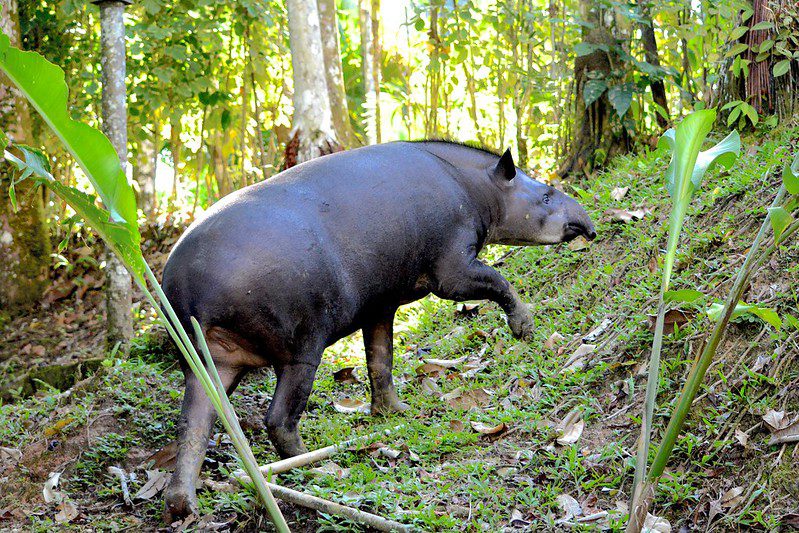
Deep within the lush Amazon rainforest, where ancient trees tower above winding rivers and extraordinary wildlife thrives, lives one of South America’s most remarkable mammals: the tapir. With its stocky body, short legs, distinctive flexible snout, and impressive swimming abilities, this unusual animal is an essential part of the tropical rainforest ecosystem.
The tapir, particularly the lowland tapir (Tapirus terrestris), inhabits extensive areas of the Amazon basin, including the Peruvian rainforest. It can be found in diverse environments, from dense tropical forests and flooded woodlands to wetlands and riverbanks. Although it is generally shy and difficult to observe, this fascinating mammal plays a significant role in maintaining the health and biodiversity of its natural habitat.
Beyond its unusual appearance, the tapir has an important ecological function. As a herbivore that consumes fruits, leaves, and other vegetation, it helps disperse seeds throughout the forest. This natural process supports plant regeneration and contributes to the continued survival of countless rainforest species.
Unfortunately, tapirs face growing threats from deforestation, habitat fragmentation, hunting, and human activities. Protecting these animals is therefore essential for preserving the extraordinary biodiversity of the Amazon rainforest.
Table of Contents
In this comprehensive guide, discover everything you need to know about tapirs, including their physical characteristics, habitat, diet, behavior, reproduction, ecological importance, and conservation. You will also learn where to find tapirs in Peru and how responsible wildlife tourism can contribute to protecting these remarkable Amazonian mammals.
1. What Is a Tapir? Understanding This Unique Rainforest Mammal
A tapir is a large, herbivorous mammal belonging to the Tapiridae family. It is recognized by its rounded body, short legs, thick skin, and distinctive elongated snout, which resembles a small trunk.
Although tapirs may look unusual, they are closely related to horses and rhinoceroses. All three belong to the Perissodactyla order, a group of mammals characterized by an odd number of toes on their weight-bearing feet.
Tapirs are among the most distinctive mammals inhabiting tropical forests. Their physical adaptations allow them to move through dense vegetation, search for food, and navigate rivers and wetlands.
The lowland tapir is particularly important in South America because it occupies extensive rainforest habitats and contributes to the natural regeneration of tropical vegetation.
Scientific Classification and Evolution of Tapirs
Tapirs belong to an ancient evolutionary lineage that has existed for millions of years. Their ancestors appeared long before many modern mammals developed their current characteristics.
Their evolutionary history makes them particularly interesting to scientists studying mammalian biodiversity and the development of tropical forest ecosystems.
Tapiridae Family and Perissodactyla Order
The scientific classification of the lowland tapir is:
- Kingdom: Animalia
- Phylum: Chordata
- Class: Mammalia
- Order: Perissodactyla
- Family: Tapiridae
- Genus: Tapirus
- Species: Tapirus terrestris
The Perissodactyla order also includes horses, zebras, and rhinoceroses. Despite their different appearances, these animals share important anatomical characteristics, particularly their hoof structures.
Evolutionary History of Tapirs
Tapirs have an evolutionary history extending tens of millions of years. Their ancestors were distributed across several continents, and ancient tapir relatives occupied environments that differed considerably from the tropical rainforests they inhabit today.
Modern tapirs have retained several primitive anatomical characteristics, making them valuable animals for understanding mammalian evolution.
Physical Characteristics of a Tapir
A tapir has a distinctive appearance that makes it relatively easy to recognize. Its body is heavy and rounded, while its legs are short but strong enough to support movement through challenging forest terrain.
Adult lowland tapirs generally measure approximately 1.7–2.5 meters in body length and can weigh between 150 and 250 kilograms, although individuals vary considerably.
Prehensile Snout and Distinctive Nose
One of the most recognizable features of a tapir is its flexible snout.
This short trunk combines the nose and upper lip, allowing the animal to grasp leaves, reach fruits, and investigate its surroundings. It is especially useful when searching for food among dense vegetation.
Tapirs also possess an excellent sense of smell, which helps them locate food and detect potential dangers.
Body Size, Thick Skin, and Hooves
The tapir’s strong body and thick skin provide protection while moving through vegetation.
Its feet have different toe arrangements. The front feet generally have four toes, while the hind feet have three. These structures help distribute its weight across muddy and uneven surfaces.
Swimming Abilities and Physical Adaptations
Despite their large size, tapirs are excellent swimmers.
They frequently enter rivers, streams, and ponds to cool themselves, escape predators, and search for aquatic vegetation. Their ability to move comfortably through water is particularly useful in the Amazon, where rivers and wetlands form an important part of the landscape.
2. Different Types of Tapirs Around the World
There are four living species of tapirs, each with distinctive physical characteristics and geographical distributions. Although they share several biological features, their habitats, appearance, and conservation challenges differ.
Understanding these species helps explain the diversity of the Tapiridae family and the importance of protecting their remaining natural habitats.
Brazilian Tapir (Lowland Tapir)
The Brazilian tapir, also known as the lowland tapir, is the largest native terrestrial mammal in much of the Amazon rainforest.
Its scientific name is Tapirus terrestris. This species is distributed across several South American countries, including Peru, Brazil, Bolivia, Colombia, Ecuador, and Venezuela.
The lowland tapir typically has dark brown or grayish-brown fur, a rounded body, and a flexible snout. Its relatively small ears have distinctive pale edges.
Distribution in the Amazon Rainforest
Lowland tapirs inhabit tropical rainforests, flooded forests, wetlands, and areas near freshwater sources.
In Peru, they occur in extensive forest ecosystems, particularly in the Amazonian lowlands. Their distribution depends on suitable vegetation, available food, water, and sufficient forest cover.
Mountain Tapir
The mountain tapir is adapted to cooler environments at higher elevations in the Andes.
Unlike the lowland species, it has a thicker, woolly coat that provides insulation against colder temperatures.
Andean Cloud Forest Habitat
Mountain tapirs inhabit high-altitude forests and páramo ecosystems in parts of the northern Andes.
These environments are characterized by cool temperatures, frequent mist, high humidity, and specialized vegetation.
Adaptations to High Altitudes
Their thick fur helps them survive in colder mountain environments. Their feeding habits also reflect the availability of vegetation in these high-elevation habitats.
Baird’s Tapir
Baird’s tapir is native to Central America and parts of southern Mexico and northwestern South America.
It has a dark-colored body, a distinctive pale marking around the cheeks and throat, and a flexible snout used for gathering vegetation.
Central American Distribution
This species inhabits tropical rainforests, wetlands, and other forested environments.
Its survival depends on maintaining large, connected natural habitats.
Habitat and Conservation Challenges
Deforestation, hunting, agricultural expansion, and infrastructure development have reduced suitable habitats in several parts of its distribution.
Malayan Tapir
The Malayan tapir is the only living tapir species native to Asia.
Its most distinctive characteristic is its black-and-white body pattern. The front half is generally black, while the rear section is white, creating a striking appearance.
Distinctive Black-and-White Coat
This coloration helps the animal blend into the changing light and shadows of dense tropical forests.
Southeast Asian Rainforest Habitat
Malayan tapirs inhabit forest ecosystems in parts of Southeast Asia. Their conservation is closely connected to the protection of tropical forests and the prevention of habitat fragmentation.
3. Where Do Tapirs Live? Exploring Their Amazon Rainforest Habitat
The tapir is strongly associated with tropical forest ecosystems, particularly those containing abundant vegetation, freshwater sources, and suitable areas for resting and feeding.
The Amazon rainforest provides an ideal environment for lowland tapirs because it contains an extraordinary variety of plants, fruits, and aquatic habitats.
These animals are generally associated with areas where dense vegetation offers shelter and natural food resources throughout the year.
Tapir Habitat in the Peruvian Amazon
Peru contains extensive tropical rainforest environments that support diverse populations of mammals, birds, reptiles, amphibians, and insects.
The Amazonian lowlands provide particularly important habitats for lowland tapirs.
Lowland Tropical Rainforests
Lowland rainforests contain tall trees, thick understory vegetation, climbing plants, and abundant fruit-producing species.
Tapirs move through these environments using established pathways and natural openings in the vegetation.
Their relatively quiet movements and dark coloration help them remain difficult to detect, even in areas with abundant wildlife.
Flooded Forests, Swamps, and Riverbanks
Water plays an important role in tapir ecology.
Seasonally flooded forests, swamps, and riverbanks provide access to aquatic plants and other food resources. These environments also offer opportunities for swimming, cooling down, and escaping potential threats.
During periods of seasonal flooding, tapirs may move between different forest areas as water levels change.
Where to Find Tapirs in Peru
The Peruvian Amazon contains several important natural landscapes where lowland tapirs occur.
Tambopata National Reserve
Located in the Madre de Dios region, Tambopata is known for its extraordinary rainforest biodiversity.
Its tropical forests, rivers, wetlands, and extensive vegetation create suitable habitats for numerous mammal species, including lowland tapirs.
Tapirs are naturally elusive, so seeing one during a wildlife excursion is never guaranteed. However, forest trails, river margins, and areas with signs of animal activity can provide opportunities to learn about their presence.
Manu National Park
Manu contains extensive tropical rainforest ecosystems and an exceptional diversity of wildlife.
Its lowland forests provide suitable conditions for tapirs, including abundant vegetation, freshwater habitats, and large areas of relatively undisturbed forest.
The region is particularly important for understanding the ecological relationships between large mammals, vegetation, and tropical forest regeneration.
Madre de Dios and the Amazon Basin
Madre de Dios is one of Peru’s most important regions for rainforest biodiversity.
Its extensive forests, rivers, and wetlands support numerous mammals and other wildlife species.
Maintaining forest connectivity across the Amazon basin is essential because tapirs require suitable areas for feeding, resting, and moving between habitats.
Environmental Conditions Tapirs Need to Survive
Although tapirs are adaptable animals, they depend on certain environmental conditions.
Freshwater Sources and Dense Vegetation
Access to rivers, streams, ponds, and wetlands is important for their daily activities.
Dense vegetation provides shelter, while freshwater habitats help regulate body temperature and support feeding behavior.
Forest Cover and Natural Food Resources
Healthy forests provide a continuous supply of fruits, leaves, shoots, and other plant materials.
Large, connected habitats are particularly important because they allow tapirs to move naturally without encountering excessive human disturbance.
4. What Do Tapirs Eat? Understanding Their Diet and Feeding Habits
Tapirs are herbivores that consume a wide variety of plant materials. Their diet includes fruits, leaves, young shoots, seeds, and aquatic vegetation.
As opportunistic feeders, they take advantage of available food resources depending on seasonal conditions and the characteristics of their habitat.
Their feeding habits make them important participants in tropical forest ecosystems.
Tapir Diet in the Wild
The lowland tapir consumes different types of vegetation found throughout the Amazon rainforest.
Rather than depending on one particular plant species, it has a varied diet that changes according to food availability.
Fallen Fruits and Tropical Seeds
Fruits represent an important component of the tapir’s diet.
When tropical trees produce ripe fruits, tapirs forage beneath their canopies and consume fallen fruit from the forest floor.
They also swallow seeds, which may later be deposited in different locations through their droppings.
This feeding process contributes to natural seed dispersal and supports the regeneration of rainforest vegetation.
Leaves, Young Shoots, and Forest Vegetation
Tapirs also consume leaves, tender shoots, buds, and other plant materials.
Their flexible snouts help them select vegetation from different heights and positions.
This feeding behavior allows them to use a wide range of forest resources throughout the year.
Aquatic Plants and Other Food Sources
In wetlands and flooded forests, tapirs may feed on aquatic plants and vegetation growing close to water.
These food sources are especially useful when other plants or fruits are less available.
How Tapirs Find and Consume Food
Tapirs use their senses and physical adaptations to locate and collect food.
Using Their Flexible Snout for Foraging
Their elongated snout is highly mobile and can grasp leaves, pull vegetation, and collect fallen fruits.
This specialized structure makes feeding easier in environments where dense vegetation can limit access to food.
Feeding Patterns and Seasonal Food Availability
Food availability changes throughout the year in tropical forests.
Fruit production, rainfall, and seasonal flooding influence where tapirs forage and which plants become more important in their diet.
Their ability to consume different types of vegetation helps them adapt to changing environmental conditions.
Tapirs as Frugivores and Herbivores
Although tapirs are primarily herbivorous mammals, their consumption of fruits gives them an important ecological role as frugivores.
Their Role in Seed Dispersal
When tapirs eat fruits, they may swallow seeds that pass through their digestive systems.
These seeds can later be deposited in their droppings, sometimes far from the original parent plant.
Depending on the plant species and environmental conditions, some dispersed seeds can germinate and develop into new plants.
How Feeding Habits Support Forest Regeneration
By transporting seeds across the rainforest, tapirs contribute to plant distribution and forest regeneration.
This process helps maintain vegetation diversity and supports the ecological relationships between plants and animals.
Their contribution is particularly valuable for large-seeded plants that benefit from being transported away from parent trees.
5. Tapir Behavior: How These Amazonian Mammals Live
Tapirs have several fascinating behavioral adaptations that help them survive in dense tropical forests.
They are generally solitary animals, although individuals may occasionally encounter one another near food sources or during reproduction.
Their activities are influenced by temperature, food availability, environmental conditions, and the presence of potential predators.
Nocturnal and Crepuscular Activity
Lowland tapirs are often more active during the night and around dawn and dusk.
These activity patterns help them avoid the hottest periods of the day and reduce exposure to human disturbance in some environments.
Why Tapirs Are More Active at Night
Moving during cooler hours helps tapirs conserve energy and avoid excessive heat.
Their excellent sense of smell and hearing helps them navigate through vegetation when visibility is limited.
Daytime Resting and Hiding Habits
During the day, tapirs may rest in shaded areas with dense vegetation.
They often choose locations near water or within protected forest sections where they can remain relatively undisturbed.
Solitary Lifestyle and Social Interactions
Tapirs generally live alone rather than in permanent social groups.
Adult individuals may maintain overlapping home ranges, but they usually spend much of their time independently searching for food.
Territorial Behavior and Communication
Tapirs use scent marking and other forms of communication to interact indirectly with other individuals.
They may deposit scent signals along frequently used pathways or near particular locations.
These signals provide information about the presence of other tapirs in the surrounding habitat.
Scent Marking and Vocalizations
Tapirs communicate through several sounds, including whistles, squeaks, and other vocalizations.
They may also use scent signals to communicate reproductive information and establish awareness of other individuals.
Swimming, Mud Bathing, and Other Natural Behaviors
Water is essential to many aspects of tapir behavior.
These mammals frequently use rivers, ponds, and muddy areas for activities that support their physical condition and survival.
Why Tapirs Enjoy Water
Tapirs are strong swimmers and can move through water with surprising ease.
Swimming helps them cool down, cross waterways, and sometimes escape predators.
They may also submerge their bodies while keeping their snouts above the water to breathe.
Using Mud to Protect Their Skin
Mud bathing is another characteristic behavior.
Rolling in mud can help remove parasites, protect sensitive skin, and provide relief from heat.
Mud-covered areas also offer opportunities to observe signs of wildlife activity, even when the animals themselves remain hidden.
Tapir Reproduction and Life Cycle
Tapirs have relatively slow reproductive rates, making population recovery difficult when their numbers decline.
Female tapirs generally give birth to one offspring after a long pregnancy.
Mating and Gestation Period
The gestation period of a tapir is approximately 13 months.
After mating, the female searches for a suitable location where she can give birth and care for her offspring.
The long gestation period means that successful reproduction depends on stable habitat conditions and sufficient food resources.
Tapir Calves and Their Striped-and-Spotted Coat
Newborn tapirs have a distinctive coat covered with white spots and stripes.
This pattern provides camouflage among the changing light and shadows of the rainforest floor.
As the young animal grows, these markings gradually disappear and its coat becomes more similar to that of an adult.
Maternal Care and Juvenile Development
The mother provides essential protection, nourishment, and guidance during the early stages of development.
Young tapirs remain close to their mothers while learning to recognize food sources, avoid dangers, and navigate their surroundings.
This period is especially important because young animals are more vulnerable to predators and environmental threats.
6. Why Are Tapirs Important to the Amazon Rainforest Ecosystem?
The tapir is much more than an unusual-looking rainforest mammal. It plays an important ecological role in maintaining tropical forest biodiversity.
Through its feeding habits, movements, and interactions with vegetation, it contributes to several natural processes that help sustain healthy rainforest ecosystems.
One of its most important contributions is seed dispersal.
Tapirs as Seed Dispersers
Tapirs consume fruits from numerous tropical plant species and transport seeds through their digestive systems.
This natural process helps distribute plant seeds across different parts of the forest.
How Seeds Travel Through the Rainforest
When a tapir eats fruit, it may swallow the seeds along with the edible pulp.
Some seeds pass through its digestive system and are deposited in droppings elsewhere in the forest.
Because tapirs can travel considerable distances while searching for food, they help transport seeds beyond the immediate area where the original fruit was consumed.
This movement creates opportunities for plants to colonize new areas.
Supporting Tropical Forest Regeneration
Seed dispersal is essential for maintaining the diversity and structure of tropical forests.
When seeds reach suitable environments, they may germinate and develop into seedlings.
Over time, these seedlings can contribute to forest regeneration and the replacement of older vegetation.
Tapirs therefore help maintain natural plant communities and support the long-term ecological health of the Amazon rainforest.
Their Contribution to Amazon Biodiversity
The presence of large herbivores influences how tropical forests function.
By consuming different plant materials and transporting seeds, tapirs participate in ecological processes that connect vegetation and wildlife.
Maintaining Ecological Balance
Tapirs help distribute plant species and influence the availability of vegetation throughout their habitats.
Their feeding activities are part of a complex ecological system involving insects, birds, reptiles, and other mammals.
Although they do not control the entire rainforest ecosystem, their contribution supports the natural relationships that maintain biodiversity.
Supporting Healthy Wildlife Habitats
Healthy forests provide food, shelter, and breeding environments for countless wildlife species.
Through seed dispersal and other ecological interactions, tapirs contribute to the maintenance of vegetation that supports these habitats.
Protecting tapirs therefore also means protecting the broader ecological processes that sustain Amazonian wildlife.
Tapirs as Indicators of Forest Health
The presence of tapirs can provide useful information about the condition of natural habitats.
Because they require access to vegetation, water, and sufficiently extensive forest areas, their populations may be affected by environmental degradation.
What Their Presence Tells Us About Ecosystem Conditions
Observing tapirs or detecting their tracks, droppings, and other signs can help researchers understand wildlife distribution.
Monitoring their populations can also provide information about habitat quality and the effects of human activities.
However, the presence of tapirs alone does not guarantee that an ecosystem is healthy. Conservation assessments must consider multiple species and environmental indicators.
7. Are Tapirs Endangered? Conservation Status and Threats
Despite their importance to tropical ecosystems, tapirs face serious conservation challenges.
Habitat destruction, hunting, road development, and human activities have contributed to population declines across different parts of their geographical distribution.
The lowland tapir is classified as Vulnerable to extinction, while other tapir species face different levels of conservation risk.
Protecting these animals requires coordinated efforts to preserve natural habitats, reduce hunting pressure, and maintain connected forest ecosystems.
Tapir Conservation Status
Understanding the conservation status of tapirs helps identify which populations need the greatest protection.
The four living species have different geographical distributions and face different environmental pressures.
IUCN Red List Classification
The conservation categories of the four living tapir species are:
- Lowland tapir: Vulnerable.
- Mountain tapir: Endangered.
- Baird’s tapir: Endangered.
- Malayan tapir: Endangered.
These classifications reflect the different levels of extinction risk faced by each species.
Conservation assessments are periodically reviewed as new population information becomes available.
Conservation Status of Different Tapir Species
The lowland tapir remains distributed across large areas of South America, but its populations are affected by habitat loss and hunting.
Mountain tapirs face significant pressure from the destruction and fragmentation of high-altitude forests.
Baird’s tapirs are threatened by habitat conversion and hunting across parts of Central America.
Malayan tapirs face increasing challenges from forest fragmentation, infrastructure development, and human-wildlife conflict.
Major Threats Facing Tapirs in the Wild
Several human activities threaten tapir survival and the ecological conditions they depend on.
Deforestation and Habitat Fragmentation
Deforestation is one of the most serious threats facing tapirs.
Agricultural expansion, logging, mining, and infrastructure projects can destroy large areas of natural vegetation.
When forests become fragmented, tapirs may lose access to feeding grounds, freshwater sources, and safe movement routes.
Small, isolated populations are also more vulnerable to local extinction.
Poaching and Illegal Wildlife Hunting
Tapirs are hunted in some areas for their meat and other body parts.
Although hunting pressure varies geographically, excessive hunting can reduce local populations and interfere with natural reproduction.
Because tapirs reproduce slowly, populations may take considerable time to recover after significant declines.
Road Mortality and Human-Wildlife Conflict
Road construction creates additional risks for tapirs.
Animals attempting to cross roads may be struck by vehicles, particularly where highways pass through forest habitats.
Human settlements and agricultural activities can also increase encounters between people and tapirs.
These interactions may result in injuries, habitat displacement, or retaliatory hunting.
Conservation Challenges in the Peruvian Amazon
The Peruvian Amazon contains extensive wildlife habitats, but several environmental pressures threaten its ecological integrity.
Protecting lowland tapirs requires addressing these challenges while maintaining the natural processes that support rainforest biodiversity.
Protecting Tapir Habitat in Madre de Dios
Madre de Dios contains important tropical forest ecosystems and significant wildlife populations.
Maintaining large areas of connected forest is essential for tapirs because these animals need suitable habitats for feeding, reproduction, and movement.
Conservation efforts should prioritize protecting wetlands, riverbanks, forest corridors, and areas with abundant natural vegetation.
Wildlife Conservation in Tambopata and Manu
Tambopata and Manu are important landscapes for wildlife conservation in Peru.
Their extensive forest environments provide suitable conditions for numerous mammal species, including lowland tapirs.
Protecting these areas requires habitat monitoring, responsible land management, environmental education, and measures to reduce illegal hunting and destructive activities.
8. Where Can You See Tapirs in Peru? Wildlife Watching in the Amazon
Peru is one of the most interesting destinations for travelers hoping to discover the wildlife of the Amazon rainforest.
Its extensive tropical forests support a remarkable variety of mammals, birds, reptiles, and amphibians.
Although tapirs are difficult to observe because of their solitary and often nocturnal behavior, certain protected forest landscapes provide opportunities to learn about these fascinating animals.
Wildlife Watching in Tambopata National Reserve
Tambopata is one of the most biodiverse rainforest destinations in southeastern Peru.
Its forests contain numerous wildlife habitats, including riverbanks, wetlands, flooded forests, and areas of dense tropical vegetation.
These environments provide suitable conditions for lowland tapirs.
Rainforest Trails and Natural Habitats
Exploring rainforest trails with an experienced naturalist can help visitors understand where tapirs live and how they interact with their environment.
Guides may identify tracks, feeding signs, droppings, and other evidence of animal activity.
These observations are particularly valuable because tapirs often remain hidden during daylight hours.
Best Opportunities for Wildlife Observation
Tapirs are generally more active during nighttime and cooler periods.
Wildlife observation opportunities may therefore be better around dawn, dusk, or during permitted nighttime excursions.
However, their presence is unpredictable, and no responsible wildlife operator should guarantee a sighting.
Exploring Manu National Park
Manu is another important destination for experiencing the biodiversity of the Peruvian Amazon.
Its extensive forest environments support a remarkable variety of wildlife and ecological communities.
Amazonian Mammals and Biodiversity
The park’s tropical forests provide habitats for many mammals, including large herbivores, primates, carnivores, and smaller forest-dwelling species.
Lowland tapirs are part of this complex ecological community.
Their presence demonstrates the importance of preserving extensive natural landscapes where wildlife can move and feed without excessive disturbance.
Responsible Wildlife Observation
Visitors should observe wildlife quietly and maintain an appropriate distance.
Avoid feeding animals, approaching them too closely, or attempting to attract them using artificial sounds or food.
Responsible observation protects both wildlife and visitors while preserving natural animal behavior.
Tips for Spotting Tapirs in the Wild
Seeing a tapir requires patience, awareness, and an understanding of its natural behavior.
Best Times for Wildlife Watching
Early morning and late afternoon can offer useful opportunities to observe wildlife.
Some tapirs may also become active at night, particularly in areas where temperatures are cooler and human disturbance is limited.
Photography and Observation Techniques
Wildlife photographers should use appropriate equipment that allows them to photograph animals without approaching too closely.
Long lenses, quiet movements, and patience are more effective than attempting to chase or surround an animal.
Avoid using flash when it could disturb wildlife.
Respecting Wildlife and Maintaining Distance
Tapirs are wild mammals and should never be treated as domesticated animals.
Although they generally avoid human contact, they are powerful animals and may react defensively if threatened.
Always follow local conservation rules and the guidance of qualified naturalist guides.
9. How Can We Protect Tapirs and Their Rainforest Habitat?
Protecting tapirs requires more than preserving individual animals. It involves maintaining the ecological conditions that allow entire rainforest ecosystems to function.
Healthy forests provide food, water, shelter, and natural movement corridors.
Conservation initiatives that protect these environments benefit tapirs and countless other species.
Protecting Amazon Rainforest Ecosystems
The long-term survival of tapirs depends on maintaining large, connected natural habitats.
Preventing Deforestation
Reducing forest destruction is essential for protecting tapir populations.
Sustainable land management, responsible resource use, and the protection of natural forest areas can help limit habitat loss.
Preventing illegal logging and destructive land conversion is particularly important in regions where wildlife populations are already under pressure.
Preserving Wildlife Corridors
Wildlife corridors connect separate forest areas and allow animals to move between habitats.
These connections help tapirs find food, water, and potential mates.
Maintaining forest corridors also reduces the isolation of wildlife populations and supports genetic diversity.
Sustainable Tourism and Wildlife Conservation
Responsible tourism can contribute to rainforest conservation by creating economic incentives for protecting natural habitats.
When tourism activities are carefully managed, they can support local employment, environmental education, and wildlife monitoring.
Responsible Amazon Wildlife Tours
Wildlife excursions should prioritize animal welfare and environmental protection.
Visitors should choose experiences that follow established conservation guidelines and avoid activities that disturb natural animal behavior.
Responsible tourism can help demonstrate the economic and ecological value of preserving healthy rainforest landscapes.
Supporting Local Conservation Initiatives
Local communities play an important role in protecting Amazonian ecosystems.
Their traditional knowledge and experience can contribute to understanding wildlife behavior, monitoring environmental changes, and maintaining sustainable natural resource practices.
Supporting community-led conservation initiatives can strengthen long-term protection efforts.
How Travelers Can Help Protect Tapirs
Visitors to the Peruvian Amazon can contribute to conservation through responsible travel decisions.
Choosing Sustainable Eco-Lodges
Choosing accommodation that respects natural habitats can help support sustainable tourism.
Look for responsible waste management, reduced environmental disturbance, appropriate water use, and meaningful community involvement.
Supporting Conservation Organizations
Travelers can support conservation through responsible donations, educational activities, and participation in legitimate wildlife protection initiatives.
Before contributing, it is important to understand how conservation projects operate and how resources are used.
Practicing Responsible Wildlife Photography
Photographers should never disturb animals to obtain better images.
Maintaining distance, avoiding artificial feeding, and respecting wildlife viewing regulations help protect natural animal behavior.
A photograph should never come at the expense of an animal’s safety.
10. Interesting Facts About Tapirs You Probably Didn’t Know
Tapirs are among the most fascinating mammals of the tropical rainforest. Their unusual appearance, specialized feeding adaptations, and ecological importance make them particularly interesting animals to study.
Here are some remarkable facts about these rainforest inhabitants.
Fascinating Facts About Their Physical Abilities
- Tapirs have flexible snouts that function like short trunks.
- They have an excellent sense of smell.
- They are powerful swimmers despite their heavy bodies.
- Their strong legs help them move through muddy and uneven forest terrain.
- Their thick skin provides some protection against branches and vegetation.
Their Surprising Relationship With Water
Tapirs frequently use rivers, ponds, and wetlands.
They can swim across waterways, submerge much of their bodies, and use water as a refuge from heat and potential predators.
Their close relationship with aquatic environments makes wetlands and riverine forests important parts of their natural habitat.
How Tapirs Help Plant New Rainforest Trees
One of the most important facts about tapirs is their contribution to seed dispersal.
By eating tropical fruits and depositing seeds in different locations, they help distribute plant species throughout the forest.
This natural process supports vegetation regeneration and helps maintain rainforest biodiversity.
Why Tapir Calves Have Striped and Spotted Coats
Young tapirs have a distinctive pattern of white stripes and spots across their bodies.
This coloration provides camouflage against the forest floor, where patches of sunlight and shadows create complex visual patterns.
As the calf matures, the markings gradually disappear.
Their Ancient Evolutionary History
Tapirs belong to an ancient group of mammals with an evolutionary history extending millions of years.
Their closest living relatives include horses and rhinoceroses, despite the considerable differences in their physical appearance.
This evolutionary connection makes tapirs particularly interesting from a scientific perspective.
11. Frequently Asked Questions About Tapirs
What Is a Tapir?
A tapir is a large herbivorous mammal belonging to the Tapiridae family. It has a rounded body, short legs, thick skin, and a flexible snout. Tapirs inhabit tropical forests, wetlands, and other natural environments in South America, Central America, and Southeast Asia.
Where Do Tapirs Live?
Tapirs inhabit tropical rainforests, wetlands, flooded forests, and other areas with abundant vegetation and freshwater. The lowland tapir lives throughout parts of South America, including the Peruvian Amazon, where it occurs in regions such as Madre de Dios.
What Do Tapirs Eat?
Tapirs are herbivores that eat fruits, leaves, seeds, young shoots, and aquatic vegetation. Their flexible snouts help them collect food from the forest floor and surrounding vegetation. Their fruit-eating habits also make them important seed dispersers.
Are Tapirs Dangerous to Humans?
Tapirs are generally shy and prefer to avoid people. However, they are powerful wild animals and may defend themselves if threatened, cornered, or approached too closely. Visitors should always maintain a safe distance and avoid disturbing them.
Are Tapirs Endangered?
The conservation status varies among tapir species. The lowland tapir is classified as Vulnerable, while the mountain tapir, Baird’s tapir, and Malayan tapir are classified as Endangered. Major threats include deforestation, habitat fragmentation, hunting, and human-wildlife conflict.
How Big Can a Tapir Grow?
Adult lowland tapirs generally measure approximately 1.7–2.5 meters in body length and weigh between 150 and 250 kilograms. Their size varies depending on age, sex, and individual characteristics.
Can Tapirs Swim?
Yes. Tapirs are excellent swimmers and frequently enter rivers, streams, and ponds. Swimming helps them cool down, cross waterways, search for aquatic vegetation, and sometimes escape predators.
Where Can You See Tapirs in Peru?
Lowland tapirs inhabit several areas of the Peruvian Amazon, including the forests of Madre de Dios, Tambopata, and Manu. However, they are elusive animals, and sightings are never guaranteed during wildlife excursions.
Why Are Tapirs Important to the Rainforest?
Tapirs are important because they disperse seeds from the fruits they consume. This helps distribute plant species, supports forest regeneration, and contributes to tropical rainforest biodiversity.
How Do Tapirs Disperse Seeds?
Tapirs eat fruits and swallow their seeds. Some seeds pass through their digestive systems and are deposited in droppings in other locations. Under suitable environmental conditions, these seeds may germinate and develop into new plants.
Conclusion: Protecting the Tapir and the Future of the Amazon Rainforest
The tapir is one of the most extraordinary mammals of the Amazon rainforest. With its distinctive flexible snout, powerful swimming abilities, and fascinating feeding behavior, it represents an important part of South America’s natural heritage.
Beyond its unusual appearance, the lowland tapir plays an essential ecological role. By consuming fruits and dispersing seeds throughout the forest, it contributes to plant regeneration and supports the biodiversity of tropical ecosystems.
In Peru, the extensive forests of Tambopata, Manu, and Madre de Dios provide important habitats for these remarkable animals. Protecting these landscapes means preserving the natural conditions that allow tapirs and countless other wildlife species to survive.
However, deforestation, hunting, habitat fragmentation, and expanding human activities continue to threaten their future. Conservation efforts must therefore focus on protecting connected forests, maintaining freshwater habitats, reducing hunting pressure, and encouraging responsible tourism.
Every traveler, nature enthusiast, researcher, and conservation supporter can contribute to protecting the Amazon rainforest.
The next time you explore the Peruvian Amazon, remember that the forest is more than a collection of beautiful trees and fascinating animals. It is a complex living ecosystem in which every species has a role.
And the tapir, quietly moving through the vegetation and carrying seeds across the forest, is one of its most important natural gardeners.
Protecting the tapir means protecting the future of the Amazon rainforest.