
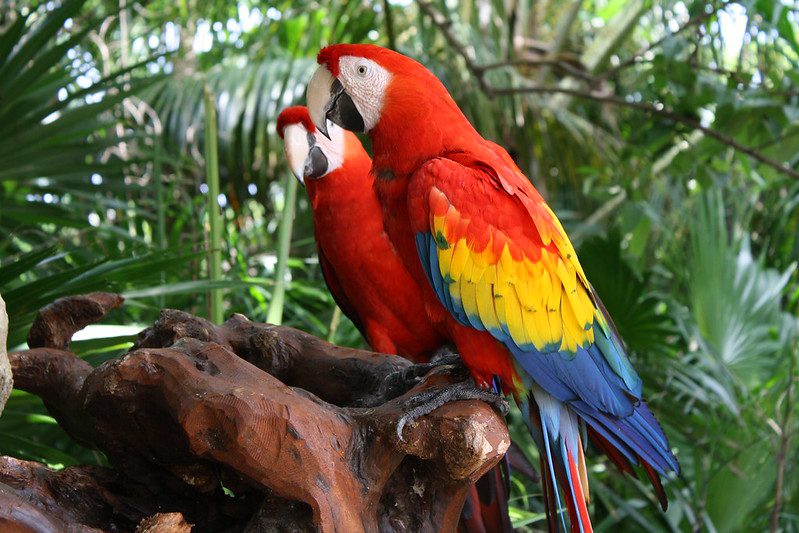
The macaw is one of the most spectacular birds found in the tropical forests of Central and South America. Famous for its brilliant plumage, powerful beak, impressive wingspan, and remarkable intelligence, this colorful parrot is among the most recognizable inhabitants of the Amazon rainforest. Macaws play an important role in tropical ecosystems, where they feed on fruits, seeds, nuts, and palm fruits while interacting with the surrounding vegetation and wildlife.
These fascinating birds belong to the parrot family and are especially known for their social behavior, loud vocalizations, strong pair bonds, and ability to fly across large areas of forest. Several species inhabit different environments, from humid lowland rainforests to tropical woodlands and savannas.
The Amazon rainforest provides some of the most important habitats for wild macaws. In southeastern Peru, particularly in the Madre de Dios region and Tambopata, visitors can observe spectacular gatherings of these birds at natural clay licks, where hundreds of colorful parrots sometimes congregate to consume mineral-rich soil.
Table of Contents
Understanding the macaw means exploring its physical adaptations, feeding habits, reproduction, social behavior, natural habitat, and conservation challenges. These birds are not only beautiful rainforest inhabitants but also an important part of the ecological balance of tropical forests.
What Is a Macaw?
A macaw is a large tropical parrot belonging to the family Psittacidae. These birds are recognized by their long tails, strong curved beaks, brightly colored feathers, and excellent climbing abilities. Most species inhabit tropical regions of Central and South America, although their geographical distribution varies considerably.
Macaws are highly intelligent birds with complex social relationships. They communicate through loud calls, maintain strong relationships with their partners, and use their powerful beaks and feet to manipulate food and climb branches.
Unlike many smaller parrots, macaws generally have large bodies and exceptionally long tails. Their colorful feathers can include combinations of red, blue, yellow, green, and turquoise, depending on the species.
Macaw Scientific Classification
Macaws belong to the animal kingdom and are classified as birds within the order Psittaciformes. They are members of the parrot family, which includes numerous species distributed across tropical and subtropical regions worldwide.
Their scientific classification is:
- Kingdom: Animalia
- Phylum: Chordata
- Class: Aves
- Order: Psittaciformes
- Family: Psittacidae
Macaws belong to several genera, including Ara, Anodorhynchus, and Primolius.
The genus Ara includes several well-known large macaws, such as the scarlet macaw, blue-and-yellow macaw, and red-and-green macaw.
What Makes Macaws Different from Other Parrots?
Macaws have several physical and behavioral characteristics that distinguish them from many other parrots.
Their large size is one of their most noticeable features. Some species can reach approximately one meter in total length, including their long tail feathers. Their strong, curved beaks allow them to break open extremely hard nuts and seeds that many other birds cannot access.
Another distinctive feature is their long, pointed tail, which helps maintain balance and stability during flight.
Macaws also have strong feet with two toes pointing forward and two pointing backward. This arrangement, known as zygodactyl feet, allows them to grip branches, climb tree trunks, and hold food while eating.
Their intelligence and social behavior are equally remarkable. Wild macaws frequently travel in pairs or small groups and use a wide range of vocalizations to communicate.
Interesting Macaw Facts
Macaws are fascinating birds with several unusual characteristics.
- Some macaw species can live for several decades in the wild.
- Their powerful beaks can crack extremely hard nuts.
- Many species form long-lasting pair bonds.
- Macaws use their feet to hold and manipulate food.
- Their colorful feathers help distinguish different species.
- They frequently communicate through loud calls and squawks.
- Some macaws gather in large numbers at natural clay licks.
- They can travel considerable distances while searching for food.
Different Types of Macaws and Their Characteristics
There are several species of macaws, each with distinctive physical characteristics, geographical distributions, and habitat preferences. Although they share many similarities, their size, feather colors, feeding habits, and conservation status can differ.
Scarlet Macaw
The scarlet macaw is one of the most recognizable tropical birds in the Americas. Its brilliant red body is complemented by yellow and blue feathers across its wings and a long red-and-blue tail.
This species inhabits tropical forests from Central America to parts of the Amazon Basin.
Scarlet macaws are commonly observed flying above the rainforest canopy in pairs or small groups. They feed on fruits, seeds, nuts, and other plant materials.
Their powerful beaks allow them to access food protected by hard shells. They also use their feet to hold food while breaking it apart.
Scarlet macaws are particularly important to wildlife tourism because their striking colors make them highly sought after by birdwatchers and nature photographers.
Blue-and-Yellow Macaw
The blue-and-yellow macaw is easily recognized by its brilliant blue upper body and golden-yellow chest and belly. Its green forehead, large black beak, and long tail create a distinctive appearance.
This species inhabits tropical forests, riverine environments, and wooded areas across parts of South America.
Blue-and-yellow macaws are social birds that often travel in pairs. They feed on fruits, nuts, seeds, and palm fruits.
Their strong beaks are particularly useful for opening hard-shelled foods, while their powerful feet help them climb and manipulate branches.
Red-and-Green Macaw
The red-and-green macaw is a large parrot with predominantly red plumage, green wing feathers, and blue flight feathers.
It is commonly associated with humid tropical forests in South America, including parts of the Amazon rainforest.
This species is sometimes confused with the scarlet macaw because both have extensive red plumage. However, the green wing coloration helps distinguish the red-and-green macaw.
These birds feed on fruits, nuts, seeds, and other plant materials. They frequently travel in pairs and use loud vocalizations to communicate across the forest.
Hyacinth Macaw
The hyacinth macaw is the largest flying parrot species in the world. It is famous for its deep cobalt-blue feathers, bright yellow skin around its eyes, and powerful black beak.
Unlike many Amazonian macaws, this species is strongly associated with palm-rich habitats, open woodlands, and wetlands in central South America.
Its diet consists largely of hard palm nuts, which require considerable beak strength to open.
The hyacinth macaw is particularly vulnerable to habitat changes and illegal wildlife trafficking. Conservation programs focus on protecting nesting sites, food sources, and natural habitats.
Military Macaw
The military macaw is predominantly green, with red markings on its forehead and blue feathers across its wings.
It inhabits tropical and subtropical forests, including mountainous forest environments in parts of Central and South America.
Military macaws often use natural tree cavities and cliff openings for nesting. They feed on fruits, seeds, and nuts and generally travel in pairs or small flocks.
Great Green Macaw
The great green macaw is a large parrot with mostly green feathers, a red forehead, and blue flight feathers.
It is associated with humid tropical forests, particularly areas containing large trees that provide nesting cavities and important food resources.
One of its most important food sources is the fruit of particular rainforest trees. Because of its specialized feeding requirements and dependence on suitable nesting trees, habitat destruction is a serious conservation concern.
Chestnut-Fronted Macaw
The chestnut-fronted macaw is a smaller species compared with many other large macaws.
It has predominantly green plumage, a chestnut-colored forehead, and distinctive red markings around its facial area.
This species occurs across parts of the Amazon Basin and inhabits tropical forests, forest edges, and wooded landscapes.
It feeds on fruits, seeds, nuts, and other available vegetation.
Where Do Macaws Live? Habitat and Geographic Distribution
Macaws inhabit tropical and subtropical environments across Central and South America. Their distribution includes extensive areas of rainforest, river valleys, seasonal forests, and tropical woodlands.
The Amazon Basin is one of the most important regions for macaw diversity because it provides abundant food, nesting opportunities, and suitable environmental conditions.
Macaw Natural Habitat
Macaws depend on healthy natural environments that provide sufficient food, nesting trees, and safe areas for reproduction.
Their preferred habitats vary according to species, but many are strongly associated with tropical forests.
Tropical Rainforests
Humid tropical rainforests provide an ideal environment for numerous macaw species.
These forests contain a great variety of fruit-bearing trees, palms, and other vegetation that support their feeding habits.
The upper forest canopy is particularly important because macaws spend considerable time flying between trees and searching for food.
Amazon Rainforest Canopy
The Amazon rainforest canopy is one of the most important environments for wild macaws.
Tall trees provide resting locations, feeding opportunities, and natural cavities for nesting.
Macaws often fly above the canopy in pairs or groups, producing loud calls that can be heard across considerable distances.
Tropical Woodlands and Savannas
Some species inhabit more open landscapes, including tropical woodlands and savanna environments.
These habitats may contain scattered trees, palm forests, and seasonal food sources.
The hyacinth macaw, for example, is closely associated with palm-rich environments.
Riverbanks and Flooded Forests
Riverbanks and seasonally flooded forests provide important feeding opportunities for many Amazonian birds.
Macaws frequently visit areas where fruit-bearing trees and palms grow near waterways.
These environments also create natural flight corridors that allow birds to move between feeding and nesting locations.
Macaws in the Amazon Rainforest
The Amazon rainforest supports several macaw species, making it one of the best places to observe these colorful parrots in their natural environment.
Macaws contribute to the incredible biodiversity of the region through their feeding habits, seed consumption, and interactions with rainforest vegetation.
They are commonly observed flying above rivers, visiting fruit-bearing trees, and gathering at exposed riverbanks.
Their loud calls are an important part of the natural soundscape of the rainforest.
Macaws in Peru
Peru contains extensive Amazonian forests that provide suitable habitats for several macaw species.
The southeastern region of the country is particularly important for wildlife observation.
Macaws in Madre de Dios
Madre de Dios is one of Peru’s most biodiverse regions. Its extensive tropical forests support numerous bird species, mammals, reptiles, amphibians, and other wildlife.
Scarlet macaws, blue-and-yellow macaws, and red-and-green macaws are among the spectacular parrots that can be observed in this region.
The combination of rivers, palm forests, and protected rainforest areas creates favorable conditions for their survival.
Macaws in Tambopata National Reserve
Tambopata is internationally recognized for its extraordinary wildlife diversity and spectacular macaw clay licks.
The reserve protects extensive areas of Amazonian rainforest, including important feeding and nesting habitats.
Visitors traveling through the region may encounter macaws flying above the river, feeding in fruit-bearing trees, or gathering at clay licks.
The area is especially attractive to birdwatchers and wildlife photographers because several macaw species can be observed in the same general region.
Macaw Physical Characteristics and Adaptations
Macaws possess several physical adaptations that allow them to survive in complex rainforest environments.
Their powerful beaks, strong feet, long tails, and specialized flight feathers are essential for finding food, climbing trees, and moving through the forest.
Macaw Size, Weight, and Wingspan
Macaw size varies significantly depending on the species.
Smaller species may measure approximately 30 centimeters in length, while some of the largest species can approach one meter, including their tail feathers.
Their wingspans also vary, with larger species possessing broad wings that allow them to travel efficiently between feeding areas.
Body size and weight influence their flight behavior, feeding requirements, and nesting preferences.
Colorful Macaw Feathers and Plumage
Macaws are famous for their brilliant plumage.
Their feathers may include red, blue, yellow, green, and turquoise colors.
These colors vary according to species and help observers identify different macaws in the wild.
Their facial areas are often characterized by bare skin with distinctive feather patterns, especially in some large species.
Powerful Beak and Feeding Adaptations
The macaw beak is one of its most important physical adaptations.
Its strong, curved structure allows the bird to break hard nuts, seeds, and fruits.
Macaws use the upper portion of their beak to apply considerable pressure when opening food sources protected by tough shells.
The beak also helps them climb, manipulate branches, and explore their surroundings.
Macaw Feet and Climbing Abilities
Macaws have two toes pointing forward and two pointing backward.
This arrangement allows them to grip branches securely while climbing and feeding.
Their feet are also capable of holding food, allowing them to manipulate fruits and nuts while using their beaks to remove shells.
Flight Adaptations
Macaws have strong wings and long flight feathers that allow them to move efficiently through open spaces above the rainforest.
They frequently travel between feeding locations, nesting trees, and resting areas.
Their long tails help provide stability and maneuverability during flight.
What Do Macaws Eat? Diet and Feeding Habits
Macaws are primarily plant-eating birds. Their natural diet consists of fruits, nuts, seeds, flowers, and other vegetation available in their habitats.
Their feeding habits vary according to species, location, and seasonal food availability.
Macaw Diet in the Wild
The Amazon rainforest provides an enormous variety of food sources for wild macaws.
Their diet commonly includes:
- Tropical fruits.
- Palm fruits.
- Hard-shelled nuts.
- Seeds.
- Berries.
- Flowers.
- Certain plant materials.
Macaws use their powerful beaks to access food that many smaller birds cannot easily consume.
Fruits and Berries
Fruits are an important component of the macaw diet.
They consume naturally available fruits from different rainforest trees and plants.
Seasonal fruit availability influences their feeding movements, sometimes encouraging them to travel considerable distances in search of food.
Nuts and Seeds
Macaws are particularly well adapted to eating hard nuts and seeds.
Their powerful beaks allow them to crack protective shells and access nutritious material inside.
This adaptation gives them access to food sources that are unavailable to many other rainforest birds.
Palm Fruits
Palm fruits are important food sources for several macaw species.
Different palms produce fruits and nuts with varying nutritional characteristics.
In some environments, particular palm species provide essential feeding resources throughout different seasons.
Why Do Macaws Visit Clay Licks?
One of the most fascinating feeding behaviors observed among Amazonian macaws is their regular visitation of natural clay licks.
Clay licks are exposed riverbanks or mineral-rich soil deposits where birds gather to consume small quantities of earth.
These locations are especially famous in southeastern Peru, where large groups of macaws sometimes gather in spectacular displays of color and sound.
Researchers believe that clay consumption may provide important minerals and help neutralize certain plant toxins present in their diet.
However, the exact nutritional and physiological benefits remain subjects of scientific research.
What Is Macaw Geophagy?
Geophagy is the behavior of consuming soil or clay.
Among Amazonian macaws, this behavior is frequently observed at natural clay deposits.
Birds typically arrive early in the morning, gather in nearby trees, and gradually descend toward exposed sections of the riverbank.
They consume small amounts of clay before flying away.
This behavior is especially interesting because it demonstrates how wild animals use natural environmental resources to complement their diets.
Macaw Behavior and Social Life
Macaws are highly social birds that depend on communication and cooperation to navigate their environment.
Their behavior includes flocking, pair bonding, feeding together, vocal communication, and coordinated movements between forest areas.
Macaw Social Behavior and Flocking
Many macaws spend considerable time in pairs or small groups.
Some species gather in larger flocks when feeding or visiting clay licks.
Social behavior provides opportunities for communication and may help individuals detect potential predators.
Why Macaws Fly in Pairs
Macaws are well known for flying in pairs.
These pairs frequently remain close together while traveling between feeding and resting locations.
Their strong social relationships help maintain coordination during daily activities.
Pair bonding is particularly noticeable during flight, when two birds may fly close together while producing calls.
Macaw Communication and Vocalizations
Macaws communicate using loud calls, squawks, and other vocal sounds.
Their calls can travel long distances through the rainforest, helping birds maintain contact when separated by dense vegetation.
Vocal communication is important for locating partners, coordinating group movements, and warning others about potential dangers.
Macaw Intelligence and Problem-Solving Abilities
Macaws possess well-developed cognitive abilities.
Their intelligence is reflected in their ability to manipulate objects, solve feeding challenges, and learn from their environment.
Their feet and beaks work together when handling food, while their social behavior demonstrates the importance of communication and learning.
Macaw Courtship and Pair Bonding
Many macaw species establish long-lasting relationships with their partners.
Courtship behaviors may include mutual preening, vocal communication, close physical contact, and coordinated movements.
These behaviors help strengthen social bonds before and during reproduction.
Daily Activities and Sleeping Habits
Macaws are generally active during daylight hours.
They spend much of the morning searching for food, visiting feeding areas, and interacting with other birds.
During the hottest parts of the day, they may rest in shaded trees.
At night, they usually return to suitable roosting locations, where they can remain relatively protected from predators.
Macaw Reproduction, Nesting, and Life Cycle
Macaw reproduction is closely connected to the availability of suitable nesting sites and sufficient food.
Most species depend on natural cavities in large trees for breeding.
Macaw Breeding Season
Breeding seasons vary depending on geographical location, environmental conditions, and species.
Rainfall patterns and food availability can influence the timing of reproduction.
During breeding periods, macaws establish or defend nesting locations and prepare suitable cavities for their eggs.
Where Do Macaws Build Their Nests?
Many macaws use natural cavities in mature trees.
These cavities provide protection from rain, strong sunlight, and some predators.
Suitable nesting trees are extremely important because large cavities may take many decades to develop naturally.
Some species also use cliff cavities or other natural openings.
Macaw Eggs and Incubation Period
Female macaws generally lay a small clutch of eggs.
The exact number varies by species, but many large macaws lay approximately two or three eggs.
Incubation usually lasts several weeks, with the female performing much of the incubation while the male provides food.
Macaw Chicks and Early Development
Macaw chicks hatch with limited physical development and depend entirely on their parents.
During the first weeks of life, they require regular feeding and protection.
Their feathers gradually develop, and they become stronger as they grow.
How Macaw Parents Raise Their Young
Adult macaws provide food and protection throughout the early stages of their offspring’s development.
Both parents may participate in caring for the chicks, although their specific roles can vary.
They bring food to the nest and protect their young from potential threats.
When Do Young Macaws Learn to Fly?
Young macaws eventually leave their nests after developing sufficient strength and feather growth.
This stage is known as fledging.
Even after leaving the nest, young birds may continue depending on their parents while developing their flying, feeding, and survival abilities.
Macaw Life Expectancy in the Wild
Macaw lifespan varies significantly by species.
Many large macaws can live for several decades, and some individuals may survive for 40 to 50 years or longer under favorable conditions.
Their longevity depends on food availability, habitat quality, predation, disease, and environmental pressures.
Macaws and the Amazon Rainforest Ecosystem
Macaws are important inhabitants of tropical forests.
Their feeding activities connect different plant species and contribute to the ecological relationships that maintain rainforest biodiversity.
Why Macaws Are Important to Rainforest Biodiversity
Macaws interact with numerous plants through their feeding habits.
By consuming fruits and seeds, they participate in natural processes that influence forest regeneration and plant distribution.
Their presence also reflects the availability of suitable feeding and nesting habitats.
Macaws and Seed Dispersal
Macaws consume seeds and fruits from many rainforest plants.
Some seeds may be carried away from the parent tree during feeding activities.
Depending on the species and feeding behavior, seeds may be transported to different locations, contributing to plant distribution.
However, macaws also destroy many seeds while feeding, so their ecological contribution includes both seed consumption and potential dispersal.
Their Relationship with Palm Trees
Palm trees provide important food resources for many macaws.
Their fruits and nuts can represent valuable sources of energy and nutrients.
The relationship between macaws and palm forests demonstrates the importance of maintaining healthy tropical vegetation.
Macaws as Part of the Amazon Food Chain
Although macaws are large and powerful birds, they remain part of the rainforest food chain.
Their eggs and chicks can be vulnerable to predators, including snakes and birds of prey.
Adult macaws may also face threats from large raptors.
These interactions form part of the complex ecological relationships found throughout tropical forests.
Macaw Clay Licks: One of the Amazon’s Most Spectacular Wildlife Events
Macaw clay licks are among the most extraordinary wildlife attractions in the Amazon rainforest.
These natural locations provide an opportunity to observe numerous parrots and macaws gathering together in their natural environment.
What Is a Macaw Clay Lick?
A clay lick is a natural area where birds and other animals consume mineral-rich soil.
In the Amazon, these locations frequently occur along riverbanks where erosion exposes suitable clay deposits.
Some clay licks attract a wide variety of parrots, including macaws, parakeets, and smaller species.
Why Do Macaws Eat Clay?
Scientists believe clay consumption may help macaws obtain minerals and reduce the effects of certain plant compounds.
Many rainforest fruits and seeds contain naturally occurring substances that can interfere with nutrient absorption or digestion.
Clay consumption may help counteract some of these effects.
Nevertheless, the precise reasons for geophagy are complex and may differ according to species and environmental conditions.
How Macaws Gather at Clay Licks
Macaws often approach clay licks in the early morning.
They may spend time in nearby trees before descending to exposed areas of the riverbank.
Large groups can gather at the same location, creating an impressive natural spectacle.
Their colorful plumage contrasts beautifully with the green rainforest vegetation and brown riverbank soil.
Best Time to Observe Macaws at Clay Licks
Early morning is generally the best time to observe macaws at many Amazonian clay licks.
Birds frequently begin arriving around sunrise, although their activity depends on weather conditions, disturbance, and seasonal patterns.
Rain, heavy cloud cover, and strong winds can affect their feeding behavior.
Visitors should remain quiet and maintain a respectful distance to avoid disturbing the birds.
Macaw Clay Licks in Tambopata, Peru
Tambopata, in southeastern Peru, is one of the most famous regions for observing macaws at natural clay licks.
Its extensive rainforest, rivers, and diverse wildlife populations create excellent conditions for birdwatching.
The region contains several natural clay deposits where different macaw species can be observed.
One of the best-known wildlife attractions is the Chuncho clay lick, where visitors may witness large gatherings of colorful parrots.
Why Chuncho Clay Lick Is Famous for Macaw Watching
The Chuncho clay lick is famous for its impressive concentrations of parrots and macaws.
Visitors may observe scarlet macaws, red-and-green macaws, blue-and-yellow macaws, and other parrot species.
The spectacle usually develops gradually as birds arrive from surrounding forest areas.
Watching these colorful birds descend toward the riverbank is an unforgettable experience for wildlife enthusiasts and photographers.
What Wildlife Can You See at a Macaw Clay Lick?
Although macaws are the main attraction, clay licks can attract several other species.
Depending on the location and season, visitors may observe:
- Scarlet macaws.
- Red-and-green macaws.
- Blue-and-yellow macaws.
- Mealy parrots.
- Blue-headed parrots.
- Smaller parakeets.
- Other tropical bird species.
The surrounding rainforest may also contain monkeys, toucans, raptors, and other wildlife.
Macaw Predators and Natural Threats
Macaws face several natural and environmental threats throughout their lives.
Although adult birds are relatively large and powerful, their eggs and chicks are especially vulnerable.
Natural Predators of Macaws
Potential predators include large birds of prey, snakes, and certain mammals that can access nesting sites.
Predation pressure varies depending on the species, habitat, and geographical region.
Harpy Eagles and Other Birds of Prey
Large forest raptors, including harpy eagles, are among the natural predators capable of hunting large parrots.
Their powerful talons and hunting abilities allow them to capture birds in forest environments.
However, predation is a natural ecological process and does not necessarily indicate a decline in macaw populations.
Predators of Macaw Eggs and Chicks
Nesting cavities protect young macaws from many environmental threats, but they are not completely secure.
Snakes and other climbing predators may access nests and consume eggs or chicks.
The availability of suitable nesting trees can therefore influence reproductive success.
How Macaws Protect Themselves
Macaws use several strategies to reduce the risk of predation.
Their strong flight abilities allow them to escape quickly, while loud calls can alert other birds to potential danger.
Their social behavior may also help individuals detect approaching predators.
Macaw Conservation and Endangered Species
Macaw conservation is an important issue because several species face significant threats from habitat destruction and human activities.
Although not all macaws are endangered, some populations have experienced considerable declines.
Protecting natural habitats is essential for maintaining healthy populations.
Are Macaws Endangered?
The conservation status of macaws varies according to species.
Some species maintain relatively stable populations, while others are threatened or endangered.
The great green macaw and blue-throated macaw, for example, face serious conservation challenges.
The hyacinth macaw has also experienced historical pressures from illegal wildlife trade and habitat destruction, although conservation initiatives have supported population recovery in certain regions.
Which Macaw Species Are Threatened?
Several macaw species require particular conservation attention.
Their vulnerability is influenced by geographical distribution, population size, reproductive success, and habitat availability.
Species with restricted ranges or specialized feeding requirements can be especially vulnerable to environmental changes.
Habitat Loss and Deforestation
Deforestation is one of the most serious threats to wild macaws.
The removal of mature trees reduces nesting opportunities and destroys important feeding habitats.
Agricultural expansion, logging, mining, and infrastructure development can fragment rainforest environments.
When forests become divided into smaller isolated areas, macaw populations may have difficulty finding sufficient food and suitable breeding locations.
Illegal Wildlife Trade and Poaching
Illegal capture and trafficking have historically affected several macaw species.
Their attractive colors and intelligence make them valuable in the illegal exotic bird trade.
Removing wild individuals from natural populations can reduce breeding opportunities and weaken already vulnerable populations.
Protecting nesting sites and enforcing wildlife protection laws are essential for preventing these activities.
Conservation Programs and Protected Areas
Protected areas play an important role in macaw conservation.
They preserve natural habitats, protect nesting trees, and provide important feeding environments.
Wildlife monitoring programs help researchers understand population trends and identify conservation priorities.
Environmental education also encourages local communities and visitors to participate in rainforest protection.
How Ecotourism Helps Protect Macaws
Responsible ecotourism can contribute to the protection of wild macaws by creating economic opportunities connected to healthy natural environments.
Wildlife observation encourages visitors to appreciate rainforest biodiversity and understand the importance of conservation.
When tourism activities are managed responsibly, they can support local employment, environmental education, and protected areas.
Where Can You See Macaws in the Wild?
Macaws can be observed in several tropical regions of Central and South America.
The best locations are generally areas with extensive natural forests, abundant food resources, and protected wildlife habitats.
Best Countries for Macaw Watching
Several countries offer opportunities to observe wild macaws.
These include Peru, Brazil, Bolivia, Ecuador, Colombia, and Costa Rica.
Each country contains different species and habitats, creating unique opportunities for birdwatching.
Macaw Watching in the Peruvian Amazon
The Peruvian Amazon is one of the most rewarding destinations for observing tropical parrots.
The Madre de Dios region is particularly important because of its extraordinary biodiversity and accessible wildlife observation areas.
Visitors traveling through the region may encounter macaws flying over rivers, feeding in rainforest trees, or gathering at natural clay licks.
Tambopata National Reserve
Tambopata is an exceptional destination for wildlife enthusiasts.
Its protected forests support numerous bird species and provide opportunities to observe macaws in their natural environment.
Wildlife excursions often combine boat transportation, rainforest exploration, birdwatching, and visits to clay licks.
The experience allows visitors to understand the relationship between macaws and the broader Amazon ecosystem.
Best Places and Seasons for Macaw Photography
Clay licks and rainforest riverbanks are among the best locations for macaw photography.
Early mornings frequently offer favorable observation opportunities because many birds become active around sunrise.
Clear weather and good natural lighting can improve photography conditions.
Visitors should use appropriate camera equipment and avoid approaching birds too closely.
Responsible Wildlife Watching in the Rainforest
Responsible wildlife observation is essential for protecting macaws.
Visitors should avoid feeding wild birds, disturbing nesting locations, or making loud noises near clay licks.
Following the instructions of experienced local guides helps minimize disturbance and improves wildlife observation opportunities.
Maintaining a respectful distance allows macaws to continue their natural activities without unnecessary stress.
Frequently Asked Questions About Macaws
1. What Is a Macaw?
A macaw is a large tropical parrot belonging to the family Psittacidae. It is recognized by its colorful feathers, powerful curved beak, long tail, and intelligence. Macaws inhabit tropical forests and other environments across Central and South America.
2. Where Do Macaws Live Naturally?
Macaws live primarily in tropical and subtropical regions of Central and South America. Their habitats include Amazonian rainforests, tropical woodlands, river valleys, and palm-rich environments.
3. What Do Macaws Eat in the Wild?
Wild macaws primarily eat fruits, nuts, seeds, palm fruits, berries, and flowers. Their strong beaks allow them to open hard-shelled foods that many other birds cannot consume.
4. How Long Do Macaws Live?
Macaw lifespan depends on the species and environmental conditions. Many large macaws can live for several decades, with some individuals surviving for 40 to 50 years or longer.
5. How Many Species of Macaws Exist?
There are approximately 19 recognized living macaw species, depending on the taxonomic classification used. They vary considerably in size, coloration, geographical distribution, and conservation status.
6. Why Are Macaws So Colorful?
Macaw feathers contain specialized pigments and microscopic structures that produce their distinctive colors. These colors help distinguish species and contribute to their visual appearance during social interactions.
7. Why Do Macaws Eat Clay?
Macaws visit natural clay licks to consume mineral-rich soil. Scientists believe this behavior may help provide minerals and reduce the effects of certain naturally occurring plant compounds in their diet.
8. Are Macaws Endangered?
Some macaw species are threatened or endangered, while others have relatively stable populations. Habitat destruction, illegal wildlife trade, and nesting-site loss are among their main conservation challenges.
9. Can Macaws Fly Long Distances?
Yes. Macaws are strong fliers and can travel considerable distances between feeding, nesting, and resting areas. Their movements depend on food availability and habitat conditions.
10. Do Macaws Mate for Life?
Many macaw species form long-lasting pair bonds and may remain with the same partner for many years. Their social relationships include mutual preening, coordinated movements, and vocal communication.
11. How Many Eggs Do Macaws Lay?
Many large macaw species lay approximately two or three eggs per clutch. The exact number varies depending on the species and reproductive conditions.
12. What Predators Hunt Macaws?
Potential predators include large birds of prey, snakes, and mammals that can access their nests. Eggs and young chicks are particularly vulnerable to predation.
13. Where Can You See Macaws in Peru?
Macaws can be observed in several areas of the Peruvian Amazon, particularly in Madre de Dios and Tambopata. Natural clay licks are among the best places to witness large gatherings of these colorful birds.
14. What Is the Best Time to See Macaws at Clay Licks?
Early morning is generally the best time to observe macaws at clay licks. Birds frequently gather around sunrise, although their activity depends on weather conditions, seasonal patterns, and human disturbance.
15. Why Are Macaws Important to the Amazon Rainforest?
Macaws contribute to rainforest ecosystems through their feeding activities and interactions with vegetation. They consume fruits, nuts, and seeds, participate in plant dispersal processes, and form part of the complex food web that maintains tropical biodiversity.
Conclusion: The Importance of Macaws in the Amazon Rainforest
Macaws are among the most remarkable inhabitants of tropical forests. Their brilliant colors, powerful beaks, impressive flying abilities, and complex social relationships make them fascinating subjects for wildlife enthusiasts and researchers.
Beyond their beauty, these birds have an important ecological role. Their feeding activities connect different plant species, while their dependence on mature rainforest trees makes them closely associated with the health of tropical ecosystems.
The Amazon rainforest, particularly the Madre de Dios region and Tambopata in Peru, provides exceptional opportunities to observe macaws in their natural environment. Their spectacular gatherings at clay licks demonstrate the extraordinary biodiversity of this region and the importance of protecting its natural resources.
However, deforestation, habitat fragmentation, and illegal wildlife trafficking continue to threaten several macaw species. Protecting rainforest habitats, preserving nesting trees, and supporting responsible ecotourism are essential steps toward ensuring their survival.
By understanding these magnificent birds and their relationship with the rainforest, we can better appreciate why macaws are such an important part of the natural heritage of the Amazon.