
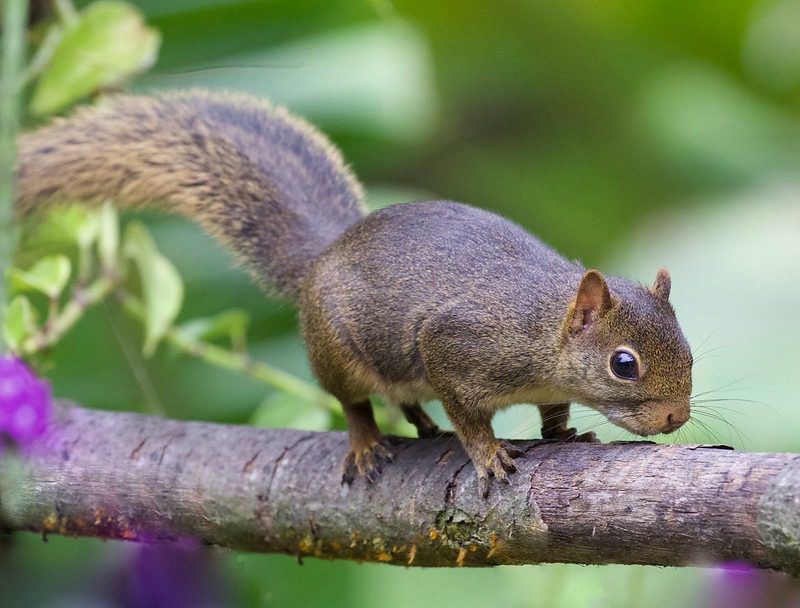
The Amazon rainforest is home to an extraordinary variety of wildlife, from powerful jaguars and colorful macaws to tiny frogs, fascinating insects, and small tree-dwelling mammals. Among these remarkable creatures, the dwarf squirrel represents an interesting example of how small mammals adapt to life in tropical forest environments. With its compact body, agile movements, and ability to navigate branches and dense vegetation, a small squirrel can play an important role in the complex ecosystem of the rainforest.
Dwarf squirrels are particularly interesting because their lives are closely connected to the trees, plants, seeds, and fruits that make tropical forests so productive. Their feeding habits, climbing abilities, and interactions with other wildlife help illustrate the relationships that maintain rainforest biodiversity.
The Peruvian Amazon, especially the forests surrounding Madre de Dios, provides an excellent setting for understanding the diversity of tropical mammals. Its dense vegetation, seasonal fruit production, and extensive forest habitats support numerous small mammals with specialized ecological roles.
In this guide, we explore dwarf squirrel characteristics, habitat, diet, behavior, survival adaptations, ecological importance, and conservation. We also examine the wider diversity of small mammals found in the Amazon rainforest and explain why protecting their natural habitats is essential for maintaining healthy tropical ecosystems.
Scientific note: Dwarf squirrel is a common name that can refer to different small squirrel species. Their distribution, physical characteristics, and ecological habits vary. The information below describes general squirrel biology and tropical forest ecology rather than claiming that every characteristic applies to one confirmed Peruvian species.
What Is a Dwarf Squirrel?
A dwarf squirrel is generally understood as a small-bodied member of the squirrel family. These mammals belong to the rodent group and are recognized for their compact proportions, strong hind limbs, sharp claws, and characteristic bushy tails, although their appearance varies considerably between species.
Squirrels are highly adaptable mammals that occupy different environments, including tropical rainforests, temperate woodlands, mountain forests, and urban green spaces. In tropical regions, many species spend considerable time climbing trees, searching for food, resting among branches, and moving through the forest canopy.
Their relatively small bodies can help them navigate narrow branches and dense vegetation. Their agility allows them to explore different parts of the forest while searching for fruits, seeds, and other food sources.
Physical Characteristics of Dwarf Squirrels
Small squirrels have several physical features that support their survival in woodland and rainforest environments.
Body size and proportions
Their compact bodies allow them to move through vegetation and access small spaces between branches. Although exact measurements depend on the species, smaller squirrels generally have lightweight bodies that support agile climbing and movement.
Fur color and texture
Fur coloration varies among squirrel species. Some have brown, gray, reddish, or olive-toned coats that blend into tree bark, branches, and forest vegetation. This natural coloration can make them less noticeable to predators.
Tail structure
The tail is an important feature of squirrel anatomy. It assists with balance during climbing and jumping, helps with communication, and can provide insulation when the animal rests.
Strong claws and limbs
Sharp claws help squirrels grip tree bark and climb vertical surfaces. Their powerful hind limbs provide the strength needed to jump between branches and move quickly through the forest.
Scientific Classification and Biological Features
Squirrels belong to the family Sciuridae, which includes tree squirrels, ground squirrels, and flying squirrels.
As rodents, they possess continuously growing incisors adapted for gnawing. These teeth help them open seeds, nuts, and other food items.
Their biological characteristics vary according to habitat and lifestyle. Tree-dwelling species generally have adaptations that support climbing, jumping, and maintaining balance, while ground-dwelling species may have features better suited to digging and terrestrial movement.
Understanding these differences is important when studying tropical rodent diversity because not every small squirrel has the same ecological requirements.
Dwarf Squirrel Habitat: Where Do These Small Mammals Live?
Habitat is one of the most important factors influencing squirrel survival. Food availability, vegetation structure, temperature, rainfall, shelter, and predator activity all affect where squirrels can establish territories and find suitable living conditions.
Many small tree squirrels inhabit wooded environments where branches, tree cavities, and dense foliage provide opportunities for feeding, nesting, and protection.
Tropical rainforests are especially complex habitats because they contain multiple vegetation layers. These include the forest floor, understory, middle canopy, and upper canopy. Each layer offers different food sources and shelter opportunities for wildlife.
Dwarf Squirrel Habitat in the Amazon Rainforest
The Amazon rainforest contains an enormous range of habitats, including lowland forests, seasonally flooded woodlands, river margins, and areas of secondary vegetation.
For tree-dwelling squirrels, forest structure is particularly important. Trees provide climbing surfaces, resting locations, nesting opportunities, and access to fruits and seeds.
Amazonian lowland forests
Lowland tropical forests contain abundant vegetation and diverse tree species. Their complex structure creates numerous opportunities for small mammals to find food and shelter.
Primary and secondary rainforest
Primary forests generally have mature vegetation and complex canopy structures. Secondary forests develop after previous disturbance and may provide food and shelter for some adaptable wildlife species.
However, the suitability of secondary forests depends on vegetation maturity, tree diversity, and the availability of resources.
Forest canopy and understory
The canopy provides branches, foliage, flowers, fruits, and potential nesting locations. The understory offers additional vegetation and protective cover.
Different squirrel species use these forest layers in different ways, depending on their feeding habits and physical adaptations.
Tropical vegetation and tree cover
A diverse tree community supports a greater variety of potential food sources. Trees also create connected pathways that allow arboreal mammals to travel between feeding and resting locations.
Small Mammals of the Peruvian Amazon
The Peruvian Amazon is one of the most biologically diverse tropical regions in South America. Its forests support a wide variety of mammals, including rodents, primates, bats, marsupials, and other specialized wildlife.
Madre de Dios is particularly important because its forests contain different habitat types, from river-edge vegetation to extensive lowland rainforest.
The Tambopata region is known for its rich wildlife diversity and complex tropical ecosystems. Small mammals contribute to these environments through feeding activities, interactions with plants, and their relationships with predators.
Although the presence of individual squirrel species must be confirmed through species-level records, the region provides valuable opportunities to study tropical mammalian biodiversity.
How Rainforest Conditions Influence Their Habitat
Environmental conditions influence where squirrels find suitable living spaces.
Temperature: Tropical forests generally experience warm conditions throughout the year. Small mammals must regulate their body temperature while remaining active and avoiding excessive heat.
Rainfall: Seasonal rainfall influences vegetation growth, fruit production, and the availability of food.
Forest density: Dense vegetation provides shelter and climbing opportunities, although excessive fragmentation can interrupt movement between forest patches.
Food availability: Trees producing fruits, seeds, and other edible plant material can attract feeding mammals.
Why the Forest Canopy Matters
The forest canopy is an essential habitat layer for many arboreal mammals. It provides access to sunlight, leaves, flowers, fruits, and seeds.
Branches create natural pathways between trees, reducing the need for animals to travel across exposed ground. This can help certain mammals avoid terrestrial predators.
The canopy also supports numerous other organisms, including birds, insects, reptiles, and primates, creating a complex network of ecological relationships.
How Trees Provide Shelter and Protection
Trees provide more than food. Their cavities, branches, and dense foliage can offer resting and nesting locations.
A well-developed forest canopy creates opportunities for animals to hide from predators and seek shelter during unfavorable weather.
For small mammals, maintaining access to suitable trees can be essential for survival, reproduction, and movement throughout their habitat.
Dwarf Squirrel Diet: What Do These Small Rodents Eat?
The diet of a squirrel depends on its species, habitat, seasonal food availability, and feeding adaptations. Many squirrels are omnivorous or primarily plant-eating mammals that consume a variety of natural foods.
In tropical forests, fruits, seeds, nuts, flowers, and other plant materials can represent important food sources. Some species also consume insects, eggs, or other animal matter when these resources are available.
Understanding the dwarf squirrel diet helps explain how small mammals interact with rainforest vegetation and contribute to the movement of seeds throughout tropical ecosystems.
Natural Food Sources in Tropical Forests
The Amazon rainforest provides a remarkable variety of natural food resources. Different trees and plants produce fruits, seeds, flowers, and leaves at different times of the year.
Small mammals take advantage of these resources according to their feeding preferences and physical abilities.
Tropical fruits
Fruits are an important food source for many tropical mammals. Their nutritional value and availability can make them attractive to squirrels searching for energy-rich meals.
Depending on the species, squirrels may feed on ripe fruits, soft pulp, and smaller fruit varieties found among branches.
Seeds and nuts
Seeds provide concentrated nutrients and energy. Squirrels can use their strong incisors to open protective coverings and access the food inside.
Some species also collect seeds and store them in different locations. When forgotten or left uneaten, certain seeds may have opportunities to germinate.
Young leaves and plant material
Leaves, shoots, buds, and other plant materials may supplement the diet of some squirrels.
The nutritional value of these foods varies depending on plant species and the stage of growth.
Flowers and other natural resources
Flowers can provide additional food resources, particularly when other foods are less abundant. Some mammals consume flower parts or feed on associated insects.
The variety of available plant resources helps support different feeding strategies among tropical forest animals.
Feeding Habits and Foraging Behavior
Foraging is the process through which animals search for and obtain food. Squirrels use their senses, memory, and movement abilities to locate suitable feeding opportunities.
Searching for food among branches
Tree-dwelling squirrels frequently investigate branches, leaves, and tree surfaces while looking for edible material.
Their climbing abilities allow them to reach food that may be inaccessible to many ground-dwelling animals.
Collecting and storing seeds
Food collection and caching are important behaviors in several squirrel species. They may hide seeds in tree cavities, soil, or other locations for later consumption.
This behavior can provide a valuable food reserve when resources become less available.
Feeding in the forest canopy
The canopy offers a variety of feeding opportunities. Fruits, seeds, buds, and insects may be found throughout different levels of the vegetation.
Moving between branches allows arboreal mammals to explore multiple food sources without constantly descending to the forest floor.
Seasonal changes in food availability
Food availability in tropical forests changes throughout the year. Some trees produce abundant fruits during particular seasons, while others provide seeds or flowers at different times.
Squirrels must adjust their feeding activities according to these changes.
When preferred foods become scarce, they may explore alternative resources within their habitat.
How Their Diet Supports Rainforest Ecosystems
The feeding activities of squirrels have ecological consequences that extend beyond their individual survival.
By consuming fruits and seeds, these mammals interact directly with forest vegetation. Their feeding habits can influence seed distribution, plant regeneration, and relationships between different organisms.
Seed dispersal
Some squirrels transport seeds away from the parent plant. Seeds carried to different locations may eventually contribute to plant establishment.
The effectiveness of this process depends on the species, seed characteristics, distance traveled, and whether seeds remain viable after handling.
Plant regeneration
Seeds that escape consumption may germinate under suitable environmental conditions.
This can contribute to the natural regeneration of vegetation, particularly when seeds reach favorable locations with adequate moisture and sunlight.
Connections within the rainforest food chain
Squirrels are also part of the rainforest food web. They consume plant material and may serve as prey for larger animals.
Their presence contributes to the transfer of energy between different levels of the ecosystem.
The Importance of Seeds in Their Diet
Seeds contain nutrients that support growth, movement, and daily activity.
For squirrels, the ability to locate and process seeds provides access to an important food resource. Their incisors are particularly useful for breaking protective seed coverings.
However, seed consumption does not always result in seed destruction. Some seeds may be transported, cached, or left in locations where germination remains possible.
This creates an interesting relationship between small mammals and the long-term development of tropical forests.
Seasonal Food Sources in the Amazon
The Amazon rainforest experiences seasonal changes in rainfall and vegetation productivity.
These changes influence the availability of different food resources. Some plants produce fruits during specific periods, while other trees provide seeds or flowers at different times.
Wildlife must respond to these changing conditions through flexible feeding strategies.
For small mammals, a diverse forest habitat is especially valuable because it offers multiple food sources throughout the year.
Dwarf Squirrel Behavior: How Do They Survive in Tropical Forests?
Behavior plays a fundamental role in the survival of small mammals. Finding food, avoiding predators, selecting shelter, and reproducing all require animals to respond to their surroundings.
Squirrels are particularly interesting because many species combine agility, alertness, and climbing abilities to navigate complex environments.
Their behavior is influenced by habitat structure, food availability, weather conditions, and interactions with other animals.
Tree-Climbing and Arboreal Behavior
Arboreal animals spend much of their lives in trees. For squirrels that depend on forest vegetation, climbing is an essential survival skill.
Movement between branches
Squirrels can use their limbs and claws to move along branches and navigate tree trunks.
Some species make impressive jumps between nearby branches, using their strong hind legs to generate forward movement.
Climbing adaptations
Their claws provide traction on tree bark, while flexible limbs help them maintain contact with irregular surfaces.
Their tails can assist with balance during movement and jumping.
Navigating dense vegetation
Tropical forests contain complicated networks of branches, vines, and foliage.
Agile mammals can move through these environments by selecting suitable pathways and adjusting their movements according to the available space.
Daily Activity and Foraging Patterns
Many tree squirrels are diurnal, meaning they are primarily active during daylight hours.
Daytime activity can provide opportunities to locate food, interact with other individuals, and move through the habitat while using visual information.
Food searching
Squirrels investigate vegetation and natural food sources using their senses.
Their activities may include examining fruits, opening seeds, climbing between trees, and searching for insects.
Resting periods
Resting allows animals to conserve energy between periods of activity.
Suitable resting places may include dense foliage, tree cavities, or sheltered branches, depending on the species.
Environmental awareness
Small mammals must remain alert to movement, sounds, and potential threats.
Their ability to detect changes in the environment can help them respond to predators and other disturbances.
Nesting and Reproduction
Reproduction is essential for maintaining healthy wildlife populations.
Squirrels use different nesting strategies depending on their species and habitat. Some construct nests from leaves and plant material, while others use natural tree cavities.
Nesting locations
Tree branches, hollow trunks, and protected spaces can provide suitable nesting environments.
The availability of safe nesting locations may influence reproductive success.
Shelter construction
Some squirrels build leafy nests using twigs, leaves, and other vegetation.
These structures can offer protection from rainfall, wind, and potential predators.
Breeding behavior
Reproductive patterns differ between species. Mating seasons, gestation periods, litter sizes, and parental care are not identical across all squirrels.
Consequently, species-specific information is necessary to describe the reproductive biology of a particular dwarf squirrel accurately.
Care of offspring
Young squirrels generally depend on parental care during their early development.
Protection, warmth, and access to food are important for their growth until they become increasingly independent.
Predator Avoidance and Survival Strategies
Small mammals face threats from a variety of predators, including birds of prey, snakes, and certain carnivorous mammals.
Their survival depends partly on recognizing danger and responding quickly.
Camouflage
Natural fur coloration can help squirrels blend into tree bark, branches, and surrounding vegetation.
Although camouflage does not guarantee protection, it may reduce the likelihood of detection.
Quick movements
Agility allows squirrels to move rapidly between branches and escape from exposed locations.
Their climbing abilities provide access to elevated areas that may be difficult for some predators to reach.
Hiding among vegetation
Dense foliage, tree cavities, and sheltered branches can provide temporary protection.
Selecting appropriate resting and nesting locations is an important aspect of survival.
Awareness of predators
Squirrels may respond to unfamiliar sounds, sudden movements, and changes in the behavior of nearby animals.
Their alertness can help them detect potential threats before an attack occurs.
How Small Mammals Avoid Rainforest Predators
Predator avoidance involves several interconnected strategies.
An animal may rely on camouflage when remaining still, speed when escaping, and sheltered vegetation when seeking protection.
Tree-dwelling mammals can also benefit from the three-dimensional structure of rainforest habitats.
Branches provide multiple escape routes, while dense leaves create visual barriers.
However, the presence of predators remains an important ecological factor that influences the behavior and distribution of small mammals.
Adaptations for Life in the Forest Canopy
Living in trees requires specialized physical abilities.
Strong limbs, gripping claws, flexible movement, and effective balance help arboreal squirrels navigate elevated habitats.
These adaptations allow them to exploit food resources and shelter opportunities that may not be available to animals living primarily on the ground.
The forest canopy is therefore more than a place to rest. It is an active environment where animals feed, travel, communicate, reproduce, and avoid danger.
The Ecological Role of Dwarf Squirrels in the Amazon Rainforest
Every animal in a tropical ecosystem contributes to a network of ecological relationships. Even small mammals can influence vegetation, food availability, and the movement of nutrients throughout their environment.
Dwarf squirrels and other small tree-dwelling mammals are interesting because their feeding activities connect plant communities with other wildlife.
Although their individual ecological contributions may be difficult to measure, their interactions with seeds, fruits, and predators help illustrate how rainforest ecosystems function.
Dwarf Squirrels and Seed Dispersal Ecology
Seed dispersal is an important natural process that allows plants to spread beyond the immediate area of the parent tree.
Several squirrel species participate in this process through food collection, transportation, and caching behavior.
Seed movement
When squirrels carry seeds away from fruiting trees, they can move them into different parts of the forest.
This movement may reduce competition between seedlings and parent plants.
Seed consumption
Not all seeds transported by squirrels survive. Some are eaten, while others may be damaged during feeding.
Nevertheless, the seeds that remain intact can sometimes contribute to natural plant regeneration.
Forest regeneration
Successful seed germination supports the development of new vegetation.
Young trees replace older plants, maintain forest structure, and provide future resources for wildlife.
Plant diversity
Seed dispersal can influence the distribution of different plant species.
By moving seeds across the landscape, animals contribute to ecological processes that help maintain diverse plant communities.
Their Place in the Amazon Rainforest Food Chain
The rainforest food chain connects plants, herbivores, omnivores, and predators through the movement of energy.
Small squirrels occupy an interesting position within this system.
They consume plant-based foods and, depending on the species, may also feed on insects and other small food items.
At the same time, they can become prey for larger animals.
Relationships with plants
Fruits, seeds, flowers, and other plant materials provide energy and nutrients.
These feeding interactions connect small mammals with the reproductive cycles of rainforest vegetation.
Role as prey for predators
Small mammals can provide food for snakes, raptors, and other carnivorous animals.
Their presence contributes to the availability of prey within the forest ecosystem.
Contribution to ecosystem balance
Healthy ecosystems depend on numerous interconnected relationships.
Predators influence prey populations, plants provide food and shelter, and small mammals participate in seed movement and energy transfer.
These relationships help maintain the ecological complexity of tropical forests.
Why Small Mammals Matter for Tropical Biodiversity
Small mammals are an important component of Amazonian biodiversity.
Although they are often less noticeable than large mammals, they contribute to the functioning of forest ecosystems.
Their feeding activities, movement patterns, and interactions with other organisms influence ecological processes.
Protecting small mammal populations also means protecting the vegetation, nesting locations, and food resources they depend on.
How Small Rodents Contribute to Forest Regeneration
Certain rodents contribute to forest regeneration by transporting and caching seeds.
Some cached seeds remain uneaten and may eventually germinate.
The resulting seedlings can become part of the next generation of forest vegetation.
The extent of this contribution depends on the species and the characteristics of the seeds involved.
Connections Between Wildlife and Plant Diversity
Plant and animal communities are closely connected.
Trees provide food and shelter for mammals, while animals can influence the distribution of seeds and the regeneration of vegetation.
This relationship demonstrates why biodiversity conservation must consider entire ecosystems rather than individual species alone.
Dwarf Squirrel Conservation: Threats to Their Natural Habitat
Tropical forests face several environmental pressures that can affect small mammals and other wildlife.
Although conservation threats vary between species and locations, habitat loss, fragmentation, climate change, and human disturbance can influence the survival of rainforest animals.
For small tree-dwelling mammals, the availability of connected forest habitats is particularly important.
Deforestation and Habitat Fragmentation
Deforestation is one of the major threats to tropical forest biodiversity.
When forests are cleared for agriculture, infrastructure, or other land uses, wildlife loses access to important natural resources.
Forest clearing
Removing trees reduces available food sources, nesting locations, and shelter.
Animals that depend on mature forest vegetation may find it difficult to survive in heavily modified landscapes.
Agricultural expansion
The conversion of natural vegetation into agricultural land can reduce habitat availability.
Large areas of cleared land may prevent small mammals from moving between remaining forest patches.
Road construction
Roads can divide previously connected habitats.
They may also increase human access to remote forest areas, creating additional pressure on wildlife.
Loss of tree cover
Because many squirrels depend on trees for movement and feeding, the removal of vegetation can directly affect their ability to access resources.
Habitat fragmentation can also isolate populations and reduce opportunities for movement and reproduction.
Climate Change and Its Impact on Amazonian Wildlife
Climate change creates additional challenges for tropical ecosystems.
Changes in temperature, rainfall, and seasonal patterns can influence forest vegetation and the animals that depend on it.
Changing rainfall patterns
Altered rainfall can affect plant growth, flowering, and fruit production.
This may change the timing and availability of natural food sources.
Habitat conditions
Extended dry periods and extreme weather events can influence forest structure and vegetation health.
These changes may reduce suitable shelter and feeding opportunities.
Food availability
When fruiting and flowering patterns change, animals may need to adjust their feeding activities.
Species with specialized diets can be particularly vulnerable when preferred resources become less available.
Ecosystem disruption
Climate-related environmental changes can affect relationships between plants, insects, birds, mammals, and other organisms.
Maintaining large, healthy forest areas can help support ecological resilience.
Wildlife Conservation in the Peruvian Amazon
Conservation in the Peruvian Amazon is essential for maintaining the natural habitats of countless wildlife species.
The forests of Madre de Dios are especially valuable because they support extensive biodiversity and contain different tropical forest environments.
Protecting these habitats requires a combination of responsible land management, scientific research, environmental education, and community participation.
Protected rainforest areas
Protected areas help conserve natural vegetation and provide important habitats for wildlife.
They also create opportunities for scientific research and long-term biodiversity monitoring.
Biodiversity conservation
Effective conservation should consider entire ecosystems.
Protecting trees, rivers, soil, and wildlife communities helps maintain the natural processes that support tropical forests.
Sustainable tourism
Responsible ecotourism can encourage visitors to appreciate rainforest biodiversity while supporting local conservation initiatives.
Nature-based tourism can also create economic opportunities connected to the protection of natural environments.
Forest protection initiatives
Reforestation, habitat restoration, environmental education, and sustainable resource management can help reduce pressure on tropical ecosystems.
These activities are important for maintaining suitable habitats for future generations of wildlife.
Why Protecting Rainforest Habitats Matters
Protecting rainforest habitats means preserving the natural relationships between plants, animals, and their environment.
For small mammals, healthy forests provide:
- Natural food resources.
- Suitable nesting and resting locations.
- Connected tree canopies.
- Protection from excessive environmental disturbance.
- Opportunities for movement and reproduction.
The loss of these resources can affect entire wildlife communities.
Conserving tropical forests therefore benefits not only squirrels but also birds, primates, amphibians, reptiles, insects, and countless plant species.
How Ecotourism Can Support Wildlife Conservation
Responsible ecotourism can help visitors understand the importance of rainforest biodiversity.
Wildlife observation, guided forest walks, and educational activities can introduce travelers to the ecological relationships that make tropical forests unique.
When tourism is managed responsibly, it can support local employment and strengthen awareness of conservation.
Visitors can contribute by respecting wildlife, avoiding littering, following established trails, and choosing tourism activities that prioritize environmental protection.
Where to Discover Small Mammals in the Peruvian Amazon
The Peruvian Amazon offers excellent opportunities to explore tropical biodiversity and understand the ecological importance of small mammals.
Its forests contain diverse vegetation structures, natural waterways, and habitats that support numerous wildlife species.
Although small mammals can be difficult to observe, exploring the rainforest with knowledgeable local guides can help visitors understand their behavior and natural environments.
Wildlife Watching in Tambopata National Reserve
The Tambopata region of Madre de Dios is recognized for its rich tropical biodiversity.
Its forests provide habitat for numerous mammals, birds, reptiles, amphibians, and insects.
Visitors exploring the rainforest may encounter different types of wildlife depending on the season, habitat, and observation conditions.
Rainforest trails
Walking through established forest trails provides opportunities to observe vegetation, animal tracks, feeding signs, and wildlife activity.
Small mammals may be spotted moving among trees or searching for food.
Canopy observation
Observing the forest canopy can reveal the activity of arboreal animals.
Squirrels and other tree-dwelling mammals may be difficult to identify because they move quickly and often remain partially hidden by leaves.
Wildlife photography
Photographing small mammals requires patience, observation skills, and appropriate equipment.
Using a camera with a suitable zoom lens can help visitors photograph animals without approaching too closely.
Guided nature excursions
Experienced guides can help identify animal movements, explain ecological relationships, and interpret signs of wildlife activity.
Their knowledge can make rainforest exploration more educational and rewarding.
Exploring Mammalian Biodiversity Around Puerto Maldonado
Puerto Maldonado is an important gateway to the forests of southeastern Peru.
The surrounding region contains a variety of natural environments that support different mammalian communities.
Visitors can learn about Amazonian wildlife through forest walks, river excursions, and nature-based activities.
Small mammals are an especially interesting subject because many species are difficult to observe without careful attention.
Looking for movement in the branches, listening for sounds, and examining feeding signs can help reveal the presence of animals that might otherwise remain unnoticed.
Responsible Wildlife Observation
Wildlife observation should always prioritize the safety and well-being of animals.
Small mammals are particularly vulnerable to unnecessary disturbance because they may depend on specific nesting locations and feeding areas.
Visitors can follow several simple principles:
- Maintain a respectful distance from wild animals.
- Never attempt to touch or capture wildlife.
- Avoid feeding animals with human food.
- Keep noise levels low during forest walks.
- Do not damage vegetation or disturb nests.
- Avoid using flash photography when it may disturb animals.
- Follow the instructions of trained local guides.
- Leave natural habitats exactly as they are found.
Responsible observation allows travelers to appreciate rainforest biodiversity without negatively affecting wildlife behavior.
Interesting Facts About Dwarf Squirrels and Small Rainforest Mammals
Small mammals have several fascinating characteristics that make them important subjects for wildlife observation and ecological research.
The following facts describe general squirrel biology and tropical mammal ecology rather than characteristics exclusive to one dwarf squirrel species.
1. Their tails help maintain balance.
A squirrel’s tail can assist with balance while climbing and jumping between branches.
2. Their teeth are adapted for gnawing.
Like other rodents, squirrels have continuously growing incisors that help them open seeds and other hard food items.
3. Some squirrels store food for later.
Food caching allows certain species to maintain access to resources when food becomes less abundant.
4. Many squirrels are active during the day.
Diurnal activity allows them to search for food and interact with their surroundings during daylight hours.
5. Trees provide several essential resources.
For arboreal squirrels, trees offer food, shelter, nesting opportunities, and routes for movement.
6. Small mammals contribute to rainforest food webs.
They consume plant resources and may become prey for larger animals, helping transfer energy throughout the ecosystem.
7. Their habitats support many other organisms.
Protecting forest environments benefits entire wildlife communities rather than just one mammal species.
Conclusion: Why Dwarf Squirrels Matter to the Amazon Rainforest
Dwarf squirrels and other small tree-dwelling mammals are fascinating examples of the biodiversity found in tropical forest environments.
Their compact bodies, climbing abilities, feeding strategies, and interactions with vegetation demonstrate how animals adapt to the complex conditions of rainforest ecosystems.
From searching for fruits and seeds to navigating branches and avoiding predators, these small mammals depend on healthy natural habitats to survive.
Their ecological relationships also highlight the importance of small wildlife within larger environmental systems. Through feeding activities, seed transportation, and their position in rainforest food webs, squirrels can contribute to the processes that maintain tropical biodiversity.
The Peruvian Amazon, particularly the forests of Madre de Dios, provides an extraordinary environment for understanding these ecological connections.
However, habitat loss, fragmentation, and environmental changes continue to threaten tropical biodiversity. Protecting forest vegetation, maintaining connected habitats, and encouraging responsible ecotourism are important steps toward conserving Amazonian wildlife.
Every species, regardless of size, contributes to the natural richness of the rainforest. By appreciating small mammals and protecting the ecosystems they depend on, we help preserve the extraordinary biodiversity of the Amazon for future generations.
Frequently Asked Questions About Dwarf Squirrels
1. How small is a dwarf squirrel?
The size of a dwarf squirrel depends on the particular species. Small squirrels generally have compact bodies, lightweight proportions, and physical adaptations that support climbing and movement through vegetation. Exact body measurements and weights should be checked against the scientific identification of the species.
2. Where do dwarf squirrels live?
Squirrels inhabit a variety of environments, including tropical forests, temperate woodlands, and other wooded habitats. Some species are adapted to life in trees, while others spend more time on the ground. Their geographical distribution depends on the species.
3. What do dwarf squirrels eat?
Their diet varies by species. Many squirrels consume fruits, seeds, nuts, flowers, and other plant materials. Some also eat insects and other small food items. In tropical forests, food availability changes according to seasonal conditions.
4. Are dwarf squirrels found in the Amazon rainforest?
The Amazon rainforest supports several squirrel species and other small rodents. However, the presence of a particular animal commonly called a dwarf squirrel must be verified through its scientific name and geographical distribution.
5. Are dwarf squirrels arboreal animals?
Some small squirrel species are arboreal, meaning they spend much of their time in trees. These animals use their claws, limbs, and tails to climb, balance, and move through branches. However, not every squirrel species has the same lifestyle.
6. What predators hunt small rainforest squirrels?
Potential predators include birds of prey, snakes, and certain carnivorous mammals. The actual predators depend on the squirrel species, its habitat, and its geographical location. Camouflage, agility, and access to sheltered vegetation can help reduce predation risk.
7. Why are small mammals important to rainforest ecosystems?
Small mammals contribute to rainforest ecosystems through feeding activities, seed movement, and interactions with other organisms. They can also serve as prey for larger animals. These relationships help maintain the ecological balance of tropical forests.
8. Are dwarf squirrels endangered?
Conservation status varies between squirrel species. Some have stable populations, while others face threats from habitat destruction and environmental changes. Determining whether a particular dwarf squirrel is endangered requires identifying the exact species and checking its current conservation assessment.
9. Do dwarf squirrels live in trees?
Many small squirrels are adapted to climbing and spend significant time in trees. They use branches and tree cavities for feeding, resting, nesting, and escaping predators. Other squirrel species are more terrestrial.
10. How do squirrels help the rainforest?
Some squirrels contribute to seed dispersal by transporting and caching seeds. Seeds that remain uneaten may germinate and contribute to vegetation regeneration. Squirrels also form part of rainforest food webs and provide food for predators.
11. Can visitors see squirrels in the Peruvian Amazon?
Visitors exploring the forests around Puerto Maldonado and Tambopata may have opportunities to observe different squirrel species and other small mammals. Sightings depend on the species present, season, habitat, and observation conditions. Quiet wildlife observation with an experienced guide can improve the chances of spotting small animals.
12. Why is rainforest conservation important for small mammals?
Rainforest conservation protects the trees, food sources, nesting locations, and connected habitats that small mammals need to survive. Healthy forests also maintain biodiversity and support the ecological relationships that sustain tropical ecosystems.