
The Amazon rainforest is one of the most extraordinary natural environments on Earth, celebrated for its remarkable biodiversity, incredible wildlife, and breathtaking vegetation. Beneath its towering trees, along winding rivers, and throughout its humid landscapes, countless flowering plants create a fascinating world of colors, shapes, fragrances, and ecological relationships. Amazon rainforest flowers are among the most captivating elements of this ecosystem, providing food, shelter, and reproductive opportunities for numerous animals while contributing to the forest’s natural balance.
From delicate orchids growing high on tree branches to vibrant heliconias attracting hummingbirds, the flowers of the Amazon rainforest demonstrate how plants adapt to challenging environmental conditions. Some species thrive in shaded forest understories, while others grow along riverbanks, in wetlands, or among the branches of enormous tropical trees.
Exploring Amazon rainforest flowers reveals more than botanical beauty. It also offers a deeper understanding of pollination, plant evolution, wildlife interactions, and the importance of protecting tropical ecosystems. These flowers play essential roles in maintaining biodiversity, supporting insects, birds, mammals, and preserving the ecological processes that sustain the Amazon.
What Are Amazon Rainforest Flowers?
Amazon rainforest flowers are the flowering plants that grow in the Amazon Basin, one of the world’s largest tropical forest regions. They include a wide variety of species adapted to warm temperatures, high humidity, abundant rainfall, seasonal flooding, and different levels of sunlight.
The Amazon is home to an enormous diversity of plant life, including flowering trees, shrubs, climbing vines, aquatic plants, epiphytes, and herbs. Many flowering species have developed distinctive characteristics that help them reproduce successfully in an environment where competition for sunlight, pollinators, nutrients, and space is intense.
Flowers in the Amazon are not always large or brightly colored. Some have delicate structures, subtle fragrances, or small petals that are easy to overlook. Others produce conspicuous flowers designed to attract specific pollinators, such as hummingbirds, butterflies, bees, and bats.
The diversity of flowering plants in the Amazon
The Amazon rainforest contains thousands of plant species, many of which belong to groups of flowering plants. Their diversity reflects the enormous variety of habitats found throughout the region.
Some flowers grow directly in the soil, while others develop on tree trunks, branches, or exposed roots. Epiphytic plants, including many orchids and bromeliads, grow on other plants without taking nutrients directly from their hosts. They use trees primarily as support, allowing them to reach brighter environments above the forest floor.
Flowering trees also contribute significantly to the Amazon’s ecological diversity. Their blossoms provide nectar, pollen, and other resources for insects and animals, while their reproductive cycles help maintain the forest’s long-term regeneration.
Where Amazon rainforest flowers grow
Amazonian flowers can be found in several different habitats, including:
- Tropical forest understories with limited sunlight.
- The rainforest canopy, where sunlight is more abundant.
- Riverbanks and floodplain forests.
- Wetlands, marshes, and shallow water environments.
- Forest clearings and naturally disturbed areas.
- Tree trunks and branches where epiphytic plants grow.
Each habitat presents different environmental conditions, influencing the size, shape, color, and reproductive strategies of flowering plants.
Why flowers are important in tropical ecosystems
Flowers are fundamental to the Amazon rainforest because they facilitate plant reproduction and support numerous animal species.
Through nectar and pollen production, flowers provide food for pollinators, including insects, birds, and mammals. These animals contribute to the reproductive success of plants by transferring pollen between flowers.
Flowering plants also support food chains, contribute to habitat complexity, and help maintain the ecological relationships that make tropical forests so biologically rich.
15 Beautiful Flowers of the Amazon Rainforest
The Amazon rainforest contains remarkable flowering plants that display extraordinary adaptations. Some are famous for their appearance, while others are important because of their relationships with animals or their ability to survive in challenging habitats.
1. Orchids of the Amazon
Orchids are among the most fascinating flowering plants in tropical forests. Their delicate petals, intricate shapes, and diverse colors make them especially recognizable among Amazonian vegetation.
Many orchids grow as epiphytes, attaching themselves to tree trunks and branches. This adaptation allows them to access better lighting conditions without growing directly in the soil. Their roots are often adapted to absorb moisture from the humid air and rainwater.
Orchid flowers can display white, yellow, purple, pink, and other colors. Some species produce fragrances that attract specific pollinators, while others use visual patterns or specialized flower structures to encourage pollen transfer.
The relationship between orchids and pollinators is particularly interesting because certain species have evolved highly specialized reproductive strategies. Their flower structures may encourage particular insects to interact with them in ways that promote successful pollination.
Amazonian orchids contribute to the forest’s botanical diversity and demonstrate how flowering plants can adapt to different ecological conditions.
2. Heliconia flowers
Heliconias are striking tropical plants known for their colorful, distinctive flower structures. Their red, orange, yellow, and pink bracts create spectacular displays in tropical forests and along forest edges.
Although their colorful structures are often mistaken for petals, the visible bracts usually surround the actual flowers, which emerge from within these structures.
Heliconias are particularly associated with hummingbird pollination. Their shapes, colors, and nectar production make them attractive to these small birds, which can transfer pollen while feeding.
Many heliconias grow in humid environments where rainfall is abundant. Their large leaves and impressive flowering structures make them recognizable components of tropical vegetation.
Some species grow in forest understories, while others thrive in brighter environments such as forest openings and river margins.
3. Bromeliad flowers
Bromeliads are a fascinating group of tropical plants that include many species found throughout Amazonian environments.
Some bromeliads grow on the ground, while others live as epiphytes on trees. Their leaves frequently form a rosette that can collect rainwater, creating small aquatic habitats used by insects and other organisms.
Bromeliad flowers may display vivid colors, including red, yellow, purple, and pink. Depending on the species, they can attract hummingbirds, insects, and other pollinators.
The relationship between bromeliads and the rainforest ecosystem extends beyond their flowers. Their leaf structures can collect organic matter and water, creating miniature ecosystems that support small animals.
Bromeliads are an excellent example of how tropical plants can develop specialized structures that allow them to survive in different forest environments.
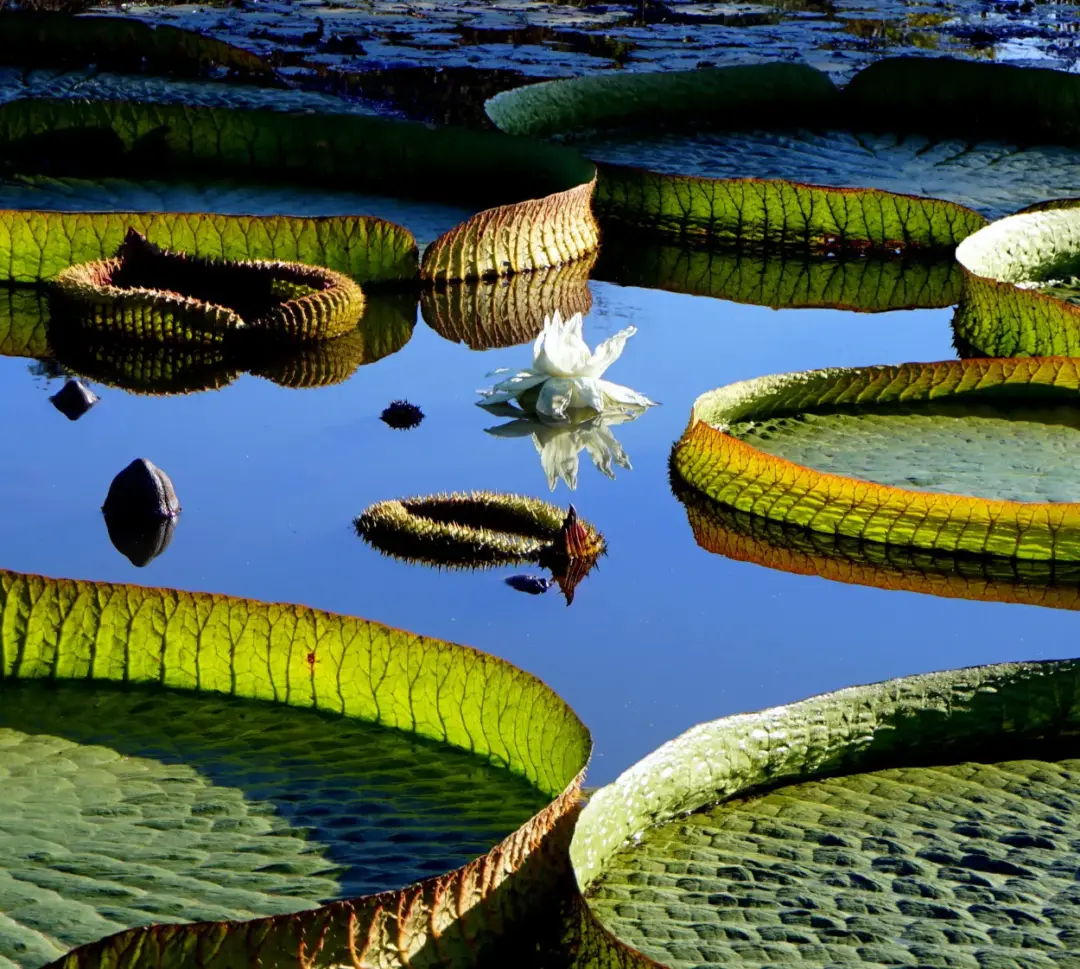
4. Victoria amazonica
Victoria amazonica is one of the most impressive aquatic plants associated with the Amazon Basin. It is famous for its enormous circular floating leaves and remarkable flowers.
The plant grows in calm waters, including lagoons, lakes, and slow-moving waterways. Its floating leaves can reach substantial sizes, allowing it to capture sunlight across the water’s surface.
Its flowers are particularly remarkable because they undergo changes in appearance during their flowering cycle. They are typically white during their initial flowering phase and may become pink during a later phase.
The flower’s reproductive biology involves changes in its structures and conditions that influence pollination.
Victoria amazonica is a striking example of how flowering plants adapt to aquatic environments, where floating structures, water availability, and sunlight influence growth and reproduction.
5. Passion flowers
Passion flowers are tropical flowering plants known for their intricate structures and unusual appearance.
Many species grow as climbing vines, using tendrils to attach themselves to vegetation and reach brighter areas. Their flowers frequently contain complex arrangements of petals, filaments, and reproductive structures.
The distinctive appearance of passion flowers makes them attractive to insects, including bees and butterflies, depending on the species.
Some passion flower species produce edible fruits, while others are primarily valued for their ornamental characteristics.
Their climbing growth habits allow them to take advantage of the vertical structure of tropical forests, where sunlight availability changes considerably between the forest floor and upper vegetation.
6. Anthurium flowers
Anthuriums are tropical plants known for their distinctive inflorescences and attractive foliage.
The visible colorful structure is often a spathe, which surrounds or supports a central flower-bearing spike called a spadix. The actual flowers are tiny and grow along this spike.
Anthuriums can display red, pink, white, orange, and green structures. Many species grow in humid tropical environments, including forest understories and other shaded habitats.
Some anthuriums grow as epiphytes, while others are terrestrial. Their adaptations allow them to survive in environments where moisture and sunlight availability vary.
Anthuriums demonstrate how tropical plants use specialized flower structures to facilitate reproduction and attract potential pollinators.
7. Vanilla orchids
Vanilla orchids are flowering vines belonging to the orchid family. They are particularly interesting because certain species produce fruits that are used to create vanilla flavoring.
The plants grow as climbing vines, often attaching themselves to trees or other supporting vegetation.
Their flowers are typically short-lived, making successful pollination an important part of their reproductive cycle. Vanilla flowers have specialized structures that influence how pollen is transferred.
Although vanilla is associated with tropical environments, not every vanilla species is native to or distributed throughout the Amazon Basin. Different species have distinct geographic ranges across tropical regions.
Vanilla orchids illustrate how tropical flowering plants can have ecological importance as well as economic and cultural significance.
8. Tropical ginger flowers
Ginger plants are common components of tropical botanical diversity. Many species produce impressive flowers surrounded by colorful bracts.
Their flower structures can be red, yellow, pink, white, or orange, depending on the species.
Some tropical ginger plants grow in humid understories, while others thrive in brighter conditions. Their underground rhizomes help them survive and regenerate.
The flowers attract different pollinators, including insects and birds, depending on the plant’s characteristics.
Ginger plants also demonstrate the importance of underground structures in tropical plant survival, especially where conditions change seasonally.
9. Inga flowers
Inga trees are important components of tropical forest ecosystems. Many species produce flowers with distinctive clusters of long, soft stamens that create a fluffy appearance.
Their flowers can attract insects, birds, and other animals seeking nectar.
Inga trees are also known for producing pods containing seeds surrounded by edible pulp in many species.
These trees contribute to forest ecology through their flowering and fruiting cycles, providing food resources for wildlife and supporting plant regeneration.
Their ability to grow in tropical environments and participate in ecological relationships makes them important components of Amazonian vegetation.
10. Kapok tree flowers
Kapok trees are among the giant trees associated with tropical forests of the Americas, including parts of the Amazon.
Their flowers are generally less conspicuous than the flowers of many ornamental tropical plants, but they are important for reproduction and wildlife interactions.
Depending on the species and location, flowers may attract bats and other pollinators.
Kapok trees contribute to the rainforest canopy, where their enormous size influences habitat structure, sunlight availability, and the ecological conditions surrounding smaller plants.
Their flowering cycles form part of the broader reproductive processes that maintain tropical forest biodiversity.
11. Bauhinia flowers
Bauhinia species are tropical flowering trees and shrubs recognized for their distinctive flower shapes and characteristic leaves.
Their flowers can display shades of pink, white, purple, and other colors, depending on the species.
Many bauhinias grow in tropical environments, including forest edges and open habitats. Their flowers attract pollinators, particularly insects.
The genus includes a wide range of species with different ecological characteristics and distributions. Some are associated with tropical forests, while others grow in different tropical and subtropical environments.
Their flower structures and leaf shapes make them recognizable among tropical plants.
12. Amazonian aquatic flowering plants
Aquatic flowering plants are an important part of Amazonian lakes, wetlands, rivers, and flooded forest environments.
These plants can grow floating on water, rooted in shallow aquatic environments, or partially submerged.
Some produce flowers that emerge above the water’s surface, allowing pollinators to interact with their reproductive structures.
Aquatic plants provide habitat and shelter for aquatic organisms, influence water conditions, and contribute to the ecological complexity of wetlands.
The Amazon’s seasonal flooding creates changing environmental conditions that influence aquatic vegetation, including where flowering plants can grow and reproduce.
13. Amazonian aroid flowers
Aroids are a diverse group of tropical plants that includes anthuriums and many other species.
Their flowers are typically organized into an inflorescence called a spadix, frequently accompanied by a spathe.
Aroids occur in many Amazonian habitats, including shaded forest environments, wetlands, and other humid locations.
Some species grow on the forest floor, while others climb trees or grow as epiphytes.
Aroid flowers can have unusual fragrances and reproductive strategies that attract different pollinators, including insects.
Their diversity reflects the extraordinary adaptability of tropical flowering plants.
14. Tropical climbing flowers
Climbing flowering plants are important components of the Amazon rainforest because they use surrounding vegetation to reach sunlight.
Many vines grow through the forest, attaching themselves to trees or other structures. Some climb using tendrils, while others use specialized stems or roots.
Climbing plants can produce flowers that attract insects, birds, or other pollinators.
Their growth habits allow them to occupy vertical spaces that would otherwise be difficult to access.
Vines contribute to forest complexity, creating connections between vegetation and influencing the structure of different habitats.
15. Wild rainforest flowering plants
Beyond recognizable species such as orchids and heliconias, the Amazon contains countless wild flowering plants that receive little attention.
These include small herbs, shrubs, forest-floor plants, flowering trees, and species that grow in specialized habitats.
Some produce flowers only during particular seasons, while others have reproductive cycles influenced by rainfall, temperature, or environmental conditions.
Their colors and structures vary enormously, ranging from tiny flowers that are difficult to notice to larger blossoms that attract numerous animals.
These plants collectively contribute to the extraordinary biodiversity of the Amazon rainforest and represent an important part of its ecological heritage.
Where Do Flowers Grow in the Amazon Rainforest?
Amazon rainforest flowers grow throughout different forest layers and habitats. Their distribution is influenced by sunlight, moisture, soil conditions, flooding, and competition with other vegetation.
Flowers in the rainforest canopy
The rainforest canopy receives more sunlight than the forest floor. Many epiphytic plants, including orchids and bromeliads, grow on branches and tree trunks.
These plants use trees as support structures, allowing them to access light without growing directly in the soil.
The canopy also contains flowering trees and climbing plants that contribute to the forest’s reproductive cycles.
Flowers on the forest floor
The forest floor receives relatively little sunlight because the upper vegetation absorbs much of the available light.
Many plants that grow here have adapted to shaded conditions. Some produce flowers that are small, while others develop reproductive structures that stand out against surrounding vegetation.
Forest-floor plants frequently depend on moist conditions and organic matter accumulating within the soil.
Understory flowering plants
The understory is the vegetation layer beneath the canopy. It contains shrubs, young trees, herbs, and many flowering plants adapted to reduced sunlight.
Some understory flowers attract insects, while others are pollinated by birds or other animals.
The understory is an important habitat for plant diversity because it provides numerous ecological niches where different species can survive.
Flowers along Amazon rivers and wetlands
Amazon rivers, lakes, wetlands, and flooded forests provide specialized habitats for aquatic and moisture-loving flowering plants.
Seasonal flooding changes water levels, influencing plant growth, reproduction, and habitat availability.
Aquatic flowers and riverbank plants contribute to ecological relationships between vegetation, insects, fish, birds, and other animals.
How Amazon Rainforest Flowers Adapt to Their Environment
The Amazon rainforest presents several challenges for plants, including intense competition for sunlight, high humidity, heavy rainfall, and changing water levels.
Flowering plants have developed numerous adaptations that help them survive.
Adaptations to low sunlight
Plants growing beneath the canopy often receive limited sunlight.
Some develop large leaves that help capture available light. Others grow vertically, climb trees, or produce flowers in locations where pollinators can more easily find them.
Epiphytes have evolved ways of growing on trees, allowing them to occupy habitats above the forest floor.
Flowers growing in humid conditions
High humidity influences how plants exchange moisture with their surroundings.
Many tropical plants develop leaves and structures adapted to humid conditions, while their roots and stems help them obtain water and nutrients.
Flowering plants must also cope with conditions that encourage fungi and other organisms, which can influence their survival.
Adaptations to heavy rainfall
Frequent rainfall can influence flower structure, pollen availability, and plant reproduction.
Some flowers have structures that help protect reproductive organs from excessive moisture.
Leaves and flower-bearing stems may also have shapes that encourage water drainage, reducing the accumulation of water on plant surfaces.
Flower colors and scents
Flower colors, fragrances, and shapes are important strategies for attracting pollinators.
Bright colors may attract birds and insects, while certain fragrances can help pollinators locate flowers.
Some flowers produce scents during specific periods, including nighttime, when different pollinators may be active.
These characteristics help plants increase their chances of successful reproduction.
Strategies for attracting pollinators
Amazon rainforest flowers use different strategies to attract pollinators.
These include:
- Nectar production.
- Bright flower colors.
- Specialized floral structures.
- Fragrances.
- Flowering patterns that coincide with pollinator activity.
- Adaptations that facilitate pollen transfer.
The relationship between flowers and pollinators is one of the most important ecological processes in tropical forests.
How Are Amazon Rainforest Flowers Pollinated?
Pollination is the process through which pollen is transferred to the reproductive structures of flowers, allowing fertilization and seed production in many flowering plants.
The Amazon rainforest contains a remarkable variety of pollination relationships.
Hummingbirds and tropical flowers
Hummingbirds are important pollinators in many tropical environments.
They feed on nectar from flowers and can transfer pollen between plants while visiting multiple flowers.
Some flowers have evolved colors, shapes, and nectar arrangements that favor hummingbird visits.
Heliconias are among the well-known tropical plants associated with hummingbird pollination.
Bees and other insects
Bees are among the most important pollinators of flowering plants.
They visit flowers to collect nectar and pollen, transferring pollen between plants as they move.
Other insects, including beetles and flies, also contribute to pollination in tropical forests.
Different flower structures may favor particular insect groups, creating specialized ecological relationships.
Butterflies and nectar-feeding insects
Butterflies visit flowers to obtain nectar, and their movements between plants may contribute to pollen transfer.
Flowers that provide accessible nectar and suitable landing structures can attract butterflies.
The relationship between flowering plants and butterflies contributes to the biodiversity of tropical ecosystems.
Bats and nocturnal flowers
Some tropical flowers are adapted to nighttime pollination.
These flowers may produce strong fragrances, pale colors, or abundant nectar that helps attract bats.
Bats can play important ecological roles by transferring pollen between flowering plants, contributing to forest reproduction and biodiversity.
Pollination and rainforest biodiversity
Pollination helps maintain the reproductive success of many flowering plants.
Without successful pollination, numerous plants would experience reduced seed production, affecting their ability to regenerate.
The interactions between flowers and pollinators support the ecological processes that help sustain the Amazon rainforest.
Why Amazon Rainforest Flowers Are Important
Amazon rainforest flowers are much more than beautiful natural features. They contribute to ecological processes that sustain wildlife, vegetation, and biodiversity.
Food for rainforest animals
Flowers provide nectar and pollen for insects, birds, and mammals.
These resources help support animals that depend on flowering plants for food.
The availability of flowers can influence animal movements, feeding behavior, and ecological relationships.
Supporting biodiversity
Flowering plants contribute to the biodiversity of the Amazon by supporting numerous species.
Their flowers, fruits, leaves, roots, and other structures provide food and habitat for different organisms.
The diversity of flowering plants also contributes to the ecological complexity of tropical forests.
Reproduction and seed production
Flowers are essential for the reproduction of many plants.
Successful pollination can lead to fertilization, seed development, and the production of fruits in species that produce them.
These reproductive processes contribute to forest regeneration and the long-term survival of plant populations.
Ecological connections between plants and animals
The Amazon rainforest contains complex relationships between plants and animals.
Pollinators depend on flowers for food, while flowering plants often depend on animals for pollen transfer.
These relationships demonstrate how different species contribute to the stability and functioning of tropical ecosystems.
Threats to Amazon Rainforest Flowers
Despite their diversity, Amazon rainforest flowers face environmental threats that can affect their habitats and survival.
Deforestation and habitat loss
Deforestation is one of the most significant threats to Amazonian plant diversity.
Forest clearing for agriculture, infrastructure, mining, and other activities can destroy habitats, reduce plant populations, and disrupt pollination relationships.
The loss of vegetation can also affect the environmental conditions that flowering plants require.
Climate change
Climate change can influence rainfall patterns, temperature, seasonal flooding, and plant flowering cycles.
Changes in these environmental conditions may affect plant reproduction, pollinator activity, and the distribution of flowering species.
Some plants may struggle to adapt to rapid environmental changes.
Forest fragmentation
Forest fragmentation separates natural habitats into smaller areas.
This can affect pollinator movements, plant reproduction, and the ecological relationships between different species.
Fragmented forests may also experience altered environmental conditions, including greater exposure to sunlight, wind, and temperature changes.
Protecting Amazonian botanical diversity
Protecting Amazon rainforest flowers requires preserving natural habitats and maintaining the ecological relationships that sustain plant populations.
Conservation initiatives, responsible tourism, scientific research, habitat restoration, and sustainable forest management can contribute to protecting Amazonian biodiversity.
The preservation of flowering plants also supports wildlife, forest regeneration, and the long-term health of tropical ecosystems.
Frequently Asked Questions About Amazon Rainforest Flowers
What are the most beautiful flowers in the Amazon rainforest?
Some of the most visually striking flowers associated with Amazonian environments include orchids, heliconias, bromeliads, passion flowers, anthuriums, and Victoria amazonica. Their distinctive colors, shapes, and adaptations make them fascinating examples of tropical plant diversity.
Does the Amazon rainforest have orchids?
Yes. Orchids occur throughout many tropical environments within the Amazon Basin. Some grow on tree branches as epiphytes, while others grow on the ground. Their flowers vary considerably in color, size, shape, and fragrance.
Are Amazon rainforest flowers colorful?
Yes. Many Amazon rainforest flowers display vibrant colors, including red, yellow, orange, pink, purple, and white. These colors may help attract pollinators, although not all tropical flowers are brightly colored.
What animals pollinate Amazon rainforest flowers?
Pollinators include hummingbirds, bees, butterflies, beetles, flies, and bats. Different plants have evolved floral characteristics that encourage visits from particular pollinators.
Do flowers grow on the forest floor of the Amazon?
Yes. Many flowering plants grow on the forest floor, where sunlight is limited and humidity is generally high. These plants have adaptations that help them survive beneath the dense vegetation of the rainforest canopy.
What is the largest flower in the Amazon rainforest?
Victoria amazonica is famous for its enormous flowers and floating leaves and is one of the most remarkable aquatic flowering plants associated with the Amazon. However, the world’s largest individual flower and the largest flowering structures are different botanical categories, so comparisons depend on how size is measured.
How do tropical flowers survive in the rainforest?
Tropical flowers survive through adaptations that help them cope with high humidity, abundant rainfall, limited sunlight, competition, and pollinator availability. These adaptations include specialized flower structures, climbing growth habits, epiphytic lifestyles, nectar production, fragrances, and different reproductive strategies.
Are Amazon rainforest flowers medicinal?
Some Amazonian plants, including certain flowering species, have traditional medicinal uses among Indigenous peoples and local communities. However, traditional use does not automatically demonstrate safety or effectiveness, and plants should not be consumed or used medicinally without appropriate identification and professional guidance.