
The Hoatzin is one of the most unusual and fascinating birds found in the Amazon rainforest. Known for its distinctive appearance, unusual smell, and remarkable digestive system, this tropical bird has attracted the attention of wildlife enthusiasts, birdwatchers, and scientists for generations. Its scientific name is Opisthocomus hoazin, and it is the only living member of its family and order.
Unlike most birds, the Hoatzin has a specialized digestive system that allows it to process large quantities of leaves through microbial fermentation. This adaptation makes it one of the few birds that primarily depend on foliage rather than fruits, seeds, or insects. Its digestive process is so unusual that it has sometimes been compared to the fermentation systems of certain mammals.
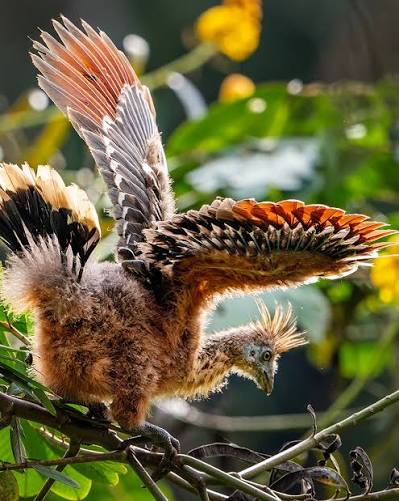
Another extraordinary characteristic is found in young Hoatzins. Their chicks possess small claws on their wings, which help them climb through branches and escape predators. When threatened, they can jump into the water, swim away, and climb back into vegetation using their claws.
The Hoatzin lives mainly in tropical wetlands, flooded forests, and vegetation along rivers and lakes throughout the Amazon and Orinoco basins of South America. Its presence is particularly associated with areas where dense vegetation grows close to freshwater environments.
Table of Contents
Although it is not an exceptionally strong flyer, the Hoatzin is well adapted to its environment. Its unusual physical characteristics, feeding habits, and behavior make it an important part of tropical wetland ecosystems.
What Is a Hoatzin?
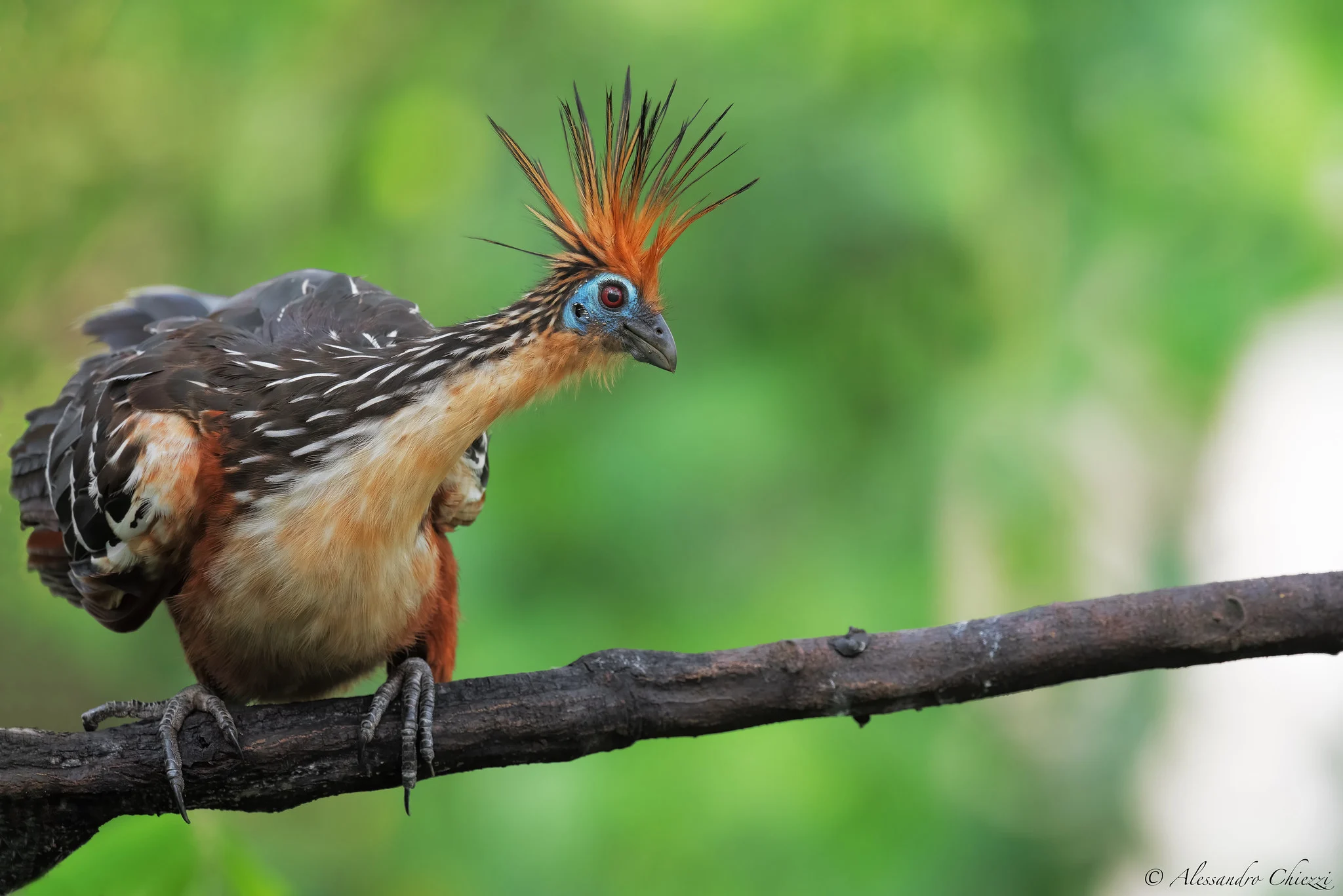
The Hoatzin is a medium-sized tropical bird native to northern South America. It is easily recognized by its spiky crest, reddish eyes, blue facial skin, and brownish plumage. Its unusual appearance makes it one of the most recognizable birds of the Amazon wetlands.
Adult Hoatzins generally measure between 60 and 70 centimeters in length, including their long tails. They have relatively small heads, long necks, broad wings, and strong feet that help them move through vegetation.
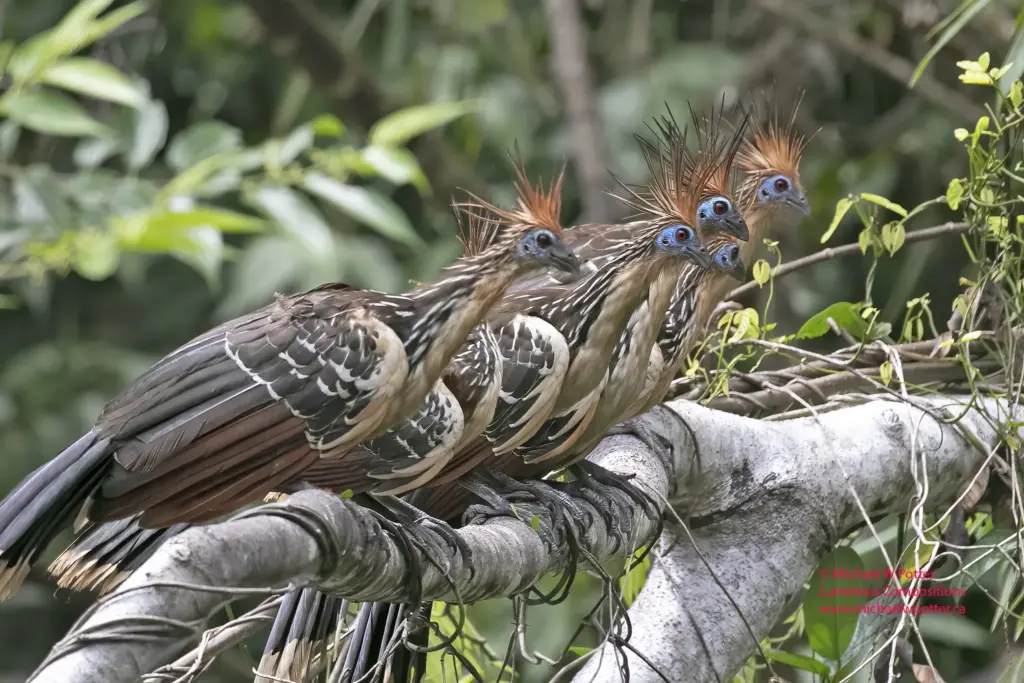
Unlike many rainforest birds that spend most of their time searching for insects or fruit, Hoatzins are specialized foliage feeders. They spend much of their day resting, feeding, and digesting leaves in trees close to rivers and lagoons.
The Hoatzin is also unusual because of its evolutionary classification. It belongs to the order Opisthocomiformes and the family Opisthocomidae. It is the only living representative of this distinctive bird lineage.
Scientific Classification of the Hoatzin
The Hoatzin has a unique taxonomic position among modern birds.
- Kingdom: Animalia
- Phylum: Chordata
- Class: Aves
- Order: Opisthocomiformes
- Family: Opisthocomidae
- Genus: Opisthocomus
- Species: Opisthocomus hoazin
Its classification has been a subject of scientific discussion because its anatomical and genetic characteristics do not fit easily into the evolutionary relationships of other bird groups.
Physical Characteristics
The Hoatzin has a distinctive appearance that makes it relatively easy to identify in its natural habitat.
Its body is covered with brown, chestnut, and reddish feathers, while its head has a prominent crest made of long, pointed feathers. The crest often appears disorganized, giving the bird a somewhat prehistoric appearance.
Its face is mostly covered with bare blue skin, contrasting with its striking red eyes. The wings are broad and rounded, while the long tail helps maintain balance when moving between branches.
The legs and feet are strong enough to support the bird as it walks and climbs through dense vegetation.
Unlike many colorful tropical birds, the Hoatzin does not have particularly bright plumage. Instead, its appearance is adapted to life among branches and leaves in wetlands.
Why Is the Hoatzin Called the Stinkbird?
One of the most interesting characteristics of the Hoatzin is its unusual smell.
The bird is commonly called the stinkbird because its digestive system produces a strong, unpleasant odor that can resemble the smell of fermented vegetation or manure.
This smell is associated with its specialized digestive process. Unlike most birds, which digest food primarily in the stomach, Hoatzins rely heavily on microbial fermentation in an enlarged crop.
When bacteria break down the leaves consumed by the bird, fermentation produces gases and other compounds that contribute to its characteristic odor.
The smell is particularly noticeable when the bird is observed at close range.
Although this characteristic may seem unpleasant, it is a natural consequence of the Hoatzin’s specialized diet and digestive system.
Where Does the Hoatzin Live?
The Hoatzin is native to tropical South America, where it inhabits wetlands, flooded forests, swamps, and riverbanks.
Its geographic distribution includes parts of the Amazon Basin and the Orinoco Basin, extending across several countries in northern and central South America.
Unlike many rainforest birds that occupy different forest layers, Hoatzins are strongly associated with freshwater environments and vegetation growing near rivers, lakes, and marshes.
These habitats provide the leaves they need for food, as well as branches and trees for resting, nesting, and protection.
Amazon Rainforest Habitat
The Amazon rainforest provides ideal conditions for Hoatzins because of its warm temperatures, abundant vegetation, and extensive network of rivers and wetlands.
Hoatzins are frequently associated with flooded forests and areas where trees grow close to slow-moving water.
These environments provide abundant young leaves and vegetation throughout much of the year.
The Amazon ecosystem is especially important because seasonal flooding creates temporary wetlands and expands the areas where aquatic and semi-aquatic vegetation can grow.
Hoatzins benefit from this environment because they can move between nearby trees without traveling long distances in search of food.
They are often observed resting in small groups on branches that extend over rivers or lagoons.
Rivers, Swamps and Freshwater Wetlands
Hoatzins are closely connected to freshwater habitats.
They commonly inhabit:
- Riverbanks with dense vegetation.
- Freshwater swamps.
- Flooded tropical forests.
- Lakes surrounded by trees.
- Marshes with abundant aquatic vegetation.
- Seasonal wetlands.
- Slow-moving river channels.
These habitats offer several advantages. They provide food, nesting locations, and access to water when the birds need to escape terrestrial predators.
The presence of dense vegetation is especially important because Hoatzins are not particularly strong flyers. They depend on nearby branches to move through their environment.
Geographic Distribution in South America
The Hoatzin is found in several South American countries, particularly within the Amazon and Orinoco drainage systems.
Its distribution includes:
- Peru
- Brazil
- Colombia
- Venezuela
- Ecuador
- Bolivia
- Guyana
- Suriname
- French Guiana
In Peru, Hoatzins inhabit suitable wetland environments throughout parts of the Amazon lowlands.
They are particularly interesting for wildlife enthusiasts visiting the Madre de Dios region, where rivers, oxbow lakes, and flooded forests provide suitable environments for observing a wide variety of tropical birds.
What Do Hoatzins Eat?
The Hoatzin is primarily herbivorous and has one of the most specialized diets among birds.
Its food consists mainly of leaves from tropical plants, particularly young leaves and shoots. Unlike many other birds, it does not depend heavily on insects, fruits, or seeds.
Its digestive system is specifically adapted to process fibrous plant material that would be difficult for most birds to digest efficiently.
This makes the Hoatzin an example of folivory, the biological feeding strategy in which animals obtain much of their nutrition from leaves.
Leaves and Tropical Vegetation
Leaves represent the main component of the Hoatzin’s diet.
The bird feeds on foliage from different tropical plants growing along riverbanks, wetlands, and flooded forests.
It particularly benefits from young leaves because they are generally softer and easier to process than mature foliage.
Young leaves often contain fewer structural fibers and may provide higher concentrations of certain nutrients.
The Hoatzin uses its strong bill to grasp and remove leaves from branches. It then swallows the vegetation, which enters its specialized digestive system.
Unlike fruit-eating birds that move frequently between feeding locations, Hoatzins can spend considerable periods feeding in the same trees.
Feeding Habits and Foraging Behavior
Hoatzins usually feed during daylight hours.
They move slowly through branches, selecting leaves and shoots from nearby vegetation.
Their feeding behavior is closely connected to their digestive requirements. Because leaf fermentation takes time, they often alternate between feeding and resting.
This means they are frequently observed sitting quietly in trees for extended periods.
Their relatively sedentary lifestyle is partly related to the energy requirements of processing large quantities of plant material.
Hoatzins generally remain close to freshwater environments where suitable vegetation is abundant.
They may feed individually or as members of small groups, depending on local conditions and the availability of food.
How the Hoatzin Digestive System Works
The digestive system is perhaps the most remarkable feature of the Hoatzin.
Most birds have relatively compact digestive systems designed to process food efficiently. The Hoatzin, however, has developed a specialized fermentation chamber in the upper digestive tract.
Its enlarged crop is used to store and ferment leaves before the food passes through the rest of the digestive system.
The process depends on microorganisms that help break down complex plant compounds.
These microorganisms are particularly important because leaves contain cellulose and other structural materials that are difficult to digest.
The fermentation process allows the Hoatzin to obtain nutrients from foliage that would otherwise provide limited nutritional value.
This digestive adaptation is one of the reasons the Hoatzin is so different from other tropical birds.
Unique Adaptations of the Hoatzin
The Hoatzin possesses several biological adaptations that allow it to survive in environments where dense vegetation and freshwater habitats dominate.
Its digestive system, wing claws, climbing ability, and behavior are all closely connected to its ecological lifestyle.
These adaptations make the species one of the most distinctive birds in the Amazon rainforest.
The Enlarged Crop and Foregut Fermentation
The Hoatzin’s enlarged crop is one of its most important adaptations.
In most birds, the crop functions mainly as a temporary food-storage structure. In the Hoatzin, however, it plays a much more specialized role.
It acts as a fermentation chamber where microorganisms help break down the leaves consumed by the bird.
This process is known as foregut fermentation because microbial digestion takes place before food reaches the stomach and intestines.
The crop is unusually large and occupies a substantial portion of the bird’s chest cavity.
Because of this structure, the Hoatzin has a relatively bulky upper body and reduced space for some of the muscles normally associated with powerful flight.
The fermentation process also explains why the bird has a characteristic smell.
Although foregut fermentation occurs in some mammals, it is extremely unusual among birds.
Why Hoatzin Chicks Have Claws on Their Wings
One of the most fascinating features of the Hoatzin appears during its early development.
Young Hoatzins possess two small claws on each wing, located near the wing’s leading edge.
These claws help chicks grip branches and climb through vegetation.
The adaptation is especially useful because young Hoatzins leave the nest when threatened by predators.
Instead of relying entirely on flight, chicks can drop into the water below, swim away, and use their wing claws and feet to climb back into nearby trees.
This unusual escape strategy provides an advantage in environments where nests are frequently located above water.
As the birds mature, the wing claws become reduced and eventually disappear.
Adult Hoatzins rely primarily on their feet and wings for movement.
Swimming and Escaping Predators
Hoatzin chicks are surprisingly capable swimmers.
When a predator approaches the nest, young birds may jump into the water rather than remain exposed.
They can swim underwater or along the surface to reach nearby vegetation.
Once they find a suitable location, they use their claws and feet to climb back into the trees.
This behavior is particularly effective in flooded forests and wetlands because water provides an alternative escape route.
Adult Hoatzins are less dependent on this behavior, but their close association with rivers and lagoons remains important for their survival.
Why Hoatzins Are Weak Flyers
Although Hoatzins have broad wings, they are not particularly strong or agile flyers.
Their flight is generally short and somewhat awkward compared with that of many other tropical birds.
One explanation is the unusual anatomy associated with their enlarged digestive system.
The large crop occupies considerable space within the chest cavity and affects the arrangement of muscles and other structures associated with flight.
Hoatzins often prefer to move by climbing and hopping between nearby branches.
When they need to fly, they usually travel relatively short distances before landing again.
Their lifestyle is therefore closely connected to the structure of the vegetation in their habitat.
Hoatzin Behavior and Social Life
Hoatzins are social birds that commonly live in small groups.
Their behavior is closely associated with feeding, resting, breeding, and defending territories around suitable wetland vegetation.
They are generally more easily observed sitting quietly in trees than flying over long distances.
Group Behavior and Territoriality
Hoatzins frequently gather in small groups along riverbanks and around freshwater lagoons.
These groups may include breeding pairs, young birds, and other individuals occupying nearby vegetation.
Their social behavior is particularly noticeable during the breeding season, when adults defend nesting areas and interact with neighboring birds.
The availability of suitable trees and feeding locations influences where groups establish themselves.
Because their diet consists mainly of leaves, Hoatzins do not need to travel long distances to find food when vegetation is abundant.
This allows them to remain within relatively small areas.
Communication and Vocalizations
Hoatzins produce several distinctive vocalizations used for communication.
Their calls are generally loud, rough, and somewhat harsh compared with the melodic songs of many other tropical birds.
They may produce grunting, croaking, and growling sounds, particularly when disturbed or interacting with other individuals.
These vocalizations help maintain contact between members of a group and may also play a role in territorial communication.
The sounds are especially noticeable in quiet wetland environments, where calls can travel through vegetation along rivers and lakes.
Daily Activities
Hoatzins are diurnal, meaning they are active during daylight hours.
Their daily routine usually includes feeding, resting, moving between branches, and interacting with other members of their group.
During the morning, they may begin feeding on nearby vegetation.
After consuming leaves, they spend considerable time resting while microbial fermentation takes place in their digestive system.
This pattern of feeding and resting is closely related to their specialized diet.
Their relatively slow movements and preference for remaining in trees make them interesting subjects for wildlife observation and photography.
Hoatzin Reproduction and Life Cycle
The reproductive behavior of the Hoatzin is closely connected to wetland environments.
Breeding pairs construct nests in trees and shrubs growing near water, where vegetation provides protection and suitable locations for raising chicks.
Their reproductive strategy includes parental care and the unusual climbing abilities of young birds.
Breeding Season and Courtship
Hoatzins generally breed according to seasonal environmental conditions.
In different parts of their geographic range, breeding activity is influenced by rainfall, water levels, and the availability of suitable nesting vegetation.
During courtship, individuals may interact through vocalizations and physical displays.
Pairs establish nesting territories and participate in activities associated with nest preparation and chick protection.
Their social structure can also include neighboring individuals that occupy nearby nesting areas.
Nesting Habits and Eggs
Hoatzins build relatively simple nests from branches and plant material.
The nests are usually positioned over water or in trees close to rivers, lakes, and wetlands.
This location provides a potential escape route for chicks if terrestrial predators approach.
Females generally lay between two and three eggs, although clutch size can vary.
The eggs are incubated by the adults until they hatch.
Both parents participate in caring for the young, including protecting and feeding them.
The nest location is particularly important because young Hoatzins are not capable of sustained flight when they first hatch.
Hoatzin Chicks and Parental Care
Newly hatched Hoatzins are covered in down feathers and depend on their parents for protection and food.
One of their most remarkable characteristics is the presence of small claws on their wings.
These claws help them move through branches and provide an unusual escape mechanism.
When threatened, chicks may jump from the nest into the water.
They can then swim toward vegetation and climb back into the trees.
Parents continue caring for their young by providing partially processed plant material and protecting them from predators.
As chicks grow, their feathers develop, their bodies become stronger, and their dependence on their parents gradually decreases.
Eventually, they lose their wing claws and develop the physical characteristics of adult Hoatzins.
Hoatzin Predators and Natural Threats
Despite their unusual adaptations, Hoatzins face several natural threats.
Their nests, eggs, and young birds are particularly vulnerable to predators.
Living near water offers some protection, but it does not eliminate the risks associated with life in tropical wetlands.
Potential predators include large snakes, birds of prey, and other animals capable of reaching nests in trees.
Young chicks are especially vulnerable because they cannot fly effectively.
Their ability to jump into the water and swim away provides an important defense mechanism.
However, aquatic predators may also pose a risk in some habitats.
The presence of dense vegetation helps Hoatzins hide from predators, while their social behavior may allow individuals to respond to disturbances more quickly.
Human activities can also affect their natural habitats, particularly when wetlands and riverbank forests are cleared or degraded.
Hoatzin Conservation Status
The Hoatzin is currently classified as a species of Least Concern on the global conservation scale.
This classification indicates that the species is not presently considered to face an immediate global extinction threat.
However, its long-term survival depends on the protection of suitable tropical wetland habitats.
Deforestation, agricultural expansion, wetland drainage, and changes to river systems can affect the availability of food and nesting locations.
Although Hoatzins are distributed across a relatively large region of South America, local populations may be affected when their habitats are damaged.
Habitat Loss and Environmental Changes
One of the main environmental concerns for tropical wetland birds is the destruction of natural vegetation.
When riverbanks are cleared, Hoatzins lose important feeding and nesting locations.
Wetland degradation can also affect the availability of aquatic vegetation and the structure of the surrounding ecosystem.
Changes in water levels may influence breeding areas and the distribution of suitable vegetation.
Protecting freshwater environments is therefore essential for maintaining healthy Hoatzin populations.
Importance of Amazon Rainforest Conservation
The Amazon rainforest contains an extraordinary diversity of birds, mammals, reptiles, amphibians, and insects.
Hoatzins are part of this complex ecosystem and depend on the ecological relationships between vegetation, water, and wildlife.
Protecting flooded forests and riverbank vegetation benefits not only Hoatzins but also many other species that depend on similar habitats.
Responsible wildlife tourism and conservation initiatives can contribute to greater awareness of the importance of tropical wetlands.
Interesting Facts About the Hoatzin
The Hoatzin is one of the most unusual birds in the world because of its combination of physical and biological characteristics.
Here are some interesting facts about this remarkable Amazon rainforest species.
1. It is called the stinkbird: Its unusual digestive fermentation process produces a distinctive smell.
2. It eats mainly leaves: Unlike most birds, its diet consists primarily of foliage.
3. It has an unusual digestive system: Its enlarged crop acts as a microbial fermentation chamber.
4. Its chicks have claws on their wings: These structures help young birds climb through branches.
5. Baby Hoatzins can swim: When threatened, they can jump into water and escape from predators.
6. It is a weak flyer: Hoatzins generally prefer climbing and hopping between branches.
7. It has red eyes: Its striking eyes contrast with the blue skin surrounding its face.
8. It has a distinctive crest: Long pointed feathers create its characteristic spiky appearance.
9. It lives near freshwater: Rivers, lagoons, swamps, and flooded forests are important habitats.
10. It belongs to a unique bird order: The Hoatzin is the only living member of Opisthocomiformes.
11. It spends much of its day resting: Leaf fermentation requires time and is associated with its relatively slow lifestyle.
12. It is native to South America: Its natural distribution includes the Amazon and Orinoco basins.
Where to See Hoatzins in the Amazon Rainforest
The Amazon rainforest offers excellent opportunities to observe Hoatzins in their natural environment.
Because these birds are strongly associated with freshwater wetlands, the best places to look for them are riverbanks, lagoons, flooded forests, and areas with dense vegetation growing close to water.
Unlike many rainforest birds that are difficult to observe because they spend most of their time high in the canopy, Hoatzins are often found in relatively accessible vegetation near rivers.
Their distinctive appearance and unusual movements make them interesting subjects for wildlife enthusiasts and birdwatchers.
Hoatzins in the Peruvian Amazon
Peru is an excellent destination for observing tropical rainforest birds.
The Amazon lowlands contain extensive freshwater ecosystems that support a remarkable diversity of wildlife.
The Madre de Dios region is particularly interesting because of its rivers, oxbow lakes, wetlands, and flooded forests.
These habitats support numerous bird species, including herons, kingfishers, macaws, toucans, and other tropical birds.
Hoatzins can be observed in suitable wetland habitats, especially where vegetation grows densely along the water’s edge.
Wildlife Observation Around Puerto Maldonado
Puerto Maldonado is one of the main gateways to the southern Peruvian Amazon.
Located in the Madre de Dios region, the city provides access to several important rainforest environments, including the Tambopata area and the surrounding river systems.
Visitors exploring these environments may encounter a wide variety of wildlife while traveling by boat, walking through forest trails, or visiting freshwater lagoons.
Hoatzins are particularly interesting to observe around wetlands and areas with abundant riverbank vegetation.
For birdwatchers, early morning excursions are especially rewarding because many tropical birds are active during the first hours of daylight.
A knowledgeable local guide can help identify species by their calls, movements, and physical characteristics.
Frequently Asked Questions About Hoatzins
What is a Hoatzin bird?
The Hoatzin is a tropical bird native to South America. It is known for its unusual digestive system, strong smell, spiky crest, and distinctive wing claws found in young chicks.
Where do Hoatzins live?
Hoatzins live in tropical South America, particularly in the Amazon and Orinoco basins. They prefer freshwater wetlands, flooded forests, riverbanks, and lagoons surrounded by dense vegetation.
What do Hoatzins eat?
Hoatzins primarily eat leaves from tropical plants. Their diet consists mainly of foliage, young leaves, and shoots, which they process through microbial fermentation in their enlarged crop.
Why do Hoatzins smell bad?
Hoatzins have an unusual digestive system that relies on microbial fermentation. This process produces a characteristic odor, which explains why the bird is commonly called the stinkbird.
Why do baby Hoatzins have claws on their wings?
Young Hoatzins have small claws on their wings that help them grip and climb branches. These claws are especially useful when chicks need to escape predators by jumping into the water and climbing back into vegetation.
Can Hoatzins fly?
Yes, Hoatzins can fly, but they are relatively weak flyers. They usually travel short distances and prefer climbing or hopping between branches.
Can Hoatzins swim?
Yes. Young Hoatzins are particularly capable swimmers. When threatened, they can jump into the water, swim away from danger, and climb back into nearby trees.
Are Hoatzins herbivores?
Yes. Hoatzins are primarily herbivorous birds that feed mainly on leaves and other plant material.
How do Hoatzins digest leaves?
They use an enlarged crop containing microorganisms that help break down plant material through foregut fermentation. This process allows them to obtain nutrients from fibrous leaves.
How big is a Hoatzin?
Adult Hoatzins generally measure approximately 60–70 centimeters in length, including their tail feathers.
How many eggs does a Hoatzin lay?
A female Hoatzin generally lays two to three eggs per clutch. Both parents participate in caring for the young.
Are Hoatzins endangered?
The Hoatzin is classified as Least Concern globally. However, habitat destruction and wetland degradation can threaten local populations.
Can Hoatzins be found in Peru?
Yes. Hoatzins occur in the Peruvian Amazon, where suitable freshwater wetlands and riverbank forests provide the vegetation and nesting locations they need.
What makes the Hoatzin different from other birds?
Its combination of leaf-based feeding, microbial fermentation in an enlarged crop, characteristic odor, and wing claws in young chicks makes it one of the most unusual birds in the world.
Conclusion
The Hoatzin is a remarkable example of how wildlife adapts to the environmental conditions of tropical rainforests.
Its unusual digestive system, specialized leaf-based diet, distinctive appearance, and extraordinary chick development make it one of the most fascinating birds of the Amazon.
From its ability to digest fibrous vegetation through microbial fermentation to the remarkable climbing and swimming abilities of its young, nearly every aspect of its biology is different from that of most familiar birds.
The Amazon rainforest and its freshwater wetlands provide the ideal environment for this unique species. Protecting these ecosystems is essential for maintaining the extraordinary biodiversity of South America’s tropical forests.
For wildlife enthusiasts visiting the Peruvian Amazon, observing a Hoatzin resting among riverbank vegetation is a memorable experience and a wonderful opportunity to discover the remarkable adaptations that make rainforest wildlife so diverse.