
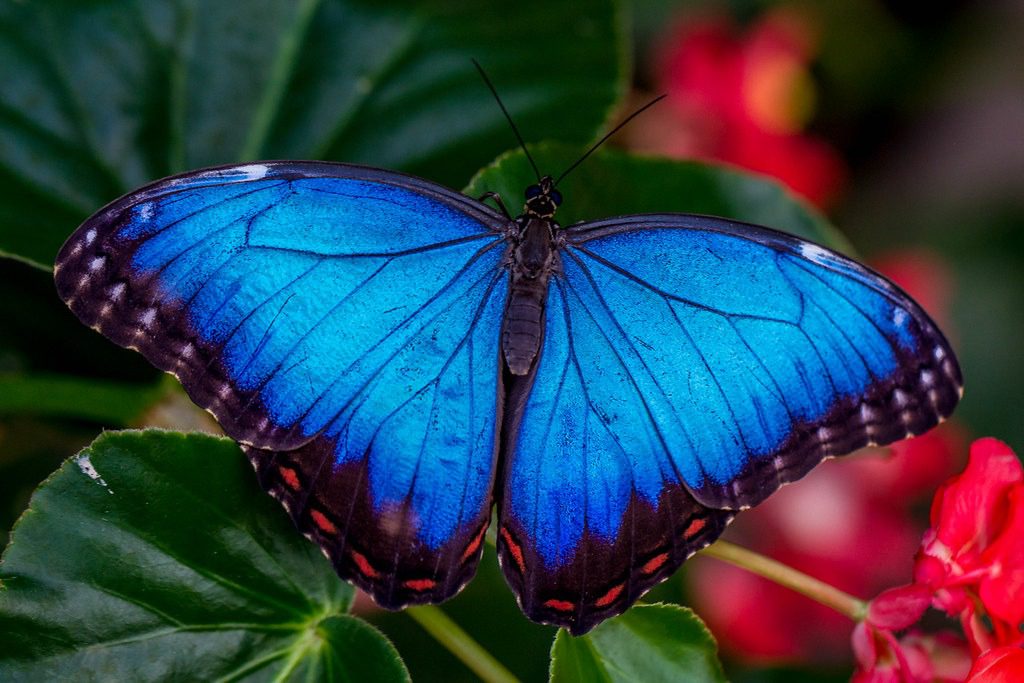
The blue morpho butterfly is one of the most spectacular insects in the tropical rainforests of Central and South America. Famous for its brilliant metallic-blue wings, this remarkable butterfly attracts attention whenever sunlight illuminates its shimmering colors. Its wings appear to change brightness and intensity as it flies through the forest, creating an almost magical display.
Belonging to the genus Morpho and the family Nymphalidae, blue morpho butterflies are among the most recognizable rainforest insects. Their striking appearance is produced by microscopic structures on their wing scales rather than ordinary blue pigments. This natural phenomenon, known as structural coloration, allows them to reflect light in extraordinary ways.
Blue morphos inhabit tropical forests, including regions of the Amazon Basin, where they feed on fermenting fruit, tree sap, and other organic materials. Their life cycle includes four stages: egg, caterpillar, chrysalis, and adult butterfly. Each stage has distinctive characteristics and adaptations that help the species survive in a challenging rainforest environment.
Table of Contents
Beyond their beauty, blue morpho butterflies provide fascinating examples of insect evolution, predator avoidance, reproduction, and the relationship between tropical biodiversity and forest ecosystems.
What Is a Blue Morpho Butterfly?
The blue morpho butterfly is a large tropical butterfly recognized for its iridescent blue wings and distinctive flight patterns. Several species within the genus Morpho are commonly called blue morphos, including Morpho menelaus, Morpho peleides, and Morpho helenor.
These butterflies belong to the order Lepidoptera, which includes butterflies and moths. Their family, Nymphalidae, is one of the largest butterfly families, containing thousands of species distributed throughout the world.
Blue morphos are particularly associated with tropical forests in Central and South America. They are frequently observed flying along forest trails, riverbanks, clearings, and vegetation near the rainforest canopy.
Unlike many butterfly species that primarily visit flowers, adult blue morphos obtain much of their nutrition from fermenting fruit and tree sap.
Blue Morpho Butterfly Scientific Classification
The scientific classification of the blue morpho butterfly depends on the particular species being discussed. For example, Morpho peleides is commonly known as the common blue morpho.
Its classification is:
- Kingdom: Animalia
- Phylum: Arthropoda
- Class: Insecta
- Order: Lepidoptera
- Family: Nymphalidae
- Subfamily: Morphinae
- Genus: Morpho
- Species: Morpho peleides
Other well-known members of the genus include Morpho menelaus and Morpho helenor. These species share several characteristics, including large wings, tropical forest habitats, and remarkable structural coloration.
Different Species of Blue Morpho Butterflies
The genus Morpho contains multiple species with different wing patterns, sizes, geographic distributions, and coloration.
Some particularly notable examples include:
- Morpho menelaus: Recognized for its intense metallic-blue wings and dark outer margins.
- Morpho peleides: Also called the common blue morpho, this species is frequently encountered in Central and South American tropical forests.
- Morpho helenor: A widespread Neotropical species with considerable variation in wing coloration and patterns.
- Morpho didius: A large South American morpho butterfly known for its impressive wingspan and brilliant blue coloration.
Although these species share the common name blue morpho, they are not identical. Their physical characteristics and geographic ranges can vary.
Blue Morpho Butterfly Physical Characteristics
The most remarkable feature of the blue morpho butterfly is its large, shimmering wings. Their bright blue appearance contrasts with their dark bodies and brown wing undersides, creating a distinctive visual pattern.
Blue morphos are relatively large compared with many other tropical butterfly species. Depending on the species, adults can have wingspans of approximately 12–20 centimeters.
Their bodies are generally dark brown or black, with long antennae, compound eyes, six legs, and a specialized mouthpart used for drinking liquids.
Why Are Blue Morpho Butterflies Blue?
One of the most interesting questions about this butterfly is why its wings appear so intensely blue.
Surprisingly, the characteristic blue coloration is not primarily produced by blue pigments. Instead, it results from microscopic structures arranged across the surface of the wings.
This phenomenon is called structural coloration.
The wings contain thousands of tiny overlapping scales. Under a microscope, these scales reveal intricate arrangements of microscopic ridges and layers that interact with incoming light.
When sunlight reaches these structures, certain wavelengths are reflected and reinforced, producing the brilliant blue appearance associated with morpho butterflies.
This optical phenomenon creates an iridescent effect, meaning the intensity and appearance of the color change depending on the viewing angle and lighting conditions.
Structural coloration is an extraordinary example of how microscopic biological structures can produce visible colors without relying entirely on chemical pigments.
Scientists study these wing structures to better understand light reflection, optical materials, and potential applications in nanotechnology.
Iridescent Wings and Microscopic Wing Scales
The wings of blue morpho butterflies contain numerous overlapping scales arranged in organized layers.
These structures influence how light interacts with the wing surface. Their microscopic ridges and layered architecture produce the intense blue reflections that make the butterfly so recognizable.
The iridescent effect can make the wings appear brilliant blue in direct sunlight but much darker when viewed from another angle.
This visual transformation is especially noticeable during flight, when the wings repeatedly open and close.
The bright upper wing surfaces contrast with the darker undersides, creating a distinctive flashing effect as the butterfly moves through the rainforest.
Wingspan and Body Structure
Blue morpho butterflies are among the larger butterflies found in tropical forests.
Depending on the species, their wingspan can reach approximately 12–20 centimeters.
Their bodies consist of three main sections:
- Head: Contains the compound eyes, antennae, and mouthparts.
- Thorax: Supports the wings and six jointed legs.
- Abdomen: Contains important digestive, reproductive, and respiratory structures.
Their wings consist of two pairs: forewings and hindwings. Both pairs work together to support flight and create the characteristic movement associated with morpho butterflies.
Male and Female Blue Morpho Butterflies
Male and female blue morpho butterflies often show noticeable differences in their appearance, a characteristic known as sexual dimorphism.
Males generally display larger areas of brilliant iridescent blue across their upper wings. Females commonly have darker brown coloration with smaller blue areas, although their exact appearance varies among species.
These differences help individuals recognize potential mates and may also influence courtship and territorial behavior.
Where Do Blue Morpho Butterflies Live?
Blue morpho butterflies inhabit tropical forests throughout Central and South America. Their geographic distribution includes countries with extensive rainforest ecosystems, such as Brazil, Peru, Colombia, Ecuador, Costa Rica, and Panama.
They are particularly associated with humid tropical environments where suitable host plants, food sources, and vegetation provide the resources required for survival.
Although they are commonly associated with the Amazon rainforest, blue morphos are not restricted to the Amazon Basin. Different species occupy different tropical forest regions.
Blue Morpho Butterfly Habitat in the Amazon Rainforest
The Amazon rainforest provides an important habitat for numerous morpho butterfly species.
Its warm temperatures, high humidity, abundant vegetation, and seasonal availability of fruit create favorable conditions for butterfly populations.
Blue morphos can be observed in several forest environments, including:
- Tropical rainforest understory.
- Forest edges and natural clearings.
- Riverbanks and streams.
- Open forest trails.
- Areas containing fruit-producing trees.
- Secondary tropical forests.
- Vegetation near the forest canopy.
Adult butterflies frequently fly through open areas where sunlight makes their bright wings particularly visible.
They may also spend considerable time resting among vegetation with their wings folded, making their darker undersides less noticeable.
Geographic Distribution in Central and South America
Blue morpho species occur across a broad region of the Neotropics.
Their distribution includes tropical forests in Central America and northern and central South America.
Different species occupy different geographic ranges, depending on environmental conditions, vegetation, elevation, and evolutionary history.
In South America, morpho butterflies are associated with important rainforest ecosystems, particularly the Amazon Basin.
Peru is one of the countries where visitors can explore tropical forest environments and discover the extraordinary diversity of Amazon butterflies.
The Madre de Dios region, including the forests around Puerto Maldonado and Tambopata, is part of an exceptionally diverse tropical landscape containing numerous butterfly species.
What Do Blue Morpho Butterflies Eat?
The diet of blue morpho butterflies changes during their development.
Caterpillars primarily consume plant leaves, while adult butterflies obtain nutrients by drinking liquids from decomposing organic materials.
Unlike many familiar butterfly species, adult blue morphos are not strongly dependent on flower nectar.
Their feeding behavior makes them important examples of fruit-feeding butterflies in tropical forest ecosystems.
Adult Butterfly Diet
Adult blue morphos commonly feed on:
- Fermenting and rotting fruit.
- Tree sap.
- Decomposing organic material.
- Fluids from dead animals.
- Moist mineral-rich substrates.
Fallen tropical fruits provide an important source of sugars and other nutrients.
As fruits decompose, microorganisms break down their tissues and produce fermenting liquids that butterflies can consume.
Blue morphos use a specialized feeding structure called a proboscis to drink these liquids.
The proboscis works like a flexible straw, allowing the butterfly to access nutrients from fruit and other liquid food sources.
How Do Blue Morpho Butterflies Find Food?
Blue morpho butterflies use sensory structures to locate suitable feeding opportunities.
Their antennae detect chemical information in the surrounding environment, while sensory receptors on their legs help them evaluate potential food sources.
When a butterfly lands on fermenting fruit, it can extend its proboscis and begin feeding.
Several individuals may gather around the same feeding site when food is abundant.
This behavior makes fallen fruit an important resource for fruit-feeding butterflies in tropical forests.
What Do Blue Morpho Caterpillars Eat?
Unlike adults, blue morpho caterpillars are herbivorous.
They feed on the leaves of various host plants, particularly plants belonging to the pea family, Fabaceae.
Their feeding activity provides the energy required for growth and development through several larval stages.
Caterpillars must consume substantial quantities of vegetation before entering the pupal stage, when their bodies undergo metamorphosis.
Blue Morpho Butterfly Life Cycle
The blue morpho butterfly undergoes complete metamorphosis, a biological process in which an insect develops through four distinct stages.
These stages are:
- Egg.
- Caterpillar or larva.
- Chrysalis or pupa.
- Adult butterfly.
Each stage has a different appearance, feeding behavior, and biological function.
Stage 1: Blue Morpho Butterfly Eggs
The life cycle begins when a female butterfly lays eggs on suitable vegetation.
The eggs of Morpho peleides are small, generally measuring around 1–2 millimeters in diameter.
They are commonly light green and have a rounded shape.
The female selects plants that can provide food for the developing caterpillars after they hatch.
Depending on environmental conditions and the particular species, the egg stage may last approximately one to two weeks.
Stage 2: Blue Morpho Caterpillar
After hatching, the young larva begins feeding on leaves.
Blue morpho caterpillars have distinctive bodies, often displaying reddish or brownish coloration with contrasting markings and small defensive structures.
Their appearance differs considerably from that of the brilliant blue adult butterfly.
As they grow, caterpillars pass through several developmental stages called instars. During these stages, they periodically shed their outer skin through a process known as molting.
The caterpillar of Morpho peleides typically passes through five larval instars.
Feeding is especially important during this period because the larva must accumulate enough energy to complete metamorphosis.
Some blue morpho caterpillars also display unusual defensive behavior, including the production of chemical secretions that may discourage predators.
Stage 3: Chrysalis and Metamorphosis
After completing its larval development, the caterpillar enters the pupal stage.
During this period, it transforms into a chrysalis, attaching itself to vegetation and remaining relatively inactive externally.
Inside the protective pupal covering, extensive biological changes take place.
The larval body is reorganized as adult structures develop, including wings, antennae, compound eyes, legs, and reproductive organs.
The pupal stage of Morpho peleides lasts approximately two weeks under the conditions described in laboratory and captive-rearing studies.
Near the end of development, the adult butterfly becomes visible through the increasingly transparent pupal covering.
Stage 4: Adult Blue Morpho Butterfly
When metamorphosis is complete, the adult butterfly emerges from its chrysalis.
Its wings are initially soft and folded. The butterfly pumps fluid through the wing veins to expand them and then allows them to harden before flying.
Once its wings are fully developed, the adult begins searching for food and potential mates.
Adult butterflies concentrate on feeding and reproduction, completing the life cycle when females lay eggs on suitable host plants.
The entire lifespan varies according to species and environmental conditions. One commonly cited estimate for the blue morpho is approximately 115 days for the complete life cycle.
Blue Morpho Butterfly Behavior
Blue morpho butterflies display several interesting behaviors that help them survive in tropical forests.
Their daily activities include feeding, flying, resting, searching for mates, and avoiding predators.
Flight Patterns and Movement
Blue morphos have a distinctive flight pattern characterized by alternating periods of rapid wing movement and gliding.
Their bright blue wings become especially noticeable when they fly through forest clearings and along riverbanks.
When resting, they often fold their wings together, exposing the brown underside and reducing their visibility against surrounding vegetation.
This contrast between bright and dark wing surfaces produces a characteristic flashing appearance during flight.
Territorial Behavior
Male blue morpho butterflies may display territorial behavior, particularly in areas where females are likely to pass.
They can patrol specific sections of the forest and interact with other males.
Their visual displays and flight movements may contribute to communication and mate recognition.
The intensity of territorial behavior differs among species and environmental conditions.
Feeding and Resting Behavior
Adult blue morphos frequently visit locations containing fermenting fruit and tree sap.
They may gather around fallen fruit on the forest floor, where several individuals can feed simultaneously.
Between feeding periods, they rest on vegetation, often keeping their wings folded.
Their activity is influenced by sunlight, temperature, humidity, and food availability.
Blue Morpho Butterfly Predators and Natural Defense Mechanisms
Despite their impressive appearance, blue morpho butterflies face threats from several rainforest predators.
Birds, reptiles, amphibians, and predatory insects may feed on adult butterflies, caterpillars, or pupae.
Their survival depends on a combination of camouflage, visual effects, defensive behavior, and reproductive strategies.
Natural Predators
Some predators of morpho butterflies include:
- Birds such as jacamars and flycatchers.
- Lizards.
- Frogs.
- Spiders.
- Predatory insects.
Different predators target different stages of the butterfly’s life cycle.
Eggs and caterpillars are particularly vulnerable because they cannot escape predators through flight.
Adult butterflies have greater mobility but remain vulnerable to birds and other flying predators.
Camouflage and Eyespot Defense
One of the most interesting defensive adaptations of blue morpho butterflies is the contrast between their upper and lower wing surfaces.
Their upper wings display brilliant blue coloration, while the undersides are generally brown with darker markings and eyespots.
When the butterfly folds its wings, the brown surfaces help it blend into the surrounding vegetation.
Eyespots are circular markings that may resemble the eyes of larger animals.
These patterns can startle predators or redirect their attention toward less vulnerable parts of the butterfly.
The combination of camouflage and visual deception provides an important defensive advantage.
Flash Coloration During Flight
The bright blue wings create a rapidly changing visual display when the butterfly flies.
As the wings open and close, the blue surfaces repeatedly appear and disappear.
This flashing effect may make it difficult for predators to follow the butterfly’s exact position.
The role of iridescence in predator avoidance and visual communication continues to interest researchers studying butterfly behavior and evolution.
Blue Morpho Butterfly Reproduction and Mating Behavior
Reproduction is an essential part of the blue morpho butterfly life cycle.
Adult males and females locate one another through visual signals, flight behavior, and other sensory cues.
Males may patrol areas where females are likely to appear, while both sexes can gather around feeding locations.
During courtship, a male may pursue a female in characteristic flight patterns.
After mating, the female searches for suitable host plants where she can deposit her eggs.
The availability of appropriate vegetation is particularly important because the newly hatched caterpillars depend on plant leaves for nourishment.
Sexual Selection and Wing Coloration
The brilliant blue wings of male morpho butterflies may play a role in visual communication and mate recognition.
Differences between male and female wing patterns help individuals distinguish potential partners.
Researchers have also investigated how iridescent coloration influences visual signaling and interactions between individuals.
The precise function of wing coloration can differ among species and should not be reduced to a single explanation.
Ecological Importance of Blue Morpho Butterflies
Blue morpho butterflies are part of the complex biological communities that make tropical rainforests among the most diverse ecosystems on Earth.
Their role extends beyond their appearance, connecting them to plant communities, food webs, and other rainforest organisms.
Role in Tropical Forest Food Webs
Adult morphos and their caterpillars provide food for different rainforest predators.
Caterpillars consume vegetation, transferring energy from plants into the insect food web.
Adult butterflies, in turn, can become prey for birds and other insect-eating animals.
Their feeding and reproductive activities contribute to the movement of nutrients and energy through tropical ecosystems.
Relationship With Rainforest Vegetation
Blue morpho caterpillars depend on suitable host plants, particularly certain members of the Fabaceae family.
The distribution and abundance of these plants can influence where butterfly populations successfully reproduce.
Adult butterflies also depend on forest resources such as fallen fruit and tree sap.
Consequently, healthy tropical forests provide essential conditions for maintaining their populations.
Are Blue Morpho Butterflies Pollinators?
Unlike many nectar-feeding butterflies, adult blue morphos primarily consume fermenting fruit and other liquid food sources.
They are therefore not considered major flower pollinators in the same way as butterflies that regularly visit flowering plants.
Their ecological importance is more closely connected to their position in rainforest food webs and their dependence on tropical vegetation.
Blue Morpho Butterfly Conservation and Threats
Blue morpho butterflies depend on tropical forest habitats that are increasingly affected by human activities.
Although conservation status varies among individual species, habitat degradation and environmental changes can threaten their populations.
Deforestation and Habitat Loss
Deforestation is one of the most important threats to tropical rainforest biodiversity.
When forests are cleared for agriculture, livestock production, infrastructure, or other activities, butterflies can lose suitable host plants, feeding locations, and breeding habitats.
Habitat fragmentation can also separate populations and reduce the availability of resources needed for reproduction.
Climate Change
Changes in temperature and rainfall can influence tropical forest ecosystems and insect development.
Because butterflies are sensitive to environmental conditions, shifts in temperature and humidity may affect their feeding, reproduction, and survival.
Changes in seasonal rainfall may also influence the availability of host plants and fermenting fruit.
Butterfly Collection and Wildlife Trade
The striking appearance of blue morpho butterflies has made them popular among collectors and artists.
Their wings are sometimes used in decorative objects, framed displays, and souvenirs.
Unsustainable collection can place additional pressure on local populations, particularly when combined with habitat destruction.
Responsible wildlife tourism and conservation education can help encourage greater appreciation of living butterflies in their natural environments.
Protecting Blue Morpho Butterfly Habitats
Protecting tropical forests is essential for maintaining the biodiversity that supports morpho butterflies.
Important conservation actions include:
- Preserving primary tropical forests.
- Restoring degraded rainforest habitats.
- Protecting native host plants.
- Reducing illegal wildlife collection.
- Supporting biodiversity research.
- Promoting responsible ecotourism.
- Raising awareness about rainforest conservation.
Healthy ecosystems provide the vegetation, food sources, and environmental conditions required for butterfly populations to survive.
Interesting Blue Morpho Butterfly Facts
The blue morpho butterfly has several remarkable characteristics that make it one of the most fascinating insects in tropical forests.
Here are some interesting facts:
- Its blue color is structural: Microscopic structures on its wings reflect light and create its brilliant blue appearance.
- It belongs to the Nymphalidae family: This is one of the largest butterfly families in the world.
- There are several blue morpho species: Morpho menelaus, Morpho peleides, and Morpho helenor are well-known examples.
- Its wings can reach impressive sizes: Some species have wingspans approaching 20 centimeters.
- It feeds on fermenting fruit: Adult butterflies commonly consume juices from decomposing fruits rather than relying primarily on flower nectar.
- Its caterpillars eat leaves: Larvae feed on host plants, particularly species belonging to the pea family.
- It undergoes complete metamorphosis: Its development includes egg, caterpillar, chrysalis, and adult stages.
- Its wing undersides are darker: Brown coloration and eyespots help provide camouflage and predator defense.
- Males and females can look different: This characteristic is known as sexual dimorphism.
- Its wings contain microscopic scales: These structures are responsible for its extraordinary optical appearance.
- It inhabits tropical forests: Its distribution includes regions of Central and South America.
- Its coloration interests scientists: Researchers investigate morpho wing structures for insights into optical materials and biomimicry.
Frequently Asked Questions About Blue Morpho Butterflies
1. What Is a Blue Morpho Butterfly?
A blue morpho butterfly is a large tropical butterfly belonging to the genus Morpho and family Nymphalidae. It is famous for its brilliant iridescent blue wings, which produce their color through microscopic structures that reflect light.
2. Why Are Blue Morpho Butterflies Blue?
Blue morpho butterflies appear blue because of structural coloration. Their wings contain microscopic scales with intricate ridges and layered structures that reflect and reinforce particular wavelengths of light.
Unlike ordinary pigment-based coloration, this effect depends on the physical structure of the wing surface.
3. Where Do Blue Morpho Butterflies Live?
Blue morpho butterflies live in tropical forests throughout Central and South America. Their habitats include Amazon rainforest environments, forest clearings, riverbanks, forest edges, and areas with suitable vegetation.
4. What Do Blue Morpho Butterflies Eat?
Adult blue morpho butterflies primarily feed on fermenting fruit, tree sap, and liquids from decomposing organic materials.
Their caterpillars have a different diet and consume leaves from suitable host plants, particularly members of the pea family.
5. How Big Is a Blue Morpho Butterfly?
Depending on the species, blue morpho butterflies can have wingspans of approximately 12–20 centimeters.
Their large wings and brilliant coloration make them among the most recognizable tropical butterflies.
6. How Long Do Blue Morpho Butterflies Live?
Their lifespan varies according to species and environmental conditions. The entire life cycle is sometimes estimated at approximately 115 days, although this figure should not be interpreted as a universal lifespan for every blue morpho species.
7. What Does a Blue Morpho Caterpillar Look Like?
Blue morpho caterpillars generally have reddish or brownish bodies with contrasting markings and small defensive structures.
They look very different from the adult butterfly and spend much of their development feeding on leaves.
8. What Is the Life Cycle of a Blue Morpho Butterfly?
The life cycle consists of four stages: egg, caterpillar, chrysalis, and adult butterfly.
This process is called complete metamorphosis because the insect undergoes substantial physical transformation between its larval and adult forms.
9. What Eats Blue Morpho Butterflies?
Potential predators include birds, lizards, frogs, spiders, and other insect-eating animals.
Caterpillars and pupae are also vulnerable to different predators throughout their development.
10. Are Blue Morpho Butterflies Endangered?
The conservation status depends on the particular species. Blue morpho butterflies face threats from deforestation, habitat fragmentation, environmental changes, and collection.
It is important to distinguish the conservation status of individual species rather than assume that every butterfly commonly called a blue morpho has the same status.
11. Are Blue Morpho Butterflies Found in the Amazon Rainforest?
Yes. Several morpho species occur in the Amazon region. The rainforest provides suitable vegetation, food sources, and environmental conditions for these butterflies and many other tropical insect species.
12. Do Blue Morpho Butterflies Drink Flower Nectar?
Adult blue morphos primarily feed on fermenting fruit, tree sap, and other liquid food sources. Unlike many other butterflies, they do not regularly depend on flower nectar as their main food source.
13. How Do Blue Morpho Butterflies Protect Themselves?
They use several defensive adaptations, including camouflage, eyespots, and rapid flight. Their brown wing undersides help them blend into vegetation when resting, while their flashing blue wings may make them harder for predators to track.
14. What Is the Scientific Name of the Blue Morpho Butterfly?
There is no single scientific name for all blue morpho butterflies because the common name refers to multiple species in the genus Morpho.
Examples include Morpho menelaus, Morpho peleides, and Morpho helenor.
15. Can You See Blue Morpho Butterflies in Peru?
Yes. Peru contains extensive tropical rainforest habitats where different morpho butterflies occur. The Amazon regions around Puerto Maldonado, Tambopata, and other rainforest destinations offer opportunities to explore the incredible diversity of tropical butterflies.
Conclusion: The Remarkable Beauty of the Blue Morpho Butterfly
The blue morpho butterfly is one of the most extraordinary insects of the tropical rainforest. Its brilliant blue wings, fascinating structural coloration, unusual feeding behavior, and complete metamorphosis make it an important subject for understanding tropical insect biodiversity.
From the microscopic structures responsible for its iridescent appearance to the caterpillar’s dependence on rainforest vegetation, every stage of its development reveals remarkable biological adaptations.
Found across tropical regions of Central and South America, blue morpho butterflies are also part of the extraordinary biodiversity of the Amazon rainforest.
Protecting their natural habitats helps preserve not only these spectacular butterflies but also the countless plants, animals, and ecological relationships that make tropical forests so important to the natural world.