
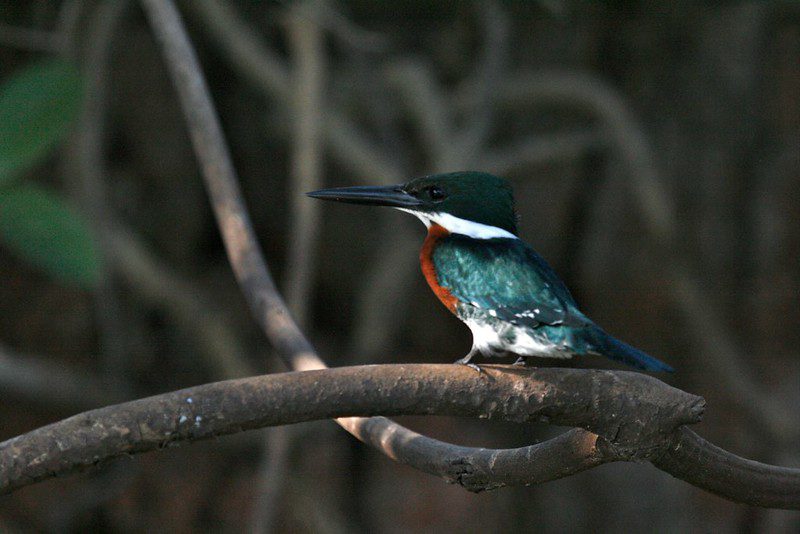
The kingfisher is one of the most fascinating birds found near tropical rivers, freshwater lakes, forest streams, and wetlands. Recognized for its colorful plumage, long pointed beak, excellent eyesight, and remarkable fishing abilities, this bird is a remarkable example of how wildlife adapts to life around water. In the Amazon rainforest, kingfishers are particularly interesting because they depend on healthy aquatic ecosystems for food, shelter, and breeding opportunities.
The Amazon rainforest is home to several kingfisher species that inhabit riverbanks, oxbow lakes, flooded forests, and slow-moving waterways. Their presence adds to the extraordinary diversity of Amazon rainforest birdlife and offers exciting opportunities for birdwatching in Peru. From the impressive Ringed Kingfisher to the smaller American Pygmy Kingfisher, these birds display different physical characteristics, feeding strategies, and habitat preferences.
For wildlife enthusiasts, observing a kingfisher diving into the water to capture a small fish is an unforgettable experience. Their hunting techniques demonstrate exceptional coordination, precision, and patience. Beyond their beauty, kingfishers also contribute to aquatic food webs and form part of the ecological balance of tropical river ecosystems.
Table of Contents
In this guide, we explore kingfisher habitat, feeding habits, hunting techniques, reproduction, behavior, Amazonian species, conservation challenges, and the best opportunities to observe these fascinating birds in Peru.
1. What Is a Kingfisher? Discover This Fascinating Tropical Bird
A kingfisher is a bird belonging to the family Alcedinidae. Kingfishers are widely distributed across different regions of the world, including tropical forests, temperate environments, coastal areas, and freshwater habitats. Although many species are associated with fishing, their diets vary depending on their environment and the availability of prey.
Most kingfishers are recognizable by their relatively large heads, compact bodies, strong beaks, and distinctive plumage. Their physical adaptations make them highly effective predators, particularly in environments where fish and other aquatic animals are abundant.
In the Amazon rainforest, kingfishers are commonly associated with rivers, streams, lagoons, and flooded forest environments. They frequently perch on branches overlooking the water, watching carefully for movement beneath the surface.
Physical Characteristics of Kingfishers
Kingfishers have several physical features that help them survive and hunt successfully in aquatic environments. Although their appearance differs between species, many share adaptations associated with catching and handling prey.
Bright Plumage and Iridescent Feathers
One of the most noticeable characteristics of kingfishers is their colorful plumage. Depending on the species, their feathers may display combinations of blue, green, turquoise, white, brown, and orange.
Some kingfishers have brilliant blue or green upperparts that contrast with lighter-colored undersides. These colors make them particularly attractive subjects for wildlife photography.
The appearance of their feathers is influenced by both pigmentation and structural coloration. In some species, microscopic feather structures interact with light to produce iridescent blue or green effects.
Long Pointed Beak and Sharp Eyesight
The kingfisher’s long, pointed beak is an essential hunting adaptation. It helps the bird capture slippery prey, including small fish, and carry food back to a suitable perch.
Their eyesight is equally important. Kingfishers spend considerable time observing the water from branches, rocks, or other elevated positions. They must accurately judge the location of prey before diving.
Body Structure and Adaptations for Hunting
Kingfishers generally have compact bodies, short legs, and strong feet. Their body structure supports quick movements between perches and rapid dives toward prey.
Many species can dive into water with remarkable precision. Their streamlined shape and specialized hunting behavior help them capture prey efficiently.
Different Kingfisher Species Found Around the World
Kingfishers belong to a diverse bird family containing numerous species with different ecological preferences. Some specialize in freshwater fishing, while others hunt insects, reptiles, amphibians, and small terrestrial animals.
In tropical regions, their diversity is particularly interesting because different species occupy different habitats. Some prefer large rivers, while others are more frequently observed around smaller streams and forest pools.
Why Kingfishers Are Important to Rainforest Biodiversity
Kingfishers contribute to rainforest biodiversity through their role as predators. By feeding on small fish, insects, crustaceans, and other animals, they participate in aquatic and terrestrial food webs.
Their dependence on suitable feeding and nesting environments also connects their survival to the condition of freshwater ecosystems.
Observing kingfishers can provide valuable opportunities to appreciate the relationship between forest vegetation, water quality, aquatic prey, and tropical birdlife.
2. Kingfisher Habitat: Where Do These Birds Live?
Kingfishers inhabit a variety of natural environments, but most species depend on areas where food is readily available and suitable perching or nesting locations exist. Their preferred habitats include tropical rainforests, freshwater rivers, wetlands, lakes, streams, mangroves, and coastal environments.
In tropical South America, the Amazon rainforest provides particularly favorable conditions for several kingfisher species. Its extensive river systems, abundant aquatic prey, and dense vegetation create diverse habitats that support their feeding and reproductive activities.
Tropical Rainforest and Freshwater Ecosystems
Freshwater ecosystems are essential to many kingfishers because they provide access to fish and other aquatic animals. The availability of suitable perches near the water also influences where these birds establish their feeding territories.
Riverbanks and Forest Streams
Riverbanks are among the most important habitats for kingfishers. Overhanging branches provide excellent observation points from which birds can watch for fish swimming close to the surface.
Small forest streams also attract kingfishers, particularly where clear water, exposed roots, and low vegetation provide suitable hunting locations.
These environments offer several advantages:
- Accessible feeding areas with abundant aquatic prey.
- Branches and exposed roots for hunting perches.
- Natural vegetation that provides shelter.
- Suitable locations for resting and territorial activities.
- Riverbank soil that may support nesting burrows in certain species.
Lakes, Lagoons, and Wetlands
Lakes, lagoons, and wetlands provide additional feeding opportunities. These habitats often support diverse freshwater fish populations, insects, amphibians, and crustaceans.
In the Amazon, oxbow lakes are particularly interesting environments for wildlife observation. These water bodies form when sections of rivers become separated from their main channels, creating distinctive aquatic habitats surrounded by rainforest vegetation.
Kingfishers may use branches along lagoon edges as observation points before diving toward suitable prey.
Mangrove Forests and Aquatic Habitats
Some kingfisher species inhabit coastal environments, including mangroves and estuaries. These ecosystems provide access to fish, crustaceans, and other aquatic organisms.
Although mangroves are not the primary habitat associated with most Amazonian freshwater kingfishers, they demonstrate the ecological flexibility of this bird family.
Kingfisher Habitat in the Amazon Rainforest
The Amazon rainforest offers an extensive network of aquatic habitats, including major rivers, tributaries, flooded forests, forest streams, and seasonal wetlands.
Kingfishers frequently use the vegetation along these waterways for hunting and resting. Their distribution depends on factors such as prey availability, water depth, vegetation structure, and nesting opportunities.
During seasonal flooding, changes in water levels can influence the availability and distribution of aquatic prey. These environmental changes may also affect the locations where kingfishers hunt.
Where to Find Kingfishers in Tambopata, Peru
The Tambopata region of southeastern Peru is an excellent destination for exploring Amazon rainforest birdlife.
Its combination of rivers, oxbow lakes, rainforest streams, and seasonally flooded forests creates suitable habitats for several kingfisher species.
Wildlife enthusiasts may encounter these birds along the Tambopata River, smaller tributaries, and forest lagoons.
Boat excursions can be especially productive because they allow visitors to observe riverbanks and overhanging branches without disturbing the surrounding vegetation.
How Water Quality and Vegetation Influence Their Habitat
Water quality directly influences aquatic ecosystems and the availability of food for kingfishers.
Pollution, excessive sedimentation, and habitat destruction can reduce fish populations and alter the structure of freshwater environments.
Healthy riverbank vegetation is equally important. Trees and shrubs provide hunting perches, shade, shelter, and suitable conditions for other wildlife.
Protecting freshwater ecosystems therefore benefits kingfishers and numerous other species that depend on Amazonian waterways.
3. Kingfisher Feeding Habits: What Do Kingfishers Eat?
Kingfisher feeding habits are closely connected to their habitat, physical adaptations, and hunting opportunities.
Although many people associate kingfishers exclusively with fish, their diet is more diverse than their common name suggests. Depending on the species, they may consume small fish, aquatic insects, crustaceans, amphibians, and other small animals.
Their feeding strategies demonstrate how tropical birds adapt to different ecological conditions.
The Kingfisher’s Diet and Favorite Prey
Fish are an important food source for many kingfishers, particularly those living near rivers, lakes, and streams.
However, prey selection varies considerably between species and depends on local food availability.
Small Fish and Aquatic Animals
Small freshwater fish are among the most common prey items for fish-eating kingfishers.
They often hunt near the water surface, targeting fish that swim close enough to be captured during a rapid dive.
Depending on their size, kingfishers may also consume small aquatic vertebrates.
Crustaceans and Freshwater Insects
Some species supplement their diet with freshwater crustaceans, aquatic insects, and insect larvae.
These food sources can be especially important in habitats where fish are less accessible.
The ability to exploit different prey allows certain kingfishers to adapt to changing environmental conditions.
Other Small Prey Depending on Species
Not all kingfishers depend heavily on aquatic prey.
Some species hunt terrestrial insects, small reptiles, amphibians, and other invertebrates.
This dietary variation highlights the diversity of feeding strategies within the kingfisher family.
Why Kingfishers Are Known as Fish-Eating Birds
Many kingfishers have specialized adaptations for catching fish.
Their pointed beaks help them seize prey, while their excellent eyesight allows them to identify movement near the water surface.
Their hunting behavior often involves remaining motionless on a perch until a suitable opportunity appears.
Once prey is detected, the bird dives rapidly and attempts to capture it with its beak.
Fish-eating kingfishers are therefore considered piscivorous birds, meaning that fish form a significant part of their diet.
How Kingfishers Locate Their Food
Kingfishers rely heavily on vision when searching for prey.
They often choose elevated branches that provide unobstructed views of the water.
From these positions, they observe the movement of small fish and wait for the right moment to strike.
Their ability to judge distance is especially important because light changes direction when passing between air and water.
Accurately estimating the position of submerged prey helps improve hunting success.
The Role of Kingfishers in Aquatic Food Webs
Kingfishers occupy an important position in freshwater food webs.
By feeding on small fish and aquatic invertebrates, they participate in the movement of energy between aquatic and terrestrial environments.
Their feeding activity also connects different ecological communities, especially when they capture aquatic prey and consume it on branches above the water.
Kingfishers are not responsible for controlling entire fish populations, but they form part of the natural predator-prey relationships that maintain ecosystem complexity.
4. Kingfisher Hunting Techniques: How Do They Catch Fish?
Kingfisher hunting techniques are among the most impressive behaviors to observe in tropical birdlife.
Their ability to remain motionless before suddenly diving into the water demonstrates exceptional coordination and precision.
Most fish-eating species use elevated perches to identify potential prey before launching an attack.
Perch Hunting and Observation Techniques
Perch hunting is a common feeding strategy among kingfishers.
The bird selects a branch, exposed root, or another suitable location overlooking the water.
From this position, it scans the surface for fish and other potential prey.
Remaining still helps reduce unnecessary movement and allows the bird to concentrate on detecting small changes in the water.
Once it identifies a suitable target, it launches itself toward the prey.
Underwater Hunting and Diving Techniques
Diving is one of the most recognizable hunting behaviors of kingfishers.
Their strong flight muscles and specialized body structure help them perform rapid movements toward the water.
How Kingfishers Spot Fish Beneath the Water
Kingfishers use their eyesight to locate prey, often watching for movement near the surface.
Because light bends as it enters water, identifying the precise position of a fish requires accurate visual judgment.
Their hunting experience and repeated observations help them improve their ability to target moving prey.
How They Dive and Capture Their Prey
When a suitable fish appears, the kingfisher launches from its perch and dives toward the water.
It attempts to capture the prey with its pointed beak before returning to a perch.
The success of each dive depends on several factors, including water clarity, prey movement, depth, and the bird’s ability to judge distance.
How They Return to Their Perches With Food
After capturing prey, many kingfishers return to a suitable branch.
They may adjust the position of the fish before swallowing it, often orienting the prey headfirst to make swallowing easier.
This behavior also helps reduce the risk of injury from fins or other sharp structures.
Adaptations That Make Kingfishers Successful Predators
Several adaptations contribute to their hunting abilities:
- Excellent eyesight for locating prey.
- Pointed beaks for capturing fish.
- Strong flight muscles for rapid dives.
- Compact bodies that support quick movements.
- Specialized visual processing that helps compensate for changes in light direction.
- Feeding behaviors that improve prey handling.
These characteristics make fish-eating kingfishers highly effective predators in suitable aquatic environments.
How Weather and Water Conditions Affect Hunting Behavior
Environmental conditions can influence hunting success.
Clear water may make it easier to identify fish, while muddy water and suspended sediment can reduce visibility.
Heavy rainfall may increase river levels and alter water clarity. Seasonal flooding can also change where fish are concentrated.
Kingfishers may respond by changing their feeding locations or selecting different hunting perches.
5. Kingfisher Behavior: Understanding Their Daily Activities
Kingfishers display a range of behaviors associated with feeding, territorial defense, communication, and reproduction.
Observing their daily activities provides valuable insight into how tropical birds interact with their environment.
Territorial Behavior and Social Interactions
Many kingfisher species are territorial, particularly when defending feeding areas and breeding sites.
Individuals may use vocalizations, displays, and aggressive movements to discourage other birds from entering their territories.
The size of a territory can depend on food availability, habitat quality, and breeding requirements.
Hunting, Feeding, and Resting Patterns
Kingfishers often spend considerable time perched near water.
They alternate between observing potential prey, attempting hunting dives, consuming food, and resting.
Their activity patterns can vary according to weather, prey availability, and local environmental conditions.
During quiet periods, they may remain almost motionless on a branch, making them difficult to notice among riverbank vegetation.
Vocalizations and Communication
Kingfishers communicate through a variety of calls.
Their vocalizations can serve different purposes, including territorial defense, contact between individuals, and communication during breeding activities.
Some species produce sharp, high-pitched calls that can be heard along forest waterways.
Recognizing these sounds can help birdwatchers locate kingfishers even when the birds are hidden by vegetation.
Seasonal Movements and Adaptation to the Environment
Kingfisher movements depend on the species and the conditions of their habitat.
Some populations remain in relatively stable territories, while others move in response to seasonal changes in food availability and environmental conditions.
In the Amazon, fluctuations in river levels and seasonal flooding can influence the distribution of aquatic prey and suitable feeding locations.
6. Kingfisher Reproduction: Nesting and Breeding Behavior
Kingfisher reproduction involves courtship, nest selection, egg incubation, and parental care.
Although breeding strategies vary among species, many kingfishers use burrows excavated in suitable soil banks.
These nesting sites provide protection for eggs and developing chicks.
Courtship Displays and Pair Formation
During the breeding season, kingfishers may engage in courtship behaviors that help establish reproductive pairs.
Depending on the species, these behaviors can include vocalizations, displays, and food offerings.
Males of some species present fish or other prey to females as part of courtship and pair bonding.
Kingfisher Nesting Behavior
Nesting requirements vary according to the species and the surrounding environment.
Some kingfishers depend on riverbanks or suitable soil formations where they can excavate nesting tunnels.
Burrow Nesting and Nesting Tunnels
Many fish-eating kingfishers construct nesting tunnels in earthen banks.
These tunnels may extend into the soil and end in a chamber where eggs are laid.
The tunnel provides a sheltered environment for reproduction and helps protect developing chicks.
Choosing Suitable Nesting Sites
Suitable nesting locations generally require stable soil, appropriate drainage, and protection from excessive disturbance.
Riverbank erosion, flooding, and human activities can reduce the availability of appropriate nesting sites.
Egg Incubation and Parental Care
After eggs are laid, adult birds participate in incubation.
Depending on the species, both parents may contribute to incubation and the care of their offspring.
During this period, adults must balance nesting responsibilities with their own feeding requirements.
Chick Development and Early Life Stages
Newly hatched kingfishers depend on their parents for food and protection.
Adult birds bring prey to the nest and feed their growing chicks.
As the young birds develop, they gradually acquire the physical abilities and behaviors necessary for independent survival.
Eventually, they leave the nest and begin learning how to locate and capture food.
7. Kingfishers in the Amazon Rainforest: Species and Biodiversity
The Amazon rainforest supports several fascinating kingfisher species.
These birds occupy different habitats along rivers, lakes, streams, and forest waterways.
Understanding their differences makes wildlife observation more rewarding and helps birdwatchers identify the species they encounter.
Amazonian Kingfisher Species
Five particularly interesting species found in the Amazon region include the following:
Ringed Kingfisher: This is one of the largest kingfishers in the Americas. It has a powerful beak, a prominent head, and distinctive plumage. It is frequently associated with larger rivers and open waterways.
Amazon Kingfisher: This medium-sized species is commonly found near freshwater environments. Its green upperparts and contrasting underside help distinguish it from other tropical kingfishers.
Green Kingfisher: A smaller species that frequently inhabits streams, rivers, and other freshwater environments. It often hunts from low branches near the water.
American Pygmy Kingfisher: One of the smallest kingfishers in the region. It is associated with forested waterways and quieter aquatic habitats, where its small size and colorful plumage make it an interesting bird to observe.
Green-and-rufous Kingfisher: This species has distinctive green and reddish-brown plumage. It is strongly associated with forest streams and shaded freshwater habitats.
These species demonstrate the diversity of Amazonian birdlife and the different ways kingfishers adapt to tropical aquatic environments.
The Relationship Between Kingfishers and Amazon Freshwater Fish
Amazon freshwater ecosystems support an extraordinary diversity of fish.
These aquatic animals form an essential part of the food supply for many fish-eating birds, including kingfishers.
The relationship between predators and prey is influenced by water depth, seasonal flooding, vegetation, and the availability of suitable hunting locations.
Healthy fish populations help sustain kingfisher communities and other wildlife that depend on freshwater resources.
Neotropical Birds and Avian Diversity
The Amazon is one of the world’s most important regions for bird diversity.
Its combination of forests, rivers, wetlands, and seasonal habitats supports an extraordinary variety of Neotropical birds.
Kingfishers are part of this broader avian community, alongside parrots, toucans, macaws, herons, eagles, and numerous smaller forest species.
Their presence highlights the ecological connections between terrestrial forests and freshwater environments.
Kingfishers Along the Amazon River and Its Tributaries
The Amazon River and its tributaries create extensive habitats for kingfishers.
River margins, flooded forests, and smaller waterways provide different feeding opportunities throughout the year.
Some species are more commonly associated with open river environments, while others prefer shaded forest streams.
These habitat differences help explain why several kingfisher species can occur within the same broad geographical region without necessarily competing for exactly the same resources.
Their Ecological Importance in Tropical River Ecosystems
Kingfishers contribute to the ecological complexity of tropical river ecosystems through their feeding relationships and habitat requirements.
Their survival depends on the interaction between aquatic food resources and suitable terrestrial vegetation.
Protecting riverbanks, maintaining water quality, and conserving surrounding rainforest habitats are therefore important for preserving their populations.
8. Kingfisher Birdwatching in Peru: Where and How to Spot Them
Peru is an outstanding destination for birdwatching because it contains diverse ecosystems ranging from the Andes to the Amazon rainforest.
The southeastern Amazon region offers particularly interesting opportunities to observe tropical bird species.
Kingfishers are among the birds that wildlife enthusiasts may encounter while exploring rivers, lakes, and forest waterways.
Best Places for Kingfisher Birdwatching in Peru
Tambopata National Reserve
The Tambopata region is recognized for its remarkable biodiversity and extensive rainforest habitats.
Its rivers, lagoons, and forest streams provide suitable environments for several kingfisher species.
Boat excursions along the waterways offer opportunities to observe birds perched on branches overlooking the water.
Visitors should pay particular attention to exposed roots, low branches, and quiet sections of riverbanks.
Madre de Dios River
The Madre de Dios River is another interesting location for observing Amazon rainforest birdlife.
Its riverbanks and surrounding vegetation provide feeding and resting habitats for aquatic birds.
Kingfishers may be seen watching the water from branches or flying rapidly along the river.
Amazon River and Its Tributaries
The Amazon River system supports numerous aquatic and terrestrial habitats.
Its tributaries, lagoons, and forest waterways create opportunities to encounter different kingfisher species.
The variety of aquatic environments makes this region particularly valuable for wildlife observation.
Birdwatching Tours in Puerto Maldonado
Puerto Maldonado serves as an important starting point for exploring the Peruvian Amazon.
From this area, visitors can access different rainforest environments where kingfishers and other tropical birds may be observed.
Guided boat excursions are particularly useful because experienced naturalists can identify suitable habitats, recognize bird calls, and explain animal behavior.
Responsible birdwatching should always prioritize wildlife welfare and avoid disturbing nesting sites or feeding activities.
Best Time to Observe Kingfishers in the Amazon
Kingfishers can be observed throughout the year in suitable habitats, although environmental conditions may influence birdwatching opportunities.
The Amazon has distinct seasonal patterns that affect river levels, rainfall, and accessibility.
During periods of lower water levels, some riverbanks and exposed branches may become easier to observe.
During higher water levels, flooded forests and changing aquatic habitats can provide different wildlife observation opportunities.
The best time for a visit therefore depends on the location, weather conditions, and the type of experience visitors prefer.
Wildlife Photography Tips for Capturing Kingfishers
Kingfishers are excellent subjects for wildlife photography because of their colorful plumage and distinctive hunting behavior.
However, photographing them requires patience and an understanding of their feeding habits.
Consider these practical tips:
- Use a telephoto lens to photograph birds from a respectful distance.
- Observe their preferred hunting perches before taking photographs.
- Use a fast shutter speed to capture sudden movements and diving behavior.
- Take advantage of natural morning or late-afternoon light.
- Avoid approaching nesting areas.
- Minimize sudden movements and unnecessary noise.
- Be patient and allow the bird to continue its natural activities.
Photographers should never use bait or disturb wildlife to obtain a photograph.
Essential Equipment for Amazon Birdwatching
Preparing suitable equipment can make birdwatching more comfortable and productive.
Useful items include binoculars, a camera with a telephoto lens, lightweight clothing, insect protection, drinking water, and a waterproof bag.
A field notebook can also help record species identification, habitat observations, and wildlife behavior.
For visitors exploring tropical rivers, sun protection and rain protection are particularly important.
9. Kingfisher Conservation: Threats and Protection
Although kingfishers inhabit different environments around the world, their survival depends on the availability of suitable natural habitats.
In tropical regions, environmental degradation can affect freshwater food supplies, nesting locations, and feeding territories.
Protecting kingfishers therefore requires conserving both aquatic ecosystems and surrounding rainforest vegetation.
Habitat Destruction and Deforestation
Deforestation is one of the major environmental challenges facing Amazon rainforest biodiversity.
Removing trees along rivers can eliminate important hunting perches and reduce natural shelter.
The destruction of riverbank vegetation may also increase erosion and sedimentation, changing the structure of freshwater habitats.
Protecting natural forest corridors and maintaining healthy vegetation along waterways are important conservation measures.
Water Pollution and Freshwater Ecosystem Degradation
Water pollution can negatively affect fish populations and other aquatic organisms.
Contamination from mining activities, agricultural chemicals, waste disposal, and other human activities can damage freshwater ecosystems.
As predators that depend on healthy aquatic food webs, fish-eating kingfishers may be affected by changes in prey availability and habitat quality.
Reducing pollution and protecting freshwater resources are essential for maintaining healthy wildlife populations.
Climate Change and Its Effects on Aquatic Habitats
Climate change can influence rainfall patterns, river levels, flooding, and the distribution of aquatic organisms.
These changes may affect where kingfishers hunt and whether suitable nesting environments remain available.
Extreme weather events can also damage riverbank habitats and disrupt breeding activities.
Protecting resilient ecosystems and maintaining connected natural habitats can help wildlife respond to environmental changes.
Wildlife Protection and Freshwater Conservation
Conservation efforts should focus on protecting natural waterways, maintaining forest vegetation, and reducing human disturbances.
Important actions include:
- Conserving rainforest habitats.
- Protecting riverbanks and wetlands.
- Reducing water pollution.
- Supporting sustainable land-use practices.
- Monitoring bird populations and habitat conditions.
- Promoting environmental education.
- Preventing unnecessary disturbance of nesting areas.
These measures benefit not only kingfishers but also fish, amphibians, mammals, reptiles, and countless other rainforest organisms.
How Sustainable Tourism Supports Amazon Bird Conservation
Responsible ecotourism can contribute to conservation by creating economic incentives for protecting natural habitats.
Wildlife observation encourages visitors to appreciate the importance of biodiversity and the need to preserve natural environments.
Sustainable tourism can also support local communities, environmental education, and conservation initiatives.
Visitors should choose responsible wildlife experiences that respect animal behavior, protect sensitive habitats, and minimize environmental impacts.
How Visitors Can Help Protect Rainforest Birdlife
Every visitor can contribute to wildlife protection through responsible travel choices.
Avoid leaving waste in natural environments, follow local conservation guidelines, respect wildlife observation distances, and avoid disturbing nests.
Supporting sustainable tourism initiatives and learning about local biodiversity can also encourage long-term conservation.
Small responsible actions help protect the ecological richness of the Amazon rainforest.
10. Fascinating Kingfisher Facts You Should Know
Kingfishers possess several remarkable characteristics that make them especially interesting to wildlife enthusiasts.
Their physical adaptations, feeding behavior, and ecological relationships reveal how specialized birds survive in different environments.
Interesting Facts About Kingfisher Colors
Kingfishers are famous for their striking plumage.
Many species display brilliant shades of blue and green, while others have contrasting orange, white, brown, or reddish feathers.
In some species, the vivid blue appearance results largely from structural coloration rather than blue pigment.
This means microscopic structures in the feathers interact with light to produce their characteristic colors.
How Their Eyesight Helps Them Catch Fish
Vision is essential for fish-eating kingfishers.
They must identify potential prey and estimate its location before diving.
Their visual systems are adapted to the challenges of observing prey near or beneath the water surface.
This ability allows them to make precise hunting movements in environments where light and water conditions constantly change.
Their Unique Hunting Adaptations
Kingfishers combine several adaptations to capture prey successfully.
Their pointed beaks help seize slippery fish, while their strong flight muscles support rapid dives.
Their hunting behavior also involves patience and careful observation.
Rather than continuously chasing prey, many species wait for suitable opportunities before launching an attack.
Differences Between Tropical and Temperate Kingfishers
Kingfishers occupy a wide range of climates and environments.
Tropical species often inhabit rainforests, wetlands, and warm freshwater ecosystems, while temperate species may experience seasonal changes in temperature and food availability.
Their physical characteristics and feeding strategies vary according to their ecological requirements.
Some tropical species are strongly associated with shaded forest streams, while others prefer open rivers and larger aquatic environments.
Why Kingfishers Are Fascinating Birds to Observe
Kingfishers combine attractive plumage, distinctive calls, and extraordinary hunting behavior.
Their presence along tropical rivers provides birdwatchers with opportunities to observe the connections between forest vegetation and aquatic ecosystems.
For wildlife photographers and nature enthusiasts, even a brief encounter with a kingfisher can become one of the most memorable moments of an Amazon rainforest experience.
11. Frequently Asked Questions About Kingfishers
Where Do Kingfishers Live?
Kingfishers inhabit a variety of environments, including rivers, streams, lakes, wetlands, mangroves, and coastal areas. In the Amazon rainforest, they are commonly associated with freshwater habitats surrounded by tropical vegetation.
What Do Kingfishers Eat?
Many kingfishers primarily eat small fish. Depending on the species, their diet may also include aquatic insects, crustaceans, amphibians, reptiles, and other small animals.
How Do Kingfishers Catch Fish?
Kingfishers commonly hunt from branches overlooking the water. They observe potential prey, dive rapidly, and attempt to capture fish with their pointed beaks before returning to a perch.
Are Kingfishers Found in the Amazon Rainforest?
Yes. Several kingfisher species inhabit the Amazon rainforest, including the Ringed Kingfisher, Amazon Kingfisher, Green Kingfisher, American Pygmy Kingfisher, and Green-and-rufous Kingfisher.
Where Can You See Kingfishers in Peru?
Kingfishers can be observed in suitable freshwater habitats throughout parts of the Peruvian Amazon. The Tambopata region, Madre de Dios River, and surrounding rainforest waterways offer opportunities for birdwatching.
What Is the Best Time to Photograph Kingfishers?
Kingfishers can be photographed throughout the year. Early mornings and late afternoons often provide favorable natural lighting. Patience, a telephoto lens, and knowledge of their preferred hunting locations can improve photography opportunities.
Do Kingfishers Build Nests in Trees?
Many fish-eating kingfishers excavate nesting tunnels in suitable soil banks rather than building conventional nests in trees. Nesting strategies differ among species.
Why Are Kingfishers Important to Freshwater Ecosystems?
Kingfishers participate in aquatic food webs by feeding on fish and other small animals. Their dependence on healthy freshwater habitats also highlights the importance of protecting rivers, wetlands, and surrounding vegetation.
How Many Kingfisher Species Live in the Amazon?
Several species occur in the Amazon region, including five commonly recognized species: Ringed Kingfisher, Amazon Kingfisher, Green Kingfisher, American Pygmy Kingfisher, and Green-and-rufous Kingfisher. Their distribution varies across habitats and geographical areas.
Are Kingfishers Endangered?
Conservation status varies by species. Some kingfishers have relatively stable populations, while others face greater pressures from habitat destruction, pollution, and environmental changes. Species-specific conservation assessments are necessary to determine their current risk.
Conclusion: Discover the Beauty of Kingfishers in the Amazon Rainforest
The kingfisher is much more than a colorful bird living near tropical rivers. Its remarkable eyesight, specialized beak, hunting techniques, and feeding behavior demonstrate the extraordinary adaptations that allow wildlife to survive in freshwater environments.
In the Amazon rainforest, kingfishers are an important part of the region’s remarkable biodiversity. From the large Ringed Kingfisher to the tiny American Pygmy Kingfisher, different species occupy rivers, streams, lagoons, and forest waterways, contributing to the ecological relationships that connect aquatic and terrestrial environments.
Their survival depends on healthy freshwater ecosystems, suitable riverbank vegetation, and abundant natural food resources. Deforestation, water pollution, and habitat degradation can threaten these conditions, making rainforest and freshwater conservation increasingly important.
For travelers and wildlife enthusiasts, birdwatching in Peru offers an opportunity to appreciate these fascinating birds in their natural environments. Exploring the waterways of Tambopata and Madre de Dios can reveal extraordinary encounters with kingfishers and many other tropical species.
By supporting responsible ecotourism, respecting wildlife, and protecting natural habitats, we can help preserve the remarkable diversity of Amazon rainforest birdlife for future generations.