
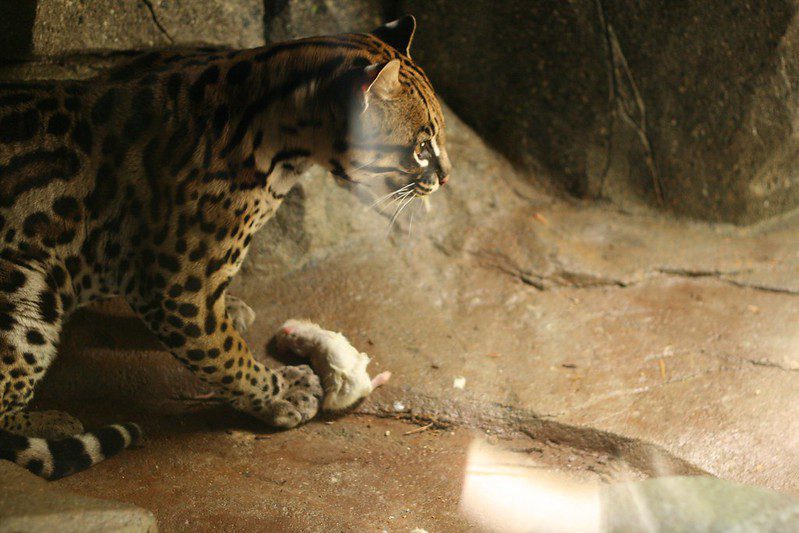
The ocelot is one of the most beautiful and elusive wild cats living in the Americas. Recognized by its golden-yellow coat, dark rosette-shaped spots, and striking facial markings, this medium-sized feline is an important predator in tropical rainforest ecosystems. From the dense Amazon rainforest to dry forests, mangroves, and grasslands, ocelots inhabit a variety of environments throughout Central and South America.
Although they are sometimes confused with larger spotted cats such as jaguars and smaller relatives such as margays, ocelots have distinctive physical characteristics, hunting techniques, and behavioral adaptations. They are mostly active at night, use their excellent eyesight and hearing to locate prey, and rely on their patterned fur to remain concealed among vegetation.
Ocelots are particularly interesting because of their ecological importance. By hunting rodents, birds, reptiles, and other small animals, they help regulate wildlife populations and maintain the balance of tropical forest food webs.
In this guide, you will discover fascinating ocelot facts, including their scientific classification, physical characteristics, size, diet, habitat, reproduction, behavior, natural predators, and conservation status. You will also learn where ocelots live in the Amazon rainforest and how they compare with other wild cats of South America.
What Is an Ocelot?
The ocelot (Leopardus pardalis) is a medium-sized wild cat native to the Americas. It belongs to the Felidae family, which includes domestic cats, lions, tigers, leopards, jaguars, and other wild feline species.
Table of Contents
Ocelots are known for their beautiful spotted coats, powerful bodies, and exceptional ability to move quietly through dense vegetation. Their markings provide camouflage in forest environments, making them difficult to observe even when they are relatively close.
These carnivorous mammals are primarily solitary and territorial. Each individual generally occupies a home range where it hunts, rests, and searches for potential mates. Although they spend much of their time on the ground, ocelots are also capable climbers and swimmers.
Ocelots are distributed across a large geographic area, from parts of the southern United States and Mexico through Central America and much of South America. They are particularly associated with tropical forests, including the Amazon rainforest.
Ocelot Scientific Name and Classification
The scientific name of the ocelot is Leopardus pardalis. It belongs to the genus Leopardus, a group of small and medium-sized wild cats native to the Americas.
Its classification helps distinguish it from other spotted felines, including the margay (Leopardus wiedii) and oncilla (Leopardus tigrinus).
| Taxonomic classification | Name |
|---|---|
| Kingdom | Animalia |
| Phylum | Chordata |
| Class | Mammalia |
| Order | Carnivora |
| Family | Felidae |
| Subfamily | Felinae |
| Genus | Leopardus |
| Species | Leopardus pardalis |
| Common name | Ocelot |
The ocelot is closely related to several other Neotropical wild cats. However, its larger body, distinctive coat patterns, and ecological characteristics make it relatively easy to distinguish from its smaller relatives.
Where Does the Name Ocelot Come From?
The word ocelot comes from the Nahuatl word ocēlōtl, historically associated with the jaguar. The name became widely used to describe this spotted American wild cat.
Ocelots have also appeared in historical accounts and cultural traditions throughout Mesoamerica, where spotted felines were associated with strength, hunting abilities, and the natural world.
Is an Ocelot a Big Cat?
No. Despite its impressive appearance, the ocelot is classified as a small-to-medium-sized wild cat rather than a big cat.
Unlike lions, tigers, leopards, and jaguars, ocelots belong to the group of smaller felines that cannot roar in the same way. They produce sounds such as growls, meows, purrs, and other vocalizations.
Their relatively compact size allows them to move through thick vegetation, climb trees, and hunt smaller prey with considerable agility.
Ocelot Physical Characteristics: Size, Weight, and Appearance
The ocelot has a distinctive appearance that makes it one of the most recognizable wild cats in the Americas. Its coat features a combination of dark spots, elongated markings, stripes, and rosettes against a golden, yellowish, or reddish-brown background.
Its muscular body, relatively short legs, rounded ears, and long tail are adaptations that help it navigate different forest environments.
How Big Is an Ocelot?
An adult ocelot is considerably larger than a domestic cat but much smaller than a jaguar or puma. Its body length generally ranges from approximately 55 to 100 centimeters (22–39 inches), excluding the tail.
The tail measures approximately 25 to 45 centimeters (10–18 inches), while adult individuals commonly weigh between 7 and 16 kilograms (15–35 pounds).
| Physical characteristic | Approximate measurement |
|---|---|
| Body length | 55–100 cm |
| Tail length | 25–45 cm |
| Weight | 7–16 kg |
| Shoulder height | 40–50 cm |
| Lifespan in the wild | Around 7–10 years |
Females are generally smaller than males, although size varies according to geographic location, genetics, and environmental conditions.
Ocelot Fur, Spots, and Markings
One of the most remarkable characteristics of an ocelot is its patterned coat. Its fur contains dark spots and elongated rosettes that form irregular arrangements across the body.
Unlike the small circular spots found on some other wild cats, ocelot markings frequently form larger shapes with dark borders and lighter centers.
These patterns provide natural camouflage in forests, where sunlight filters through leaves and creates changing combinations of shadows and light.
The coat also features distinctive markings on the neck, legs, and face. Dark stripes extend from the forehead toward the eyes, while white areas around the cheeks and chin create additional facial contrast.
Ocelot Eyes and Night Vision
Ocelots have large eyes adapted for hunting in low-light environments. Their vision allows them to detect movement and locate prey during nighttime and twilight hours.
Like other cats, they possess a reflective layer behind the retina called the tapetum lucidum. This structure helps improve vision in dim conditions by reflecting light back through the retina.
Their eyes are particularly useful when hunting in dense forests, where visibility can be limited by vegetation and darkness.
Ocelot Teeth, Claws, and Paws
Ocelots possess sharp canine teeth designed to capture and kill prey. Their carnivorous teeth also include cutting teeth that help tear meat into manageable pieces.
Their paws contain retractable claws, allowing them to grip prey, climb trees, and move across different surfaces.
Soft paw pads help reduce noise while walking, giving ocelots an advantage when approaching animals without being detected.
Where Do Ocelots Live? Habitat and Geographic Distribution
Ocelots live throughout a large portion of the Americas, occupying habitats from southern Texas and Mexico to Central America and much of South America.
They are particularly common in tropical and subtropical environments, including rainforests, seasonal forests, mangroves, and areas with dense vegetation.
The Amazon rainforest provides an important habitat because it contains abundant prey, water sources, and vegetation that offers shelter and protection.
Ocelot Habitat in the Amazon Rainforest
The Amazon rainforest is one of the most important ecosystems for ocelots. Its extensive vegetation, river systems, and diverse wildlife provide suitable conditions for these predators.
Ocelots can inhabit several forest environments, including:
- Tropical lowland rainforests.
- Dense understory vegetation.
- Seasonally flooded forests.
- Forest edges and clearings.
- Riverbanks and areas near water.
- Secondary forests with sufficient vegetation.
They often use fallen trees, thick bushes, tree roots, and natural shelters as resting locations.
Although ocelots are capable of climbing trees, they generally spend much of their hunting time on the forest floor, where they search for rodents, reptiles, birds, and other prey.
Where Are Ocelots Found in South America?
Ocelots occur in numerous South American countries, including:
- Peru
- Brazil
- Colombia
- Ecuador
- Bolivia
- Venezuela
- Guyana
- Suriname
- French Guiana
- Paraguay
- Argentina
They are especially associated with tropical forest regions, although their distribution extends into other suitable habitats.
Ocelots in Peru and Tambopata
Peru is an important country for Amazon rainforest wildlife, including ocelots. These wild cats inhabit forest ecosystems in the Peruvian Amazon, where they benefit from extensive vegetation and diverse prey populations.
The Tambopata region, located in southeastern Peru, contains important rainforest habitats for numerous mammals, birds, reptiles, and amphibians.
Within and around Tambopata National Reserve, the combination of tropical forest, river systems, and abundant wildlife creates suitable conditions for several wild feline species.
Ocelots are elusive and mostly nocturnal, so sightings are uncommon during ordinary jungle walks. However, camera traps used by researchers and conservationists can document their movements and provide valuable information about their populations.
Other wild cats found in the broader Amazon region include jaguars, pumas, margays, jaguarundis, and oncillas.
What Type of Habitat Do Ocelots Prefer?
Ocelots generally prefer environments with dense vegetation, suitable shelter, and abundant prey.
They can occupy forests at different elevations, but their distribution is strongly influenced by the availability of food, water, and protective vegetation.
Unlike animals that depend on open grasslands, ocelots benefit from environments where they can remain hidden while hunting and resting.
Their ability to use different forest types helps explain their extensive distribution throughout the Americas.
What Do Ocelots Eat? Diet and Hunting Behavior
Ocelots are carnivorous mammals that feed on a wide variety of animals. Their diet mainly consists of small and medium-sized vertebrates, including rodents, birds, reptiles, amphibians, and occasionally fish.
As opportunistic predators, they adapt their feeding habits according to the prey available in their environment. This flexibility allows them to survive in different ecosystems, from tropical rainforests to dry forests and wetlands.
What Animals Do Ocelots Hunt?
Ocelots hunt a variety of rainforest animals, particularly species that live close to the forest floor.
Their typical prey includes:
- Rodents: Rats, mice, spiny rats, and other small mammals.
- Birds: Ground-dwelling birds and smaller forest species.
- Reptiles: Lizards, snakes, and small turtles.
- Amphibians: Frogs and other amphibians.
- Fish: Small fish when opportunities arise near water.
- Other small animals: Crabs and insects may occasionally supplement their diet.
The exact composition of their diet varies according to habitat, season, and local prey availability.
How Do Ocelots Hunt?
Ocelots are stealthy hunters that rely on excellent hearing, sharp eyesight, and camouflage to capture prey.
They usually hunt alone, moving quietly through vegetation while searching for signs of nearby animals. Once they detect potential prey, they approach carefully before launching a quick attack.
Their powerful hind legs help them leap toward prey, while their sharp claws and teeth provide an effective way to capture and kill animals.
Ocelots can also hunt near streams and wetlands, where they may encounter frogs, fish, and other aquatic animals.
Are Ocelots Nocturnal?
Yes. Ocelots are primarily nocturnal and crepuscular, meaning they are most active during the night, dawn, and dusk.
However, their activity patterns can change according to environmental conditions, human disturbance, and the availability of prey.
During the daytime, they generally rest in sheltered places such as dense vegetation, hollow trees, and other protected locations.
Their nighttime activity helps them avoid some daytime disturbances while taking advantage of prey that becomes active after sunset.
What Role Do Ocelots Play in the Food Chain?
Ocelots are important predators in tropical forest ecosystems because they help control populations of smaller animals.
By hunting rodents and other prey, they contribute to the natural balance of the rainforest food web.
Their presence also reflects the condition of their habitat. Healthy forest ecosystems with sufficient prey and vegetation can support populations of these medium-sized predators.
Ocelot Behavior and Lifestyle
Ocelots are generally solitary animals that spend most of their lives moving through established territories. They are highly adaptable and use a combination of stealth, climbing abilities, and nocturnal activity to survive.
Although they are powerful predators, they usually avoid unnecessary encounters with larger animals and humans.
Are Ocelots Solitary Animals?
Yes. Ocelots generally live alone outside the breeding season and the period when females raise their young.
Adult individuals maintain territories that may overlap with those of other ocelots, particularly between males and females.
They communicate through scent markings, vocalizations, and other signals that help establish territorial boundaries.
Can Ocelots Climb Trees?
Yes. Ocelots are capable climbers and can use trees to escape danger, rest, and explore their surroundings.
Their strong limbs, muscular bodies, and sharp claws help them move along branches and climb tree trunks.
However, unlike margays, which are especially adapted to an arboreal lifestyle, ocelots spend much of their time on the ground.
Can Ocelots Swim?
Yes. Ocelots are capable swimmers and can cross rivers, streams, and other bodies of water when necessary.
Their swimming ability is useful in tropical rainforest environments, where rivers, wetlands, and flooded forests form an important part of the landscape.
They may also hunt near water sources, where prey animals gather.
How Do Ocelots Communicate?
Ocelots use different communication methods to interact with other members of their species.
These include:
- Scent marking: Urine and scent glands help communicate territorial information.
- Vocalizations: Growls, meows, purrs, and other sounds are used in different situations.
- Body language: Ear positions, facial expressions, and posture can communicate behavior and intentions.
- Scratching: Claw marks on trees and other surfaces can provide territorial signals.
These communication methods are particularly important for solitary animals that rarely encounter one another outside breeding periods.
Ocelot Reproduction and Life Cycle
Ocelots reproduce sexually, and females generally raise their young without assistance from males.
Breeding can occur throughout the year in some regions, although seasonal patterns may vary depending on geographic location and environmental conditions.
Female ocelots search for protected locations where they can give birth and care for their kittens.
Ocelot Mating Season and Breeding Habits
Ocelots generally live independently, but males and females interact during breeding periods.
Males may travel across their territories searching for receptive females. After mating, the male typically does not participate in raising the offspring.
Females select sheltered locations, such as dense vegetation or protected spaces among tree roots, where their young can remain hidden.
How Long Is an Ocelot Pregnant?
The gestation period of an ocelot generally lasts around 79–85 days.
After this period, the female gives birth to a small litter, commonly consisting of one or two kittens.
Newborn ocelots are vulnerable and depend entirely on their mother for warmth, nourishment, and protection.
Baby Ocelot: Growth and Development
Baby ocelots are born with their eyes closed and a soft coat covered in characteristic dark markings.
During their first weeks of life, they remain in a protected den while their mother provides milk and protection.
As they grow, their eyesight and coordination improve, allowing them to explore their surroundings.
Important stages in their development include:
- Newborn stage: Kittens depend entirely on their mother.
- Early development: Their eyes open, and they begin moving around the den.
- Exploration: Young ocelots gradually explore nearby areas.
- Learning to hunt: They observe their mother and develop hunting skills.
- Independence: Juveniles eventually leave their mother and establish their own territories.
The mother plays an essential role in teaching her kittens how to locate, approach, and capture prey.
How Long Do Ocelots Live?
Ocelots can live approximately 7–10 years in the wild, although lifespan varies depending on environmental conditions, disease, predation, and human-related threats.
In captivity, where food, veterinary care, and protection are available, some individuals can live considerably longer.
Ocelot Adaptations for Survival in the Rainforest
Ocelots possess several physical and behavioral adaptations that allow them to survive in tropical forests.
Their camouflage, excellent senses, sharp claws, and flexible hunting behavior make them effective predators in environments where visibility is often limited.
Camouflage and Spotted Fur
The ocelot’s coat is one of its most important adaptations.
Its irregular dark markings break up the outline of its body, helping it blend into the forest floor, fallen leaves, branches, and vegetation.
This camouflage provides two important advantages: it helps ocelots approach prey without being noticed and makes it more difficult for other animals to detect them.
Excellent Hearing and Night Vision
Ocelots rely heavily on their senses when hunting.
Their sensitive hearing helps them detect small movements made by rodents and other animals hidden beneath leaves or vegetation.
Their eyes are adapted to low-light conditions, making nighttime hunting more effective.
Together, these sensory abilities allow them to locate prey even when visual conditions are poor.
Powerful Legs and Retractable Claws
Ocelots have strong limbs that support quick movements, short bursts of speed, and powerful jumps.
Their retractable claws help them grip prey and climb trees, while their padded feet allow them to move quietly through the forest.
Adaptability to Different Environments
Although tropical rainforests are important habitats, ocelots can survive in several other environments.
They can inhabit mangroves, wetlands, dry forests, scrublands, and areas of secondary vegetation.
Their ability to exploit different prey species and shelter locations helps them occupy a wide geographic range.
Ocelot Predators and Natural Enemies
Although ocelots are predators themselves, they can become prey for larger carnivores.
Their natural enemies include some of the largest predators found in Central and South American ecosystems.
Do Jaguars Eat Ocelots?
Jaguars are among the potential natural predators of ocelots.
The jaguar (Panthera onca) is considerably larger and more powerful, and it occupies a higher position in many rainforest food webs.
Although interactions between the two cats are not necessarily common, jaguars may kill smaller carnivores, including ocelots, under certain circumstances.
Do Pumas Eat Ocelots?
Pumas (Puma concolor) are another large feline that may pose a threat to ocelots.
They are powerful predators with a broad geographic distribution that overlaps with ocelot habitats.
Direct encounters can result in competition or predation, although these interactions depend on local conditions.
Other Natural Threats
Large snakes, including anacondas, may represent potential threats to ocelots, particularly near water.
Young ocelots are more vulnerable than adults because of their small size and limited ability to defend themselves.
However, predation is only one part of the natural challenges these animals face. Habitat destruction and human activities represent much more significant conservation concerns.
Are Ocelots Endangered? Conservation Status and Threats
Ocelots are currently classified as Least Concern on the IUCN Red List at the species level. However, this does not mean that every population is safe or that the species faces no conservation challenges.
Local populations can decline when forests are destroyed, natural habitats become fragmented, or animals are killed by vehicles and illegal hunting.
Protecting suitable rainforest habitats is essential for maintaining healthy ocelot populations throughout their geographic range.
Is the Ocelot Population Decreasing?
Ocelot populations vary across different regions.
In some areas, populations remain relatively stable because extensive natural habitats are still available. In other locations, deforestation, urban development, and agricultural expansion have reduced suitable habitat.
Because ocelots are elusive and difficult to observe, researchers often use camera traps, tracking methods, and other wildlife monitoring techniques to estimate their distribution and population trends.
Major Threats to Ocelots
The main threats affecting ocelots include:
1. Deforestation
Forest clearing for agriculture, cattle ranching, mining, and infrastructure development reduces the amount of available habitat.
2. Habitat fragmentation
Roads, farms, settlements, and other developments divide forests into smaller sections, making it harder for ocelots to move between suitable habitats.
3. Road mortality
Ocelots sometimes cross roads while moving between territories or searching for food. Vehicle collisions can cause serious population losses, especially in fragmented landscapes.
4. Illegal hunting and wildlife trafficking
Ocelots have historically been hunted for their beautiful spotted fur. Although international trade restrictions have reduced this threat, illegal killing and trafficking remain concerns in some areas.
5. Human-wildlife conflict
Ocelots may occasionally enter agricultural areas or approach human settlements while searching for prey, increasing the possibility of conflict.
Ocelot Conservation Efforts
Conservation programs focus on protecting forest habitats, monitoring wildlife populations, reducing illegal hunting, and improving connectivity between fragmented ecosystems.
Camera traps are particularly useful because they allow researchers to study ocelot movements without disturbing these elusive animals.
Protected areas, wildlife corridors, and responsible land management also help maintain suitable habitats.
In the Peruvian Amazon, protected rainforest landscapes such as Tambopata National Reserve contribute to the conservation of many species, including wild cats and their prey.
Ocelots in the Amazon Rainforest: Importance to Biodiversity
The Amazon rainforest contains one of the richest collections of wildlife on Earth. Among its many mammals are several species of wild cats, including jaguars, pumas, margays, jaguarundis, and ocelots.
Ocelots are important members of this ecosystem because they help regulate populations of smaller animals and contribute to the natural functioning of rainforest food webs.
Ocelots and Other Amazon Rainforest Animals
Ocelots share their habitat with thousands of animal species, including monkeys, rodents, birds, reptiles, amphibians, and other carnivorous mammals.
Some animals found in the same broad rainforest ecosystems include:
- Jaguars
- Pumas
- Margays
- Jaguarundis
- Giant anteaters
- Tapirs
- Capybaras
- Agoutis
- Howler monkeys
- Squirrel monkeys
- Toucans
- Macaws
- Anacondas
- Black caimans
These species occupy different ecological roles, creating a complex network of predator-prey relationships.
Why Are Ocelots Important to the Amazon Ecosystem?
Ocelots help regulate populations of rodents and other small vertebrates.
This predatory activity contributes to ecological balance and can influence the distribution and abundance of prey species.
They are also part of the wider food web, providing a potential food source for larger predators.
Their presence in rainforest habitats is therefore an important part of the biodiversity that makes the Amazon such a remarkable ecosystem.
Can You See Ocelots on an Amazon Jungle Tour?
Seeing an ocelot in the wild is possible but relatively uncommon. These cats are naturally elusive, usually active at night, and excellent at hiding among dense vegetation.
In destinations such as Puerto Maldonado and Tambopata, visitors may encounter many rainforest animals during guided jungle walks, river excursions, and nighttime wildlife activities.
However, observing an ocelot requires considerable luck.
Wildlife camera traps offer a better opportunity to document their presence because they can record animals moving along forest trails after dark.
Responsible wildlife tourism can also help support the protection of natural habitats by increasing awareness of rainforest biodiversity and the importance of conservation.
Ocelot vs. Other Wild Cats: Main Differences
The Americas are home to several wild cat species with spotted coats and overlapping geographic distributions. However, each species has different physical characteristics, hunting behaviors, and habitat preferences.
Understanding these differences helps identify ocelots and distinguish them from other Neotropical felines.
Ocelot vs. Jaguar
The ocelot and jaguar both have spotted coats, but they differ considerably in size and physical strength.
| Characteristic | Ocelot | Jaguar |
|---|---|---|
| Scientific name | Leopardus pardalis | Panthera onca |
| Family | Felidae | Felidae |
| Body size | Medium | Large |
| Weight | 7–16 kg | 45–120 kg |
| Coat | Spots and elongated rosettes | Large rosettes, often with central spots |
| Diet | Small and medium-sized prey | Large and medium-sized prey |
| Hunting | Primarily nocturnal | Day and night |
| Habitat | Forests, wetlands, and other habitats | Forests, wetlands, and other habitats |
The jaguar is the largest wild cat in the Americas, while the ocelot is considerably smaller and generally hunts smaller animals.
Ocelot vs. Margay
The margay (Leopardus wiedii) is another spotted wild cat found in Central and South America.
Although both species have similar coats, margays are smaller and more specialized for climbing trees.
Margays possess flexible ankle joints that allow them to descend tree trunks headfirst and move through branches with exceptional agility.
Ocelots, in comparison, spend more time hunting on the ground.
Ocelot vs. Oncilla
The oncilla (Leopardus tigrinus) is a small wild cat native to parts of Central and South America.
It is generally smaller than an ocelot and has a more compact body with smaller dark markings.
Both species belong to the genus Leopardus, but they occupy different ecological niches and have different geographic distributions.
Ocelot vs. Jaguarundi
The jaguarundi (Herpailurus yagouaroundi) has a very different appearance from an ocelot.
Instead of a spotted coat, jaguarundis have relatively uniform-colored fur that can range from reddish-brown to gray or black.
They also have elongated bodies, short legs, and relatively small heads, giving them an unusual appearance compared with other American wild cats.
Interesting Facts About Ocelots
Ocelots have several fascinating characteristics that make them unique among rainforest mammals.
Here are some interesting facts about these elusive American wild cats:
1. Every ocelot has a unique coat pattern: Their spots and markings vary between individuals, making their patterns useful for identifying animals in camera-trap studies.
2. They are excellent nocturnal hunters: Their sensitive hearing and low-light vision help them locate prey after sunset.
3. They are strong swimmers: Ocelots can cross rivers and streams, making them well adapted to tropical rainforest environments.
4. They can climb trees: Although they spend much of their time on the ground, they can climb when necessary.
5. They have a large geographic range: Ocelots occur from southern North America through Central America and much of South America.
6. They are mostly solitary: Adults generally live independently and maintain individual territories.
7. They hunt many different animals: Their diet includes rodents, birds, reptiles, amphibians, and occasionally fish.
8. Their fur provides camouflage: Their spotted markings help them blend into the forest environment.
9. They are smaller than jaguars: Despite their similar spotted appearance, jaguars can weigh several times more than ocelots.
10. They are important rainforest predators: By hunting smaller animals, ocelots help maintain ecological balance.
Frequently Asked Questions About Ocelots
1. What is an ocelot?
An ocelot is a medium-sized wild cat native to the Americas. Its scientific name is Leopardus pardalis. It is recognized by its golden-colored coat, dark spots, and distinctive facial markings.
2. Where do ocelots live?
Ocelots live throughout Central and South America, as well as parts of southern Texas and Mexico. They inhabit tropical rainforests, dry forests, mangroves, wetlands, and areas with dense vegetation.
3. What do ocelots eat?
Ocelots are carnivores that eat rodents, birds, reptiles, amphibians, fish, and other small animals. They are opportunistic hunters that adapt their diet to the prey available in their habitat.
4. How big is an ocelot?
Adult ocelots generally measure 55–100 centimeters (22–39 inches) in body length and weigh approximately 7–16 kilograms (15–35 pounds). Their tails measure approximately 25–45 centimeters.
5. Are ocelots dangerous to humans?
Ocelots are wild predators, but they generally avoid humans. They are not considered a major threat to people. However, they can defend themselves if cornered or threatened, so they should always be observed from a safe distance.
6. Are ocelots nocturnal?
Yes. Ocelots are primarily nocturnal and crepuscular animals. They are generally most active during nighttime, dawn, and dusk, when they search for prey and move through their territories.
7. Can ocelots climb trees?
Yes. Ocelots are capable climbers and use trees for resting, exploring, and escaping potential threats. However, they spend more time on the ground than highly arboreal cats such as margays.
8. Can ocelots swim?
Yes. Ocelots are good swimmers and can cross rivers, streams, and other bodies of water. This ability is useful in the Amazon rainforest, where waterways form an important part of their habitat.
9. How long do ocelots live?
Ocelots generally live around 7–10 years in the wild. Individuals in captivity can sometimes live longer because they receive regular food, veterinary care, and protection from natural threats.
10. How many babies do ocelots have?
Female ocelots typically give birth to one or two kittens after a gestation period of approximately 79–85 days. The mother raises the young and teaches them essential survival and hunting skills.
11. What animals hunt ocelots?
Larger predators, including jaguars and pumas, can pose a threat to ocelots. Young individuals are particularly vulnerable to predation.
12. Are ocelots endangered?
Ocelots are classified as Least Concern at the species level. However, certain local populations face threats from deforestation, habitat fragmentation, road accidents, illegal hunting, and human-wildlife conflict.
13. What is the difference between an ocelot and a jaguar?
The main difference is size. Jaguars are much larger and more powerful, while ocelots are medium-sized wild cats that generally hunt smaller prey. Both species have spotted coats but different body proportions and markings.
14. Can you find ocelots in Peru?
Yes. Ocelots inhabit several rainforest regions of Peru, including the southeastern Amazon. Tambopata and other protected rainforest landscapes provide suitable habitats for these elusive cats.
15. Are ocelots good pets?
Ocelots are wild animals, not domesticated cats. They have natural hunting instincts, territorial behaviors, and specialized environmental needs. Keeping them as pets is unsuitable, and wildlife ownership is subject to legal restrictions.