
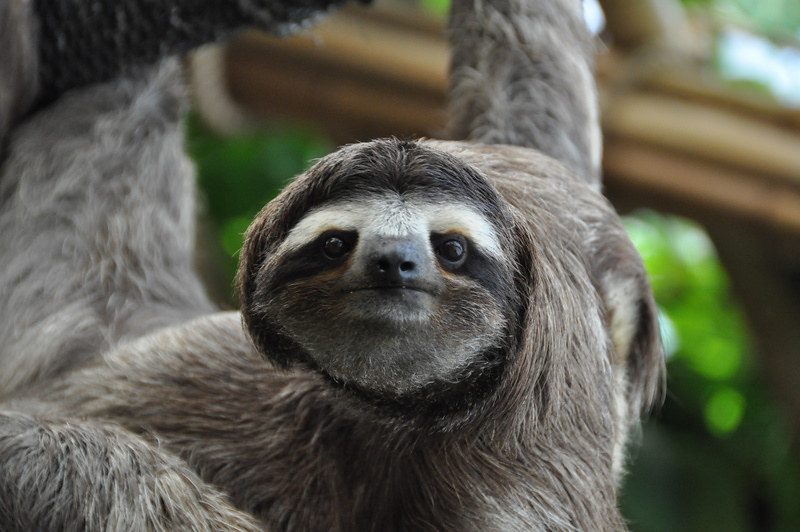
Sloths are among the most fascinating mammals inhabiting the tropical rainforests of Central and South America. Famous for their slow movements, long curved claws, and unusual habit of hanging upside down from tree branches, these remarkable animals have developed unique adaptations that allow them to survive in dense forest environments. Their slow metabolism, specialized digestive systems, and distinctive physical characteristics make them very different from most other mammals.
There are two main groups of living sloths: two-toed sloths and three-toed sloths. Although they share several characteristics, they belong to different biological genera and have important differences in their anatomy, behavior, and feeding habits.
Sloths spend most of their lives in trees, where they feed on leaves, rest, reproduce, and find protection from predators. Their fur also supports a small ecosystem of algae, insects, and microorganisms, creating unusual relationships between different organisms.
Table of Contents
The Amazon rainforest provides important habitat for several sloth species. These animals are an essential part of tropical forest biodiversity and represent some of the most extraordinary examples of adaptation to life in the rainforest.
Understanding sloths means exploring their evolution, diet, habitat, reproduction, behavior, natural predators, and the environmental challenges they face.
1. What Are Sloths?
Sloths are arboreal mammals belonging to the biological suborder Folivora. They are members of the superorder Xenarthra, a group of mammals that also includes anteaters and armadillos.
Unlike many mammals that move quickly to find food or escape predators, sloths have evolved a lifestyle based on energy conservation. Their slow metabolism allows them to survive on a diet consisting primarily of leaves, which provide relatively little energy compared with other food sources.
These mammals spend most of their lives hanging from tree branches using their long, curved claws. Their specialized limbs and joints allow them to remain suspended for extended periods without using as much muscular energy as many other climbing animals.
Sloths are particularly well adapted to tropical forests, where warm temperatures, abundant vegetation, and dense tree canopies provide suitable living conditions.
Scientific Classification of Sloths
Sloths belong to the following biological classification:
- Kingdom: Animalia
- Phylum: Chordata
- Class: Mammalia
- Superorder: Xenarthra
- Order: Pilosa
- Suborder: Folivora
Modern sloths are divided into two living genera: Bradypus and Choloepus.
Bradypus includes three-toed sloths, while Choloepus includes two-toed sloths. Despite their similar appearance and lifestyle, these groups have distinct evolutionary histories.
What Makes Sloths Unique Mammals?
Several characteristics distinguish sloths from other rainforest animals.
Their most recognizable feature is their extremely slow movement. This behavior is closely connected to their low metabolic rate and specialized diet.
Other distinctive characteristics include:
- Long, curved claws used for gripping tree branches.
- Specialized limbs adapted for hanging upside down.
- Dense fur that can support algae and small organisms.
- Slow digestion of plant material.
- Limited energy requirements.
- Excellent swimming abilities.
- Specialized neck and skeletal structures.
These adaptations allow sloths to survive in an environment where food is abundant but often difficult to digest and relatively low in nutritional value.
Evolutionary History of Sloths
The evolutionary history of sloths extends millions of years into the past. Their ancient relatives included enormous ground-dwelling mammals that were very different from the small tree-dwelling species seen today.
Some prehistoric sloths reached impressive sizes, with certain species weighing several tons. These animals walked on the ground and used their powerful limbs and claws to obtain vegetation.
One famous prehistoric species was Megatherium, a giant ground sloth that lived in South America.
Over evolutionary time, different sloth lineages developed specialized adaptations. Some ancient species became adapted to life in trees, eventually giving rise to the modern sloths found in tropical forests.
2. Different Types of Sloths and Their Species
There are six recognized living species of sloths, divided into two genera: Bradypus and Choloepus.
Although their common names refer to the number of toes on their front limbs, the differences between these groups involve more than their claws. They also differ in anatomy, facial appearance, feeding behavior, and activity patterns.
Three-Toed Sloths
Three-toed sloths belong to the genus Bradypus. They are generally recognized by their small heads, rounded faces, short snouts, and three long claws on each front limb.
Their fur often appears greenish because of algae growing within the hairs.
The four recognized species are:
Brown-throated sloth
The brown-throated sloth is one of the most widely distributed sloth species. It inhabits tropical forests across Central and South America, including parts of the Amazon basin.
It has brownish fur, a darker facial mask, and a characteristic throat coloration. Its diet consists mainly of leaves from different rainforest trees.
Pale-throated sloth
The pale-throated sloth is found primarily in northern South America, including parts of the Amazon region.
It is recognized by its lighter throat coloration and thick fur. Like other three-toed sloths, it spends most of its life in the forest canopy.
Maned sloth
The maned sloth is native to the Atlantic Forest of Brazil. It is distinguished by a dark mane of longer hair running along the back of its neck.
This species has a more restricted distribution than several other sloths and faces significant habitat pressures due to forest fragmentation.
Pygmy three-toed sloth
The pygmy three-toed sloth is a particularly small species associated with a restricted habitat on an island in Panama.
Its limited distribution makes habitat protection especially important for its survival.
Two-Toed Sloths
Two-toed sloths belong to the genus Choloepus. They have two claws on their front limbs and three claws on their hind limbs.
Compared with three-toed sloths, they generally have longer snouts, larger bodies, and a somewhat different facial appearance.
The two recognized species are:
Linnaeus’s two-toed sloth
This species inhabits tropical forests of northern and central South America, including parts of the Amazon rainforest.
It has long limbs, a rounded head, and thick brownish fur. It is primarily arboreal and feeds on leaves and other plant material.
Hoffmann’s two-toed sloth
Hoffmann’s two-toed sloth occurs in Central America and parts of northern South America.
It is generally nocturnal, spending much of the day resting in trees and becoming more active during the night.
Differences Between Two-Toed and Three-Toed Sloths
Although both groups share an arboreal lifestyle, several important differences help distinguish them.
Two-toed sloths have two claws on their front limbs, while three-toed sloths have three. Their facial structures also differ, with two-toed sloths generally having longer snouts.
Their diets overlap considerably, although two-toed sloths may consume a wider variety of plant material.
Three-toed sloths are generally more specialized leaf feeders. Their daily activity patterns also vary, with three-toed sloths often showing activity throughout the day and night.
3. Where Do Sloths Live?
Sloths inhabit tropical and subtropical forests throughout Central and South America. Their distribution includes countries such as Brazil, Peru, Colombia, Ecuador, Venezuela, Costa Rica, Panama, and several other regions.
They are particularly associated with humid tropical forests where trees provide abundant leaves, shelter, and suitable branches for climbing and resting.
Geographic Distribution of Sloths
The distribution of modern sloths is closely connected to tropical forest ecosystems.
Different species occupy different geographical ranges, depending on their evolutionary history and environmental requirements.
Three-toed sloths are found across parts of Central and South America, while two-toed sloths also inhabit extensive areas of northern South America.
Their preferred environments include:
- Tropical lowland forests.
- Humid rainforests.
- Secondary forests.
- River-edge vegetation.
- Seasonally flooded forests.
- Mangrove environments in certain regions.
Sloths in the Amazon Rainforest
The Amazon rainforest is one of the most important natural environments for sloths.
Its enormous diversity of trees provides different food sources and suitable locations for resting and reproduction.
Sloths spend most of their lives in the forest canopy, where their fur coloration helps them blend into surrounding vegetation.
The branches of large tropical trees provide protection from ground-dwelling predators and allow sloths to move between feeding areas.
The humid conditions of the Amazon also support the growth of algae within their fur, creating a distinctive greenish appearance in some individuals.
Sloth Habitat in Peru
Peru contains extensive tropical rainforest ecosystems that provide habitat for several species of sloths.
The Amazonian departments of Madre de Dios, Loreto, Ucayali, and other lowland regions support diverse wildlife populations.
In Madre de Dios, sloths can be found in tropical forests around river systems, protected areas, and forest concessions.
The Tambopata region is particularly important for Amazonian biodiversity. Its combination of primary forest, riverbanks, wetlands, and secondary vegetation creates suitable habitat for many arboreal mammals.
Observing sloths in these environments usually requires patience and careful attention because their slow movements and natural camouflage make them difficult to distinguish among tree branches.
4. What Do Sloths Eat?
Sloths are primarily herbivorous mammals that feed on leaves and other plant material.
Their diet is closely connected to their slow metabolism and specialized digestive systems. Unlike animals that consume energy-rich fruits, meat, or insects, many sloths depend heavily on foliage.
Leaves are widely available in tropical forests, but they are often difficult to digest and contain relatively low concentrations of energy.
Sloths have evolved biological adaptations that allow them to obtain nutrients from this challenging food source.
The Natural Diet of Sloths
The diet of sloths varies according to their species, geographical location, and available vegetation.
Common food sources include:
- Young leaves.
- Mature leaves.
- Tree buds.
- Tender shoots.
- Flowers.
- Selected fruits.
- Other available plant material.
Cecropia trees are frequently associated with sloth feeding, particularly in discussions of three-toed sloths. However, different species consume leaves from numerous tree species.
Their food preferences can change depending on seasonal vegetation and local environmental conditions.
Why Do Sloths Eat Leaves?
Leaves are an abundant food resource in tropical forests.
For sloths, feeding on foliage provides a relatively dependable source of nutrition without requiring frequent movement across large distances.
However, leaves contain structural compounds such as cellulose that are difficult for mammals to digest.
Some leaves also contain chemical compounds that can reduce their nutritional value or make them less suitable for consumption.
Sloths have adapted to these limitations through slow digestion and specialized microbial activity in their digestive systems.
How Do Sloths Digest Their Food?
Sloths have complex digestive systems that help them extract nutrients from fibrous vegetation.
Their stomachs contain multiple compartments where food remains for extended periods while microorganisms help break down plant material.
This fermentation process allows sloths to obtain energy from leaves that would be difficult for many other mammals to digest.
Digestion can take several days, depending on the food consumed and the species.
Their digestive strategy is closely connected to their slow metabolism and low-energy lifestyle.
How Often Do Sloths Eat?
Sloths feed periodically throughout their active periods.
Rather than searching constantly for food, they often remain near suitable feeding trees and consume relatively small amounts of foliage.
Their feeding behavior depends on food availability, environmental temperature, and individual activity patterns.
5. Why Are Sloths So Slow?
Slow movement is one of the most recognizable characteristics of sloths.
Their unusual speed is not simply a result of poor physical ability. Instead, it is an important adaptation that allows them to survive on a diet containing limited amounts of energy.
Understanding the Slow Metabolism of Sloths
Sloths have exceptionally low metabolic rates compared with many other mammals.
Their bodies require relatively little energy to maintain essential functions, allowing them to survive while consuming low-energy food sources.
Their metabolism is also influenced by environmental temperature.
Unlike many mammals that maintain a relatively stable internal temperature, sloths can experience greater changes in body temperature depending on environmental conditions.
This flexibility helps reduce energy requirements.
How Slow Can a Sloth Move?
Sloths generally move slowly through tree branches, using their long claws to maintain a secure grip.
Their movement is deliberate and controlled, allowing them to conserve energy while navigating the forest canopy.
On the ground, sloths are considerably less agile. Their limbs are better adapted for climbing and hanging than for walking.
However, they are capable of swimming surprisingly well.
How Slow Movement Helps Sloths Survive
Moving slowly offers several advantages.
One important benefit is energy conservation. Sloths avoid unnecessary physical activity, reducing the amount of food they need to consume.
Their slow movements may also help them avoid attracting the attention of predators.
In the forest canopy, their fur coloration and relatively motionless behavior can make them difficult to detect among leaves and branches.
6. Physical Characteristics and Unique Sloth Adaptations
Sloths possess several specialized anatomical features that allow them to survive in tropical forests.
Their bodies are adapted for climbing, hanging, feeding, and conserving energy.
Long Curved Claws and Powerful Grip
One of the most recognizable characteristics of sloths is their long, curved claws.
These claws function like hooks, allowing sloths to hold onto tree branches while hanging upside down.
Their limbs and joints are specially adapted to support this unusual posture.
The claws are particularly useful because sloths spend most of their lives suspended from vegetation.
Fur and Its Unique Ecosystem
Sloth fur is more than a protective covering. It can also support a variety of small organisms.
The coarse hairs of some sloths provide a suitable environment for algae, fungi, bacteria, and specialized insects.
The algae growing in their fur can create a greenish appearance that helps them blend into rainforest vegetation.
This relationship represents an interesting example of the biological interactions found in tropical ecosystems.
Why Does Sloth Fur Turn Green?
Algae can grow within the grooves and surfaces of sloth hairs, especially under humid environmental conditions.
The green coloration helps reduce the visual contrast between the animal and the surrounding leaves.
This provides a form of natural camouflage that may make sloths less visible to predators.
The Relationship Between Sloths and Sloth Moths
Sloth fur can also provide habitat for specialized moths.
These insects live in the animal’s coat and are associated with a distinctive ecological relationship involving the sloth’s occasional visits to the forest floor.
Female sloth moths can lay their eggs in sloth dung. Their larvae develop in the dung, and adult moths eventually return to the fur of sloths.
This relationship demonstrates how a single mammal can support other organisms within a small ecological community.
Specialized Skeleton and Body Structure
Sloths have unusually adapted skeletons.
Their long limbs, curved claws, and specialized joints allow them to hang comfortably from branches.
Their neck anatomy is also distinctive. Some three-toed sloths possess an unusually high number of cervical vertebrae compared with most mammals.
This gives them considerable head mobility, helping them look around while remaining suspended.
7. Sloth Behavior and Daily Lifestyle
Sloths spend most of their lives in trees, where they feed, rest, and reproduce.
Their behavior is strongly influenced by their energy requirements and the environmental conditions of tropical forests.
Are Sloths Nocturnal or Diurnal?
Activity patterns vary between sloth species.
Two-toed sloths are generally more nocturnal, becoming active primarily during nighttime hours.
Three-toed sloths can be active during both daylight and nighttime, often showing irregular activity patterns.
Their behavior may change according to temperature, food availability, and environmental conditions.
Why Do Sloths Hang Upside Down?
Hanging upside down allows sloths to feed and rest while remaining attached to tree branches.
Their specialized muscles, joints, and curved claws make this position comfortable and energy efficient.
Their internal organs also have anatomical adaptations that help them tolerate an inverted posture.
This ability is one of the most important characteristics of their arboreal lifestyle.
Are Sloths Solitary Animals?
Most sloths are relatively solitary mammals.
Adult individuals generally spend their time alone, except during mating periods and when females care for their young.
They do not normally form large social groups like some monkeys or other rainforest mammals.
Their interactions are usually limited to reproduction and occasional encounters around suitable feeding areas.
Can Sloths Swim?
Despite their slow movement on land, sloths are capable swimmers.
They use their long limbs to paddle through water, and their natural buoyancy helps them remain near the surface.
Swimming can be particularly useful in tropical forests where seasonal flooding creates temporary waterways.
In the Amazon rainforest, flooded forests and river systems form important parts of the natural environment.
Why Do Sloths Come Down From Trees?
Sloths occasionally descend from trees, although this behavior exposes them to greater risks from ground-dwelling predators.
One of the best-known reasons is defecation.
Many three-toed sloths regularly descend to the ground to defecate near the base of a tree.
Researchers have proposed several explanations for this unusual behavior, including possible ecological relationships involving moths and algae.
However, the exact evolutionary reasons remain a subject of scientific investigation.
8. Sloth Reproduction and Life Cycle
Sloths reproduce sexually and generally have relatively slow reproductive rates.
Females usually give birth to a single offspring, which depends heavily on maternal care during its early development.
Sloth Mating Behavior
Sloth mating behavior varies between species.
During reproductive periods, females may communicate their availability through vocalizations or other signals.
Males locate receptive females and engage in mating behavior.
Unlike highly social mammals, sloths do not maintain permanent family groups.
Pregnancy and Gestation Period
The gestation period differs between species.
Three-toed sloths generally have a pregnancy lasting approximately five to six months, while two-toed sloths can have longer gestation periods.
Most females give birth to one baby at a time.
Baby Sloths and Their Development
Newborn sloths are relatively well developed and can cling to their mothers shortly after birth.
They spend their early lives attached to the mother’s body, receiving protection, warmth, and nourishment.
During this period, the mother provides access to suitable feeding locations and gradually introduces the young animal to its environment.
As the baby grows, it begins exploring nearby branches and learning how to feed independently.
How Long Do Sloths Live?
The lifespan of sloths varies according to species, environmental conditions, and access to suitable habitat.
Their lifespan in the wild is difficult to determine precisely because long-term population studies are limited.
Some individuals in captivity have lived for several decades, although captive longevity should not automatically be considered representative of wild populations.
9. What Animals Eat Sloths? Natural Predators and Threats
Although sloths spend most of their lives in trees, they are not completely protected from predators.
Several powerful rainforest animals are capable of hunting them.
Their slow movement makes camouflage and remaining hidden particularly important survival strategies.
Harpy Eagles and Sloths
The harpy eagle is one of the most powerful birds of prey found in tropical American forests.
It hunts animals living in the forest canopy, including monkeys and sloths.
Its powerful feet and long talons allow it to capture prey among dense branches.
Because sloths move slowly and spend much of their time resting, they can become vulnerable when detected by an aerial predator.
Jaguars and Other Big Cats
Jaguars are among the largest predators in the Amazon rainforest.
They are powerful hunters capable of capturing a wide variety of mammals.
Sloths can also be vulnerable when they descend to the forest floor.
Other wild cats may occasionally prey on sloths depending on local conditions and prey availability.
How Sloths Protect Themselves
Sloths rely on several natural adaptations to reduce the risk of predation.
Their main survival strategies include:
- Camouflage provided by their fur.
- Remaining relatively motionless.
- Spending most of their time in trees.
- Using branches to remain above ground-level predators.
- Maintaining a strong grip with their claws.
- Moving carefully through the canopy.
Their survival depends heavily on the availability of healthy forest habitats.
10. The Ecological Importance of Sloths in the Rainforest
Sloths are part of the complex ecological relationships that maintain tropical forest biodiversity.
Although they are not among the most abundant or active mammals in the Amazon, their interactions with other organisms make them scientifically interesting.
Sloths and Their Relationship With Algae
Algae growing in sloth fur provide a distinctive example of an association between animals and microorganisms.
The fur creates a humid environment that supports algae growth.
The green coloration may provide camouflage, although the complete ecological benefits of this relationship are still being investigated.
Some studies have also explored whether sloths may obtain nutritional benefits from algae through grooming.
The Sloth, Moth, and Algae Relationship
The relationship between sloths, moths, and algae is one of the most unusual ecological interactions in tropical forests.
Moths use sloth fur as a habitat, while their reproductive cycle is connected to the animal’s visits to the ground.
The nutrients released during decomposition of sloth dung may support the growth of microorganisms that contribute to the moth life cycle.
These interactions demonstrate how organisms can become connected through seemingly unrelated biological processes.
Sloths and Rainforest Biodiversity
Sloths are herbivores that depend on healthy tropical vegetation.
Their presence reflects the availability of suitable forest habitat and food resources.
They also form part of the rainforest food web by serving as potential prey for large predators.
Protecting sloth populations therefore requires maintaining the broader ecosystems on which they depend.
11. Are Sloths Endangered? Conservation and Environmental Threats
Sloths face several environmental challenges, particularly habitat destruction and human activities.
Although not all species have the same conservation status, several have restricted distributions and are vulnerable to environmental changes.
Conservation Status of Different Sloth Species
The conservation status of sloths varies considerably.
Some widespread species have relatively stable populations, while species with restricted geographical ranges face greater risks.
The pygmy three-toed sloth, for example, has a particularly limited distribution and is highly vulnerable to habitat disturbance.
Understanding the status of each species requires monitoring population trends, habitat quality, and environmental pressures.
Main Threats to Sloth Populations
Deforestation and habitat loss
Deforestation is one of the most important threats facing sloths.
Agricultural expansion, logging, mining, and infrastructure development can destroy the trees that provide food and shelter.
Because sloths depend heavily on forest canopies, the removal of trees directly affects their ability to survive.
Wildlife trafficking and illegal pet trade
Sloths are sometimes captured illegally for the exotic pet trade.
Their unusual appearance and slow behavior make them attractive to tourists and wildlife collectors.
However, wild sloths are not suitable household pets. Capturing them can cause severe stress, injuries, and health problems.
Roads and human infrastructure
Road construction can fragment forests and create dangerous barriers between suitable habitats.
Sloths that descend from trees or attempt to cross roads can be exposed to vehicle accidents.
Electrical infrastructure and other human developments may also create additional risks.
Climate change
Changes in temperature, rainfall, and forest conditions can affect tropical ecosystems.
Because sloths have relatively low metabolic rates and depend on specific environmental conditions, major changes in their habitat may influence their feeding and survival.
Sloth Rescue and Rehabilitation
Wildlife rescue centers play an important role in helping sloths affected by human activities.
Animals injured through road accidents, illegal capture, or habitat destruction may require veterinary treatment and specialized care.
Rehabilitation programs aim to restore their health and, when possible, return them to suitable natural environments.
Successful rehabilitation requires appropriate diets, climbing structures, and conditions that encourage natural behavior.
How Can We Help Protect Sloths?
Protecting sloths requires conserving the tropical forests where they live.
Important conservation actions include:
- Protecting primary rainforest.
- Preventing illegal wildlife trafficking.
- Supporting habitat restoration.
- Maintaining forest corridors.
- Promoting responsible wildlife tourism.
- Supporting scientific research.
- Avoiding the purchase of wild animals as pets.
Responsible tourism can also help raise awareness about rainforest biodiversity and the importance of protecting natural habitats.
12. Where Can You See Sloths in the Wild?
Seeing a sloth in its natural environment can be an unforgettable wildlife experience.
However, these animals are often difficult to spot because they remain high in trees and move very slowly.
Their natural camouflage makes them particularly challenging to distinguish among leaves and branches.
Seeing Sloths in the Amazon Rainforest
The Amazon rainforest offers important opportunities to observe sloths in their natural habitat.
Wildlife observation is usually more successful when visitors explore forest trails, riverbanks, and areas with mature trees.
Experienced local guides can help identify sloths by recognizing their body shapes, fur coloration, and characteristic hanging posture.
Binoculars are particularly useful because many sloths remain high above the forest floor.
Sloths in Tambopata, Peru
The Tambopata region in Madre de Dios is one of the most biodiverse areas of the Peruvian Amazon.
Its tropical forests support numerous mammals, birds, reptiles, amphibians, and insects.
Sloths inhabit different forest environments in this region, including areas near rivers and mature rainforest vegetation.
Visitors exploring Tambopata may have opportunities to observe sloths alongside other Amazonian wildlife.
Wildlife observation requires patience because sightings depend on animal activity, weather, and local environmental conditions.
Best Ways to Observe Sloths Responsibly
When looking for sloths in the rainforest, it is important to respect their natural behavior.
The following recommendations can improve wildlife observation:
- Use binoculars to examine high branches.
- Look carefully for unusual shapes among leaves.
- Move quietly through the forest.
- Avoid touching or feeding wild animals.
- Maintain a respectful distance.
- Never attempt to remove a sloth from a tree.
- Follow the instructions of experienced local guides.
Responsible wildlife observation helps protect animals while allowing visitors to appreciate their natural behavior.
13. Interesting Facts About Sloths
Sloths possess numerous characteristics that make them among the most unusual mammals in tropical forests.
Here are some fascinating facts about these animals.
- Sloths spend most of their lives hanging from tree branches.
- Their long curved claws help them maintain a secure grip.
- Some sloths have algae growing in their fur.
- Sloths are surprisingly capable swimmers.
- Their metabolism is exceptionally slow compared with many other mammals.
- Their digestive process can take several days.
- There are six recognized living species of sloths.
- Two-toed and three-toed sloths belong to different genera.
- Baby sloths cling to their mothers during early development.
- Harpy eagles are among their natural predators.
- Sloth fur can provide habitat for specialized moths.
- Some three-toed sloths regularly descend to the ground to defecate.
- Their fur coloration helps them blend into rainforest vegetation.
- Ancient ground sloths included enormous species that weighed several tons.
- Different sloth species have different daily activity patterns.
- Sloths have specialized anatomical adaptations for hanging upside down.
- Their diet consists mainly of leaves and other plant material.
- Tropical rainforests provide essential habitat for modern sloth populations.
14. Frequently Asked Questions About Sloths
Where do sloths live?
Sloths live in tropical and subtropical forests of Central and South America. They are particularly associated with the Amazon rainforest and other humid forest ecosystems, where trees provide food, shelter, and suitable places for resting.
What do sloths eat?
Sloths primarily eat leaves from tropical trees. Depending on their species and habitat, they may also consume buds, shoots, flowers, and occasional fruits. Their digestive systems are specially adapted to process fibrous plant material.
Why do sloths move so slowly?
Sloths move slowly because they have an exceptionally low metabolic rate and consume relatively low-energy food. Their slow movements help conserve energy and reduce their daily nutritional requirements.
How long do sloths sleep?
Sleep patterns vary between species and individuals. Sloths spend considerable time resting, although wild sloths do not necessarily sleep for most of the day. Their activity patterns can include both daytime and nighttime periods.
How long do sloths live?
Sloth lifespan varies depending on species and environmental conditions. Some individuals in captivity have lived for several decades, but their exact average lifespan in the wild remains difficult to establish.
Can sloths swim?
Yes. Sloths are capable swimmers and can use their long limbs to paddle through water. This ability is useful in tropical forests where rivers, wetlands, and seasonal flooding create natural water barriers.
Are sloths nocturnal?
Some sloths, particularly two-toed species, are primarily nocturnal. Three-toed sloths can be active during both daylight and nighttime hours, depending on environmental conditions.
What are the main predators of sloths?
Important natural predators include harpy eagles and jaguars. Other predators may occasionally hunt sloths, particularly when they descend to the forest floor.
How many species of sloths exist?
There are six recognized living species of sloths. They belong to two genera: Bradypus, which includes four three-toed species, and Choloepus, which includes two two-toed species.
What is the difference between two-toed and three-toed sloths?
The main difference is the number of claws on their front limbs. Two-toed sloths have two front claws, while three-toed sloths have three. They also differ in facial structure, anatomy, and some aspects of their behavior.
Why is there algae in sloth fur?
Algae grow within the structure of sloth fur, particularly under humid environmental conditions. The green coloration may provide camouflage by helping the animal blend into surrounding rainforest vegetation.
How often do sloths come down from trees?
Sloths spend most of their lives in trees and descend only occasionally. Three-toed sloths are particularly known for coming down to the forest floor to defecate, although they may also descend for other reasons.
Are sloths dangerous to humans?
Sloths are generally not aggressive animals. However, they are wild mammals with powerful claws and can scratch or bite if frightened or handled. They should always be observed from a respectful distance.
Are sloths endangered?
The conservation status varies between species. Some have relatively widespread populations, while others face serious threats from habitat destruction and restricted geographical distributions. Protecting tropical forests is essential for their long-term survival.
Can you see sloths in the Amazon rainforest of Peru?
Yes. Several sloth species inhabit the Peruvian Amazon, including forests in Madre de Dios. Areas around Tambopata and other tropical rainforest regions provide suitable habitats for these animals. Sightings are not guaranteed, but experienced local guides can help visitors identify them in the forest canopy.
15. Conclusion: Why Sloths Are Important to the Rainforest
Sloths are extraordinary mammals whose unique adaptations allow them to survive in the challenging environment of tropical rainforests. Their slow metabolism, specialized digestive systems, curved claws, and arboreal lifestyle make them among the most distinctive animals of Central and South America.
Beyond their unusual appearance and behavior, sloths are part of the complex ecological relationships that support rainforest biodiversity. Their interactions with algae, moths, trees, and natural predators demonstrate how different organisms depend on one another within tropical ecosystems.
The Amazon rainforest, including the forests of Peru and Madre de Dios, provides important habitat for these fascinating animals. However, deforestation, habitat fragmentation, and illegal wildlife trade continue to threaten some sloth populations.
Protecting sloths means protecting the tropical forests where they live. Through responsible wildlife observation, habitat conservation, and environmental education, we can help ensure that future generations continue to discover these remarkable rainforest mammals.